


Wichita State University
Master of Science Athletic Training - Degree and Curriculum Plan
WSU Athletic Training
Heskett Center, 107
1845 Fairmount St.,
Campus Box 16
Wichita, Kansas 67260-0016
Wichita State Graduate School Graduation Requirements
Access Graduate School requirements for applying to graduate, submitting your degree audit and meeting university deadlines.
Doctor of Physical Therapy (DPT)
Looking for the DPT program? Explore admissions and program details.
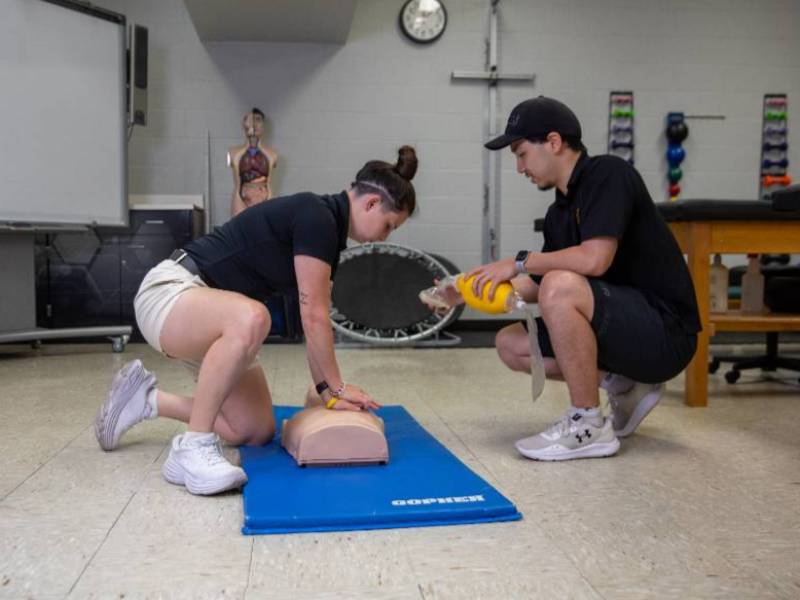
The Wichita State Master of Science in Athletic Training (MSAT) program combines coursework with hands-on clinical experience.
Students can choose from two pathways:
- Traditional program (62 credit hours over six semesters)
- Applicants must have a bachelor's degree
- Minimum 2.75 GPA required
- All prerequisite courses must be completed before admission
- Accelerated 3+2 option
- Allows qualified undergraduates to earn both a bachelor’s degree and the MSAT in about five years
A key highlight of the program is its clinical rotation opportunities. Students gain real-world experience at top healthcare facilities and athletic organizations across the Wichita area. These placements range from local schools to major medical centers, helping students build practical skills and professional connections.
Degree and Program Completion Requirements
The following are required for the degree and program completion:
- 62 credit hours passed including a cumulative GPA of at least 3.0 on all WSU courses on the plan of study and for all WSU graduate work.
- Approved Plan of Study on file with the Graduate School
- Passing of MSAT Exit Exam: 130/175 on the first attempt; 145/175 on the second or third attempt
- Complete required coursework as per the degree plan
- Complete successful degree audit for graduation (submit an application for the degree)
- An Application for Degree and Exit Survey Form and fee on file with the Graduate School
- Complete PSIT requirement (Professional and Scholarly Integrity Training.)
Additional Requirements for Accelerated (3+2) Students
- Complete dual/accelerated enrollment form
- Successfully complete the required applied learning courses: HPS 771, HPS 772, HPS 853 & HPS 854
- Meet overall minimum graduate GPA of 3.00 and overall minimum MSAT GPA of 3.00
- Complete the MSAT graduate plan of study while progressing through the accelerated undergraduate-to-graduate pathway
Note: Degree requirements for the MSAT are consistent across both pathways. The accelerated (3+2) option includes additional administrative and progression requirements related to the combined bachelor’s and master’s program.
Academic Curriculum & Course Sequence
Accepted students will attend and complete a MSAT Orientation at the beginning of each year (June) to discuss various academic expectations, clinical experiences, program changes (if any), as well as policies and procedures related to the MSAT.
Student Progression and Program Expectations (Retention Requirements)
Academic Study Plan
The MSAT has developed an academic study plan, culminating in a Master of Science in Athletic Training degree. Each student must follow the specific course sequence throughout their plan of study. Students must meet with the program advisor each semester to stay current with their study plan. Students who fail to meet MSAT requirements will be placed on probation or fail to maintain Graduate School requirements are subject to dismissal from the MSAT.
Student Evaluation and Progression
Once admitted to the MSAT, the ATS will be evaluated at least twice each semester. As long as appropriate progress is made, the student will be allowed to move on to the following semester. If progress is unsatisfactory in clinical education or classroom performance, the student will be placed on probation for the next semester giving them a chance to remedy any deficiencies.
Students will be placed on a remediation plan and will meet with an assigned program faculty member at least twice a month to provide updates on meeting their academic and/or clinical goals. If the deficiencies are not rectified in the time frame allotted, the student will be dropped from the program. The Program Director shall monitor student progress from one semester to the next and make all probationary decisions in consultation with the athletic training faculty.
Academic and Clinical Performance Standards
Students must maintain an overall grade point average of 3.0 in the program. Student performance revealing noncompliance with these guidelines is grounds for review by the Program Director.
In clinical education, the student's performance will be evaluated mid-term and end of each semester. Each student is expected to demonstrate athletic training knowledge, skills, and abilities of course material from previous semesters and new information gained in the current semester (refer to course, laboratory, and/or practicum syllabus for grading practices).