


Wichita State University
Academic Integrity Processes and Procedures
The Policy on Student Academic Integrity is overseen by Student Conduct and Community Standards. Each instructor determines appropriate outcomes and submits reports for alleged violations of the Academic Integrity Policy to the Office of Student Conduct and Community Standards. If you wish to appeal a decision, please follow the process outlined in this policy.
What is Academic Integrity?
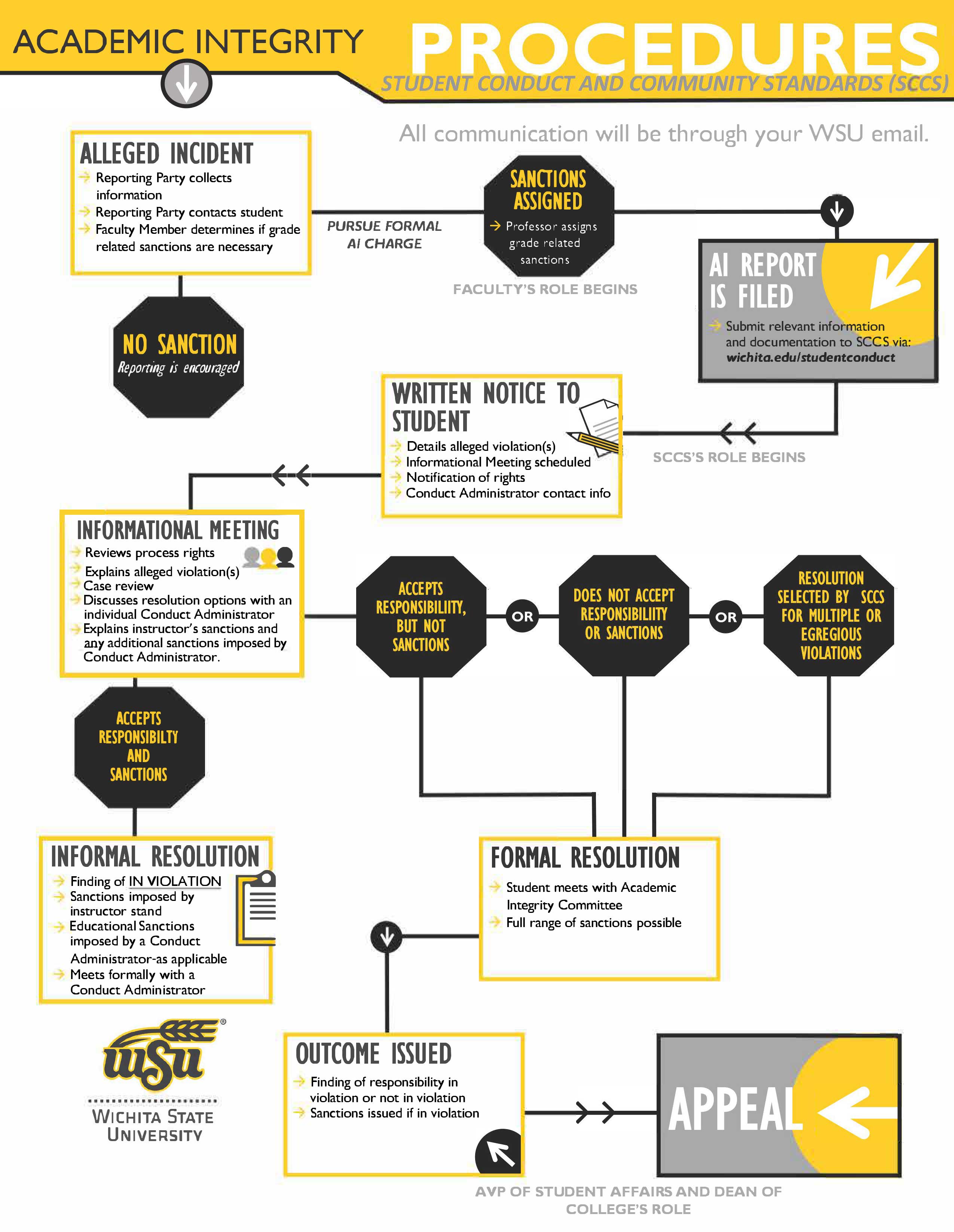
Academic Integrity Flowchart
Text only version
Academic Integrity Handbook
Last edited April 2024
-
Purpose
The Student Academic Integrity Handbook outlines how the University will proceed once it is made aware of possible academic misconduct by a student, student group, or student organization in keeping with institutional values and to meet the University's legal obligations. This process will be used to resolve alleged misconduct violations of 2.17/Student Academic Integrity in a prompt, thorough, reliable, fair, and impartial manner.
-
Philosophy
Wichita State University is committed to the ethical pursuit of knowledge. In order to ensure the integrity of faculty evaluation of students, all members of the University community share responsibility for ensuring that students have demonstrated successful mastery of the learning objectives for each academic activity. By conferring a degree, Wichita State University is assuring the general public that the student has successfully met all requirements for graduation, including meeting the learning objectives for each academic activity. Indifference to academic misconduct is not a neutral act-failure to confront and/or deter such behaviors will reinforce, perpetuate, and increase the prevalence of academic misconduct in the University community.
Students are expected to complete independent, original work for each academic activity unless otherwise specified by the faculty member. Students should seek clarification when in doubt. Faculty members are required to communicate their expectations regarding academic integrity; including, but not limited to, collaboration, information sharing, and conducting ethical research. All syllabi must contain a section that includes information on 2.17/Student Academic Integrity. Additionally, faculty members are expected to adhere to the process pertaining to the reporting and resolution of alleged violations of 2.17/Student Academic Integrity.
-
Jurisdiction
- This policy applies to behavior that is committed by:
- A University student, student group, or student organization;
- An applicant who becomes a student, for alleged violation(s) committed as part of the application process; or
- An individual who has transferred, graduated, been academically disqualified, or expelled from the University for alleged violation(s) committed prior to separation from the University.
- This policy may be applied to any academic activity conducted on campus or elsewhere. Scholarly research is considered an academic activity, which may or may not be related to a specific course. Additionally, this includes behavior conducted online, via e-mail or through other electronic media. Wichita State University will take action if an alleged violation of this policy is brought to the attention of University officials.
- This policy applies to behavior that is committed by:
-
Definitions
For purposes of this policy, the following terms have the definitions provided below. Please note that some of these terms may have different meanings in other contexts.
- Academic Activity - Any draft, assignment, assessment, examination, project, applied learning (e.g. internships, co-ops, practicums, field experiences or trips, clinical experiences, or student teaching), research, publication, presentation, or other activity that is completed, submitted, and/or required to fulfill course or degree requirements or obtain a specific distinction, or is conducted in conjunction with an academic program or course.
- Academic Integrity Committee - A panel of three (3) or five (5) individuals. A panel of three (3) individuals will consist of two (2) faculty appointed by the Faculty Senate and one (1) student from the Student Conduct & Community Standards Board. A panel of five (5) individuals will consist of three (3) faculty appointed by the Faculty Senate and two (2) students from the Student Conduct & Community Standards Board. The Committee is responsible for determining whether or not the Respondent(s) violated this policy and appropriate sanction(s) (if applicable). One (1) panelist will serve as the Committee Chairperson, selected by the Committee at the time of the hearing.
- Advisor - An individual selected by the Complainant or Respondent to assist the Complainant Respondent throughout the Student Academic Integrity process including, but not limited to, a parent, friend, faculty member, advocate, or legal counsel. An Advisor may advise and assist the Complainant or Respondent in preparation for any meetings, interviews, or hearings that may occur; accompany the Complainant or Respondent through all process meetings, interviews, or hearings; or assist the Respondent in preparing an appeal. An Advisor may not participate in the Student Academic Integrity process in any other capacity in reference to the same incident, including, but not limited to, serving as a Witness or Co-Respondent. Advisors may not directly participate, speak, comment, or make any type of representation or argument on behalf of a Respondent in any aspect of the Student Academic Integrity process including, but not limited to: meetings, interviews, or hearings. The availability of an Advisor to attend a Student Academic Integrity process meeting, interview, or hearing shall not unreasonably interfere with or delay the proceedings.
- Academic Integrity Appeals Committee (graduate) - The Associate Vice President for Student Affairs (or designee) and the Dean of the Graduate School (or designee).
- Academic Integrity Appeals Committee (undergraduate) - The Associate Vice President for Student Affairs (or designee) and either the dean of the academic college in which the violation occurred or the dean of the academic college for the student's academic major depending upon the nature of the appeal.
- Conduct Administrator - the Associate Dean, or their designee, authorized to address a student, student group, or student organization's concerns.
- Faculty Member - Any member of the University community who has responsibility for classroom or other teaching activities, mentoring, or academic evaluation of a student. This includes, but is not limited to, instructors, researchers, applied learning supervisors, teaching assistants, research assistants, graduate assistants, lab assistants, and course and program directors.
- Respondent - Any student, student group, or student organization who has been accused of or reported for allegedly violating University policy. There may be more than one Respondent for an incident. In incidents involving student groups or organizations, the president, director, team captain, or other member of student leadership will participate in the Student Academic Integrity process on behalf of the group or organization. Student groups and organizations may not be represented by non-students, alumni, inactive members, or coaches in the Student Academic Integrity process; however, such individuals may be selected by a student group or organization to serve in the role of Advisor in the Student Academic Integrity process.
- Sanction - a penalty or punishment for violating University policy.
- Student - Any individual who has been notified of admission to the University; is enrolled in, auditing, or participating in any University course or program; is assigned a space in a University owned or managed housing facility; or has a continuing relationship with the University. This includes, but is not limited to, Orientation, Intensive English, National Student Exchange, and Study Abroad. An individual is considered a student until they notify the University they are no longer a student or the University informs them that they are no longer a student for reasons including, but not limited to, withdrawal, transfer, graduation, withdrawal, academic disqualification, or expulsion. An individual who has been suspended is still considered a student during the suspension period. Students who leave the University before an Academic Integrity complaint is resolved may be prohibited from future enrollment and/or accessing University records until the matter is resolved.
- Student Group - Any number of persons who are associated with the University and each other, but who have not registered, or are not required to register, as a student organization that conducts business or participates in University-related activities. Student groups include, but are not limited to, Student Government Association, Student Activities Council, musical or theatrical ensembles, sport clubs, or intercollegiate or independent varsity athletic teams.
- Student Organization - Any student-led organization that has been approved and is recognized by the Student Government Association.
- University - Wichita State University (WSU) and its affiliates.
- University Business Day - Refers to any day the University is open for official business (usually Monday through Friday, not including University breaks or holidays).
- University Official - Any individual employed by the University, acting within the scope of their employment including, but not limited to, faculty, staff, Resident Assistants, Intramural Officials, law enforcement officers, or facility managers.
- University Policy - Any written guidelines of the University or the Kansas Board of Regents as found in, but not limited to, the Student Code of Conduct, Housing and Residence Life Handbook, Graduate/Undergraduate Catalogs, Student Organization & Advisor Handbook, WSU Policies and Procedures Manual, Library Facilities Policy, Board of Regents Board Policy Manual, Traffic Regulations, and/or Intramural Sports Handbook.
- University Premises - Any land, building, facilities, vehicles, and other property in the possession of, owned, used, leased, or otherwise controlled by the University and/or its affiliates.
- Witness - Individual who is requested to participate in an investigation or a hearing because that individual may have information about the alleged misconduct. Witness names may be provided by the Respondent or others with knowledge of the matter. Participation in the Academic Integrity Hearing is up to the discretion of the Witness.
-
Complainant and Respondent Expectations
- All parties shall be entitled to the same expectations in all investigations and resolution processes relating to reports of alleged violations of the Student Academic Integrity policy.
- All Respondents are presumed to have not violated the Student Academic Integrity policy, VI.A.1. - Academic Integrity in the Student Code of Conduct unless it is proven that it is more likely than not that a violation has occurred.
- All Respondents will be advised of their expectations, in writing, during their first meeting with a Conduct Administrator.
- All parties should make every effort to attend hearings in person, on the phone, or through video chat. SCCS will make every effort to work with all parties' schedules. However, priority will be given to the Complainant, Respondent, and Academic Integrity Committee.
- All parties have the expectation of:
- Being notified of the alleged violation(s) of University policy;
- Being provided advanced notice (3-5 Business Days) of all meetings in which they are requested or entitled to participate and be notified of the purpose of those meetings;
- Being accompanied by an Advisor of the party's choice throughout the investigation and resolution process;
- Reasonable accommodations from the Office of Student Accommodations and Testing or the Office of Human Resources (for employees) in order to ensure full and equitable participation in the investigation and resolution process;
- Being informed of the available resolution options;
- Being informed of campus and community resources available for support and assistance;
- Submitting information, including the names of any Witnesses, for consideration in the investigation;
- Being informed of all parties contacted to participate in the investigation and their relation to the alleged misconduct;
- Reviewing, after any required redaction, all information to be considered in determining the outcome of the case upon request by scheduling an appointment with the Associate Dean or designee;
- Choosing to provide or not to provide a statement or respond to questions during the investigation and resolution process;
- Submitting a written impact statement to be considered before a decision (if applicable) is rendered; and
- Requesting one (1) appeal within the University's process.
- Any party may elect to waive any of the aforementioned expectations so long as the waiver is communicated in writing.
-
Prohibited Conduct
As members of the University community, all students, student groups, and student organizations are expected to display respect for the rights of themselves and others and to be accountable for their behavior. Lack of familiarity with University policy is not a defense to a violation of this policy. Unless specifically noted in the policy definition, intent is not a required element to establish a policy violation.
Academic misconduct includes a broad range of violations. The following list, while not comprehensive, provides examples of actions that violate the expectations for the responsible acquisition, discovery, and application of knowledge by students at Wichita State University:
- Plagiarism - Representing the words, ideas, graphics, or any portion of another's work, whether published or unpublished, as one's own and/or without appropriate and/or accurate citation/attribution.
- Unauthorized Use or Possession of Materials or Resources - Using or possessing any materials or resources during an academic activity without the express permission of, or in a manner that is inconsistent with the express permission of, the faculty member. Unauthorized use of materials or resources includes, but is not limited to, any electronic device; course textbooks, articles, cheat sheets, other print sources; and/or looking at another individual's current or previous academic work. This includes submission of materials that were purchased or otherwise obtained by an outside or commercial source (e.g. ghostwriting or pay-for-paper services).
- Unauthorized Collaboration or Consultation - Collaborating or consulting with another individual or group during an academic activity without the express permission of the faculty member.
- Fabrication, Falsification, or Misrepresentation of Information - Providing fabricated or falsified information or misrepresenting information in an academic activity or related to academic attendance or other academic requirements.
- Academic Interference - Engaging in any behavior or taking any material(s) for the purpose of interfering
with an academic activity. Academic Interference includes, but is not limited to:
- Removing, concealing, damaging, destroying, or stealing materials or resources that are necessary to complete or perform an academic activity;
- Tampering with another person or group's work; and/or
- Interfering with another student's academic performance.
- Unauthorized Resubmission - Submitting an academic activity which has been previously submitted for credit, publication, or presentation without authorization from the faculty member to which the submission is made. This provision also applies when repeating a course, regardless of whether or not a grade was awarded for the previous enrollment period.
- Facilitation of Academic Misconduct - Engaging in behavior that facilitates another person or group's ability to engage in or causes another person or group to engage in academic misconduct, including but not limited to providing another student with a copy of the student's work and/or access to unauthorized materials or resources, or forcing or coercing another student to complete academic work on behalf of another.
- Bribery - Offering, giving, receiving, or soliciting any funds, goods, services, or anything else of value in exchange for an academic advantage for any student.
- Unauthorized Sale, Distribution, or Receipt of Academic Materials - Buying, selling, receiving, or distributing academic materials without the express permission of the faculty member including, but not limited to previous assessments, study guides, solutions manuals, lecture slides, or any other form of intellectual property. This includes, but is not limited to, providing academic materials to crowdsourced digital databases and web platforms.
- Research misconduct as identified in policy 9.13/Misconduct in Research. Alleged violations of research misconduct will be resolved through policy 9.13/Misconduct in Research. Academic sanctions can be made when said research misconduct overlaps academics.
-
Complainant and Respondent Responsibilities
All Complainants, Respondents, and Witnesses who are members of the University community have the following responsibilities relating to all investigations and resolution processes related to reports of alleged violations of the Student Academic Integrity policy:
-
Honesty
All participants are expected to be honest and forthright in all communication relating to the investigation and resolution of allegations of misconduct. Providing false or misleading information is a violation of University policy and may result in additional charges under policy 8.05/Student Code of Conduct or other applicable University policy.
-
Communication and Responsiveness
The University uses @shockers.wichita.edu e-mail addresses as its formal means of communication with students and @wichita.edu for employees. Communication regarding an investigation and/or resolution process is deemed given when sent to an official @shockers.wichita.edu e-mail address. Students and employees are responsible for checking their University e-mail and responding to all requests for information within a timely manner. Failure to respond or appear by a given deadline may result in the process proceeding in an individual's absence. Decisions will be made on the information that is available at the time the decision is made.
-
Preparation
All parties are responsible for adequately preparing themselves for investigation and resolution meetings, including reviewing applicable University policies and procedures. All parties are also responsible for ensuring that their Advisor is familiar with the appropriate policies and procedures. Failure to adequately prepare for a scheduled meeting is not a reason for delaying the meeting or other proceedings.
-
Adhere to Process
All parties are to refrain from disrupting the investigation and resolution process for alleged violations of University policy. No individual, student group, or student organization involved in the process other than the Conduct Administrator or Committee Chairperson may audio or video record any investigation or resolution meetings or other portions of the process. Any individual, student group, or student organization deemed to be disruptive may be removed from a meeting and/or charged with violating policy 8.05/Student Code of Conduct.
-
Discretion
Discretion is expected by those involved in the Academic Integrity process, especially as it relates to investigations of Academic Integrity allegations. Details should only be shared by those that are on a need to know basis, and with compliance of the Family Educational Rights and Privacy Act (FERPA).
-
-
Reporting
The University encourages any individual witnessing violations of 2.17/Student Academic Integrity to report the misconduct to the faculty member of the course for the alleged violation and/or to Student Conduct & Community Standards.
-
Reporting an Incident
Any individual witnessing a student violating 2.17/Student Academic Integrity is encouraged to report the alleged violation in good faith. Reports submitted to SCCS by an individual other than the faculty member of the course in which the alleged violation has occurred will be sent to the faculty member for determination of misconduct. When a faculty member has reasonable, good faith belief that a student has committed academic misconduct that faculty member has the discretion to assign a sanction, including academic sanctions and/or educational sanctions. Any faculty member imposing a sanction against a student for a violation of this policy must report the violation to Student Conduct & Community Standards to ensure due process. An online reporting form can be found at https://wichita.edu/ReportIt. The faculty member is encouraged to submit the course syllabus and assignment(s), test(s), or document(s) with the section(s) in question marked. If the faculty member decides to not proceed with an investigation of the allegation, the evidence submitted to Student Conduct & Community Standards will be put to a review by the Academic Integrity Committee.
Any reported incident is subject to review by the Academic Integrity Committee. The Committee can decide if a reported incident should be dismissed, referred to another office, returned to the reporting party for more information, or should continue through the Student Academic Integrity process.
It is possible that academic misconduct could violate multiple policies, such as student research not associated with a specific course, but which is part of the student's academic program. A violation of this nature is included under policies 2.17/Student Academic Integrity and 9.13/Misconduct in Research. In such cases the investigative process laid out in the latter will supersede the former, but sanctions are also possible.
In order to identify habitual offenders, faculty members are encouraged to report all alleged Academic Integrity violations to Student Conduct & Community Standards, even when the faculty member chooses not to sanction a student for violations of this policy, or if the violation was resolved without an academic sanction.
-
Timeliness of Reports
Individuals are encouraged to report alleged academic misconduct as soon as possible after the incident occurs to maximize the University's ability to respond promptly and effectively; however, the University does not limit the time for reporting. It is a best practice of the University for the reporting party to file an Academic Integrity Report within 30 days of the alleged incident.
-
Assumption of Good Faith Reporting
The University presumes reports of alleged policy violations are made in good faith. An outcome that finds the reported behavior does not constitute a violation of University policy, or that there is insufficient information to conclude that the incident occurred as reported, does not mean that the report was made in bad faith. The University encourages all individuals who have experienced or witnessed behavior they believe violates the Student Academic Integrity Handbook to report the matter so that it may be addressed by the University.
-
-
Academic Integrity Procedures
-
Preliminary Investigation
It is the role of the faculty member to carry out a preliminary investigation when academic misconduct occurred, or they are notified by SCCS of misconduct to determine whether sanctions are warranted.
The preliminary investigation is a neutral fact-finding process that is used to determine whether there is sufficient information to warrant action by the faculty. Preliminary meetings with any Witnesses may occur prior to initiating the Academic Integrity process or contacting the Respondent. If the Respondent is contacted about the incident during the preliminary investigation, the Respondent will be made aware of the initiation of a preliminary investigation and that the incident could result in the Academic Integrity process being initiated.
The preliminary investigation may result in any of the following:
- No Action - If there does not appear to be credible information to indicate a violation occurred, the faculty member can choose to not assign a sanction. This information is still encouraged to be reported to SCCS, but it will not be pursued through the formal Academic Integrity process.
- Sanctions Assigned - If the faculty member determines that there is enough evidence to support a violation of academic misconduct, they may assign a single or multiple sanction(s). The faculty member has academic freedom to determine what sanctions apply and the severity of the sanction. For a list of possible sanctions refer to Section X. Keep in mind disciplinary sanctions are to be used only by the Academic Integrity Committee. Once a sanction is applied the faculty member must report this to SCCS.
After the preliminary investigation has occurred and the faculty member has reported the violation to SCCS, their role in the Academic Integrity process shifts and SCCS will facilitate and monitor the process to the completion of the Formal Hearing. If a student decides to attend an Academic Integrity Committee Hearing, the reporting party faculty member will be required to participate as the Complainant. However, the faculty member is then part of the process rather than determining the outcome.
-
Written Notice
Once the initiation of the Academic Integrity process has occurred, the student, the responsible party for the student group, or the president on record with the University for the student organization will be provided with a written notice a minimum of three (3) University business days prior to the scheduled meeting, unless exceptional circumstances exist by SCCS. The notice will include the following:
- The alleged policy violation(s);
- A link to the Handbook for more information;
- The date and time of the scheduled Informational Meeting;
- An explanation of the ability to have an Advisor of choice present throughout the Academic Integrity process;
- The contact information for the Student Conduct Administrator responsible for resolving the case; and
- A checklist of the students' expectations.
Notice is considered given to a student if it is sent to the student's official @shockers.wichita.edu e-mail address or is mailed to the local address on file with the Office of the Registrar or to the permanent address on file. For student groups and organizations, notice is considered given if it is sent by any of the aforementioned means to the student who is the last known president of the student group or organization, as provided by Student Involvement office records or the responsible party for the student group/organization, such as an Advisor.
-
Informational Meeting
All Respondents are afforded the opportunity to attend a scheduled Informational Meeting with the Conduct Administrator responsible for resolving the case. The Informational Meeting is an informal meeting with a Conduct Administrator who will explain the Respondent's rights and the alleged violation(s), discuss resolution options, review the Respondent's responsibilities, and provide an opportunity to review, after any required redaction, the information that was provided as the basis for the alleged policy violation(s). The Conduct Administrator will also answer questions about the process and available options. The Informational Meeting provides an opportunity for the Respondent to become more informed about the Academic Integrity process.
During the Informational Meeting, the Respondent will be given the opportunity to select one of the available resolution processes (Informal Resolution or Formal Resolution) for the case. In certain circumstances, the Associate Dean or designee may exercise the authority to select the resolution process. In the absence of a resolution option selection from the Respondent, the Associate Dean or designee shall determine the appropriate resolution process for the case.
-
Additional Consequences for Multiple or Egregious Violations
In cases where Respondents have a demonstrated track record of Academic Integrity violations or the alleged violation is serious in nature, Student Conduct & Community Standards can recommend the Academic Integrity Committee consider additional sanctions beyond what the Respondent received for each violation. This recommendation would result in the resolution option of a Formal Hearing be selected for the Respondent by the Associate Dean or designee.
-
Informal Resolution
If the assigned Conduct Administrator believes the outcome for the alleged violation is not egregious and the Respondent (1) accepts responsibility for the alleged violations (2) accepts the faculty's-imposed sanctions, and (3) accepts the Conduct Administrator's role and sanctions as set forth below, then Respondent may elect to have the case resolved by Informal Resolution. Informal Resolution takes place between the Respondent and a Conduct Administrator and does not allow for the presentation of Witnesses or additional information to be submitted by the Respondent prior to the meeting, although the administrator may follow up with other parties as necessary.
An Informal Resolution may occur directly following an Informational Meeting or may be scheduled for a later date. Every effort will be made to schedule an Informal Resolution within ten (10) University business days of the Informational Meeting. Informal Resolutions are not audio recorded.
During the Informal Resolution, the Conduct Administrator will have a discussion with the student about academic integrity, provide guidance on avoiding misconduct in the future and offer resources to the Respondent. If it is the Respondent’s second or more Informal Resolution, the Respondent shall also satisfactorily complete an Academic Integrity policy review and quiz issued by the Conduct Administrator. The Conduct Administrator will inform the Respondent that the sanctions imposed by the instructor and, as applicable the Conduct Administrator, will stand and that a formal outcome letter will be sent to the student within two (2) business days of the student accepting responsibility. The faculty member of the course where the academic misconduct occurred will be carbon copied. The faculty member is carbon copied in order to notify them that the sanction will stand as imposed.
By accepting responsibility, and electing the Informal Resolution process, an appeal cannot be filed by the Respondent(s). More information is referenced in Section XI of this handbook.
-
Formal Resolution
If the Respondent does not wish to proceed with an Informal Resolution, and/or disagrees with the sanctions imposed by the faculty member, the Respondent may elect to pursue an Academic Integrity Committee Hearing.
Academic Integrity Committee Hearings involve the presentation of information by Witnesses (as necessary) and provide an opportunity for the Respondent to present Witnesses and information for review as part of the decision. A list of Witnesses, their relevance to the alleged violation(s), and their contact information must be submitted, in writing, to the Conduct Administrator within five (5) University business days after the Informational Meeting.
Student groups and student organizations may submit a resolution proposal for consideration by the Academic Integrity Committee within five (5) University business days after the Informational Meeting. The resolution proposal is the student group or organization's opportunity to participate collaboratively in the resolution process and demonstrate thoughtful reflection of how to prevent further violations from occurring in the future. This document would outline all steps to be taken to remedy the alleged policy violations and timelines for completion. The resolution proposal may be adopted or adapted-in whole or in part-or denied by the Academic Integrity Committee assigned to resolve the case.
-
Academic Integrity Committee Hearing
Faculty Senate shall determine the faculty members appointed to serve and SCCS will appoint the student representatives to serve on the Academic Integrity Committee. Members are appointed for a one-year term with the possibility of reappointment. University governance bodies may recommend individuals for membership to Faculty Senate. All members must complete appropriate and thorough training prior to hearing cases.
An Academic Integrity Committee is conducted by a panel of three (3) or five (5) individuals comprised of students and faculty, based on availability. A panel of three (3) individuals will consist of two (2) faculty appointed by the Faculty Senate and one (1) student from the Student Conduct & Community Standards Board. A panel of five (5) individuals will consist of three (3) faculty appointed by the Faculty Senate and two (2) students from the Student Conduct & Community Standards Board. A minimum of one (1) panelist must be a student. The Board is responsible for determining whether it is more likely than not that a violation occurred and will determine appropriate outcomes(s). One (1) panelist will serve as the Committee Chairperson, selected by the Associate Dean or their designee, and is responsible for communicating the determination of responsibility to the Associate Dean or designee, who will notify the Respondent(s) and Complainant(s) of the decision. Decisions of the Academic Integrity Committee will be determined by a majority vote. A member of the Student Conduct & Community Standards staff or designee will serve as the Student Conduct Board Advisor and does not cast a vote.
-
Hearing Format
Hearings will be conducted in private in accordance with state privacy laws and the Family Educational Rights and Privacy Act (FERPA).
The Complainant, Respondent, and the respective Advisor(s), if applicable, of each party are permitted to attend the entire hearing, except for deliberation.
In cases involving multiple Respondents, the Associate Dean or designee may determine that the hearings be conducted jointly. Any Respondent wanting to have their hearing conducted individually, may submit a written request a minimum of three (3) University business days prior to the scheduled hearing to the Associate Dean or designee who shall decide whether to grant the request.
The Complainant, the Respondent, and the University may arrange for Witnesses to attend the hearing and present relevant information. Failure to call a Witness, or failure of a Witness to appear shall not automatically require a delay or affect the validity of the proceedings. A decision will be made on the information presented during the hearing.
Witnesses will provide information to, and answer questions from, the hearing body. Questions may be suggested by the Complainant or the Respondent to be answered by each other or by other Witnesses. This will be conducted by the hearing body with such questions directed to the Conduct Administrator or Academic Integrity Committee Chairperson, rather than to the individual directly. This method is used to preserve the educational tone of the hearing and to avoid the creation of an adversarial environment. The Conduct Administrator and/or the Hearing Committee Chairperson reserves the right to rephrase the question or to refrain from asking the question. Questions of whether potential information will be received shall be determined by the Hearing Committee Chairperson with the assistance of the Student Conduct Board Advisor.
Relevant records, pictures, written statements, impact statements, and other information may be accepted for consideration for the hearing when submitted to Student Conduct & Community Standards within five (5) days following the Informational Meeting.
All procedural questions are subject to the final decision of the Hearing Committee Chairperson with the assistance of the Student Conduct Board Advisor.
If the Respondent or Complainant, with adequate notice, does not attend a hearing, the hearing shall proceed in the Respondent or Complainant's absence.
SCCS may accommodate concerns for the personal safety, well-being and/or fears of confrontation of the Complainant, Respondent, Reporter, and/or Witnesses during the hearing by providing separate facilities, by using a visual screen, and/or by permitting participation by telephone, videophone, closed circuit television, video conferencing, video tape, audio tape, written statement, or other means, where the SCCS staff member deems this accommodation to be appropriate.
-
Standard of Information
Academic Integrity Committee will make a finding using the Preponderance of the Evidence Standard. This standard requires that it is more likely than not that a violation occurred. Under this standard, individuals are presumed to have not violated Section 2.17/Student Academic Integrity unless preponderance of the evidence supports a finding that a violation occurred. The decision of the Academic Integrity Committee supersedes all prior decisions and sanctions. When the Committee views the evidence as meeting the burden of proof, it is expected that they will typically defer to the course faculty member's decision regarding sanctions. Deviations should be robustly justified in the Academic Integrity Committee's rationale. Respondents may continue in all courses during the Academic Integrity hearing(s).
-
-
Process Outcomes
In situations where the Respondent is found in violation but does not agree with the faculty-imposed sanction or the Academic Integrity Committee feels the sanction is too severe, the Committee may vote to reduce the previously assigned sanction. The sanction may be reduced to match the severity of the violation or to match the faculty member's syllabus in accordance with the Standard of Information.
Respondents who are found to have violated policy 2.17/Student Academic Integrity may receive additional academic and/or disciplinary sanctions appropriate to the current violation(s) and in consideration of what the professor has already imposed. A single sanction may be issued, or a combination of sanctions may be issued depending upon the nature and severity of the violation(s). In the case of student groups and organizations, if a sanction issued by a national or other governing body exceeds that of the University, the University may concur with that sanction.
Potential sanctions include academic, disciplinary, and educational. Educational sanctions could include required training related to the misconduct. Academic sanctions could include additional academic requirements and/or assignment or course grade reduction. In cases where egregious and/or repeat offenses are found to have occurred, disciplinary actions such as disciplinary probation, suspension, or expulsion are possible as determined by the Academic Integrity Committee.
-
Academic Sanctions
Academic Sanctions are outcomes which impact a student's academic progress in a specific course or program:
- Additional Academic Requirements - The student is required to complete one or more additional academic activities which include, but is not limited to, retaking an examination, submitting a new paper, etc.
- Assignment Grade Reduction - The student will receive a reduced grade, up to and including zero credit, for the academic activity involved in the violation.
- Course Grade Reduction - The student will receive a reduced grade, up to and including a failing grade (i.e. F), for the course in which the violation occurred.
Course Grade Reductions will appear on a student's transcript. The student's outcome letter will be sent to the Office of the Registrar who will apply the grade change for the course in question.
-
Disciplinary Sanctions
Disciplinary Sanctions are those consequences which impact a student's overall standing with the institution and/or interactions with members of the University community, including:
-
Disciplinary Warning – This written warning is provided to acknowledge that the Respondent's behavior violated University policy and does not align with Wichita State University’s expectations for community members. Another breach of University policy and/or if the Respondent is found responsible for any future violations of University and/or HRL policy, offenses, it may result in severe disciplinary action.
-
Disciplinary Probation - The student is deemed not in good conduct standing with the University. The duration of any probationary period will be determined by the resolution body on a case-by-case basis. Any further violations of University policy while on probation may result in more serious sanctions being imposed, which may include suspension or expulsion from the University. Restrictions that may be placed on the student during the probationary period include, but are not limited to: participation in student activities, representation of the University on athletic teams or in other leadership positions, eligibility to receive any University award or honorary recognition, entrance into University residence halls or other areas of campus, participation in a study abroad program, or University computer and network usage.
-
Suspension - The student is required to leave the University for a designated time. During the suspension period, a student may not attend classes (either in person or online) nor participate in a student group or student organization activities, whether they occur on or off-campus. A currently enrolled student is withdrawn from their classes and is not eligible for a refund. A registration and records hold will be placed on the student’s account until the conclusion of the suspension period. If the student is an on-campus resident, the student’s contract with Housing & Residence Life will also be terminated and the student will be responsible for paying any remaining fees for the duration of the original contract period. The student must complete all assigned educational sanctions before the conclusion of the suspension period. The suspension will remain in effect until they are completed. Any further violations of University policy while on suspension could result in more serious sanctions being imposed.
-
Expulsion - The student is separated from the University without the possibility of graduation or future enrollment. The student is not allowed on University premises unless authorized in writing in advance under conditions approved by the Vice President for Student Affairs or their designee. A currently enrolled student is withdrawn from their classes and is not eligible for a refund. A permanent registration hold is placed on the student’s account. If the student is an on-campus resident, the student’s contract with Housing & Residence Life is terminated and the student is responsible for paying any remaining fees for the duration of the original contract period.
-
Dismissal - Dismissal removes a student from their academic program and separates the student from the University for a period of two to seven years. During the dismissal, the student is not allowed on University premises unless authorized in writing in advance under conditions approved by the Vice President for Student Affairs or their designee. A currently enrolled student is withdrawn from their classes and is not eligible for a refund. A permanent registration hold is placed on the student’s account. If the student is an on-campus resident, the student’s contract with Housing & Residence Life is terminated and the student is responsible for paying any remaining fees for the duration of the original contract period.
Following the Dismissal, the individual must apply for readmission to the University. Readmission is not guaranteed. Readmission will only be considered when:
- Duration of Dismissal is complete
- All educational sanctions are completed
- Petition for readmission is submitted to the review committee (see below)
The review committee includes the Dean of Students and the Associate Dean of Students, or their designee(s). Other individuals may include but are not limited to representatives from Housing and Residence Life, the Office of Civil Rights, Title IX & ADA Compliance (CTAC), Athletics, or Student Involvement. There must be a minimum of 3 individuals who serve on the review committee. Readmission will be granted upon a majority vote.
If readmission is approved, the committee may apply additional restrictions. These may include, and are not limited to, restricted access to campus and/or other specified activities for the duration of the student’s enrollment at the university.
If readmission is denied, the individual may reapply for readmission one (1) year after the initial application for readmission was received by the university.
- Withholding of Transcripts or Degree - The University may withhold copies of student transcripts or awarding a degree otherwise earned until the completion of the process set forth in policy 2.17/Student Academic Integrity is complete.
- Revocation of Admission and/or Degree - Admission to the University or a degree awarded from the University may be revoked for fraud, misrepresentation, or other violation of policy 2.17/Student Academic Integrity in obtaining the degree from or gaining admission to the University.
- Loss of University Privileges - The student is restricted from accessing specific University privileges including, but not limited to: parking on campus, participation in student activities, holding a student leadership position, participation in a study abroad program, and University computer and network access.
-
-
Educational Sanctions
Educational sanctions are those which provide students with an opportunity to learn from and reflect upon their choices and/or develop skills to avoid further Academic Integrity violations in the future, including:
- Knowledge Attainment Activities - Activities designed to increase a student's knowledge in areas related to the violation(s) committed including, but not limited to: attending workshops, researching a specific topic, interviewing a professional in a specific field, etc.
- Reflective Activities - Activities designed to allow the student to reflect on one's own behavior and the impact of those choices on the student and others, including potential future impact if the same choices continue.
- Restorative Activities - Activities designed to repair harm caused and give back to others or the larger community including, but not limited to: community restitution service, letters of apology, educational presentations, etc.
- Wellness Activities - Activities designed to address student's wellness in areas including social, emotional, financial, physical, academic, and environmental wellness including, but not limited to: substance use assessments, counseling assessments, meeting with an academic advisor, meeting with a Student Involvement staff member, etc.
-
-
Appeals
Following written notification of the outcome for a Formal Resolution of their case(s), Respondent(s) are entitled to one appeal of Academic Integrity sanctions to the Appeals Committee. It should be noted that if a Respondent attends an Informal Resolution an appeal cannot be filed. The burden is on the individual requesting the appeal to prove that the appeal has merit. Appellate reviews are reviews of the record only.
-
Appeal Request Grounds
Any Respondent who participated in the Academic Integrity process and wishes to file an Appeal must do so within five (5) University business days of the date of the decision. Appeal requests may be filed on one or more of the following grounds:
- A procedural or substantive error occurred that significantly affected the outcome of the case; or
- There is new, relevant information that could not have been reasonably discovered or was not available at the time of the original decision that, if available, could have significantly affected the outcome of the case. This does not include statements from a Complainant or Respondent who chose not to participate in the investigation, review, and/or hearing.
-
Appeal Request Procedures
Appeal requests must be submitted in writing via the online Appeal Request Form. Once completed, the Appeal Request Form will be processed by SCCS. SCCS will convene the Appeals Committee. The Appeals Committee is defined in Section IV of this handbook. The definition varies based on the Respondent's class standing (undergraduate or graduate).
Upon receipt of the appeal request the Appeals Committee will work with SCCS to conduct a review of the case limited to the grounds identified by the Respondent. The Appeals Committee will issue a written response to the appealing party within five (5) University business days, unless a request to extend this time period has been made and granted prior to the expiration of the five (5) University business days requirement.
Great deference is given to the decision of the Academic Integrity Committee. The presumption is that the investigation and decision processes were conducted, and the burden is on the party requesting the appeal to prove that the appeal has merit. The Respondent may only appeal once. The decisions of the Appeals Committee are final and may not be further appealed.
-
Appeal Request Outcomes
The Appeals Committee can:
- Deny the request to hear the appeal because it doesn't meet the criteria; or
- Accept the request to review the appeal, and
- Remand the case back to the same Academic Integrity Committee;
- Remand the case back to a different Academic Integrity Committee; or
- Overturn the Academic Integrity Committee's decision.
The Appeals Committee cannot issue sanctions outside of what were assigned by the Academic Integrity Committee.
In circumstances in which the appealing party (Respondent) requests, in writing, that the Appeals Committee remove themselves from the appeal on the basis of actual or perceived bias, or in cases in which the Appeals Committee is otherwise unable to perform these duties, appeal decisions may be made by another Appellate Body as determined by the Provost of the University.
-
-
Holds
Once reported to Student Conduct & Community Standards, a transcript hold and an exception hold will be added to the Respondent's record. The transcript hold prevents the Respondent from trying to attend another University while the case is ongoing. The exception hold has no direct consequence to the Respondent but is used to alert advisors and administrators that an Academic Integrity investigation is underway. Both holds will be removed upon conclusion of the investigation and can be removed prior to that upon petition.
-
Records
-
Record Retention
Student Academic Integrity records, including investigation records, are maintained electronically by Student Conduct & Community Standards for seven (7) years from the date the case is closed. A record is considered closed when the following criteria have been met:
- It is determined that the student, student group, or student organization was not in violation of University policy; or
- The student, student group, or student organization was in violation of University policy; and all periods of probation or suspension and all associated outcomes have been completed; or
- A student, student group, or student organization has been expelled from the University.
If a student remains enrolled after the record is closed, the record will be maintained until the student graduates or is no longer enrolled at the University. When a student proceeds directly from one academic program into another academic program (e.g. undergraduate study to graduate study), the records will be maintained until the completion of the final academic program. Student group and organization records will be maintained for a minimum of seven (7) years after the record is closed. Records of incidents culminating in suspension, expulsion, or dismissal will be permanently maintained by the University.
-
Access to Records
Student Conduct & Community Standards does not make copies of Academic Integrity files or audio recordings. If a student, student group, or student organization wishes to review its own Academic Integrity file, they may do so by scheduling an appointment with Student Conduct & Community Standards. The file may be redacted to protect privacy and to comply with federal and local laws.
In instances when the student lives more than 150 miles from campus, a redacted copy of the Academic Integrity file may be provided upon request and at the expense of the requestor to be paid in advance of preparing it for transfer. A release of the records will not occur until payment has been rendered. Reasonable costs for making copies, transcribing audio recordings, and/or staff time spent redacting personally identifiable information of other students may be included in calculated costs. This provision only applies to the student's location, not to that of an Advisor and/or family member.
-
Educational Record
If found in violation, the violation will be kept on file for seven (7) years as part of the Respondent's educational record which is managed by Student Conduct & Community Standards. The Respondent's educational record is separate from their academic transcript.
Educational records are shared with other institutions or on-campus offices requesting conduct record checks or any entity requesting a background check.
-