


Wichita State University
Morgan Collection of Southwest Pottery
About the pueblos
The term "Pueblo" is actually a spanish word. meaning "village," given to a distinct cultural group in the southwestern United States.
The valley of the Rio Grande, between Taos, Santa Fe and Albuquerque, contains 17 villages. These are home to 24,000 Native Americans. A common culture with individual variances connected them to a degree, though there were four separate language groups: Keres, Tanoa, Hopi and Zuni. Tanoa is further divided into three subgroups: Tewa, Tiwa and Towa.
The Ancestral Puebloans
The peoples who formed the Pueblo communities are the descendants of the prehistoric Ancestral Puebloans, the "Ancient People" who inhabited the famous ancient pueblos at Chaco Canyon, Aztec and Mesa Verde. These Ancestral Puebloan pueblos are estimated to have begun approximately 10,000 years ago and then for unknown reasons were abandoned in the 13th and 14th centuries.
Pueblo history 1540-1950
The Pueblo People live in permanent villages, constructed of stone and adobe. Traditionally they were located atop mesas, to provide them with security and a strong defensive position to withstand raids by other tribes. Although the geographical lines are not definite, there is a shift of organization and beliefs as one moves from the Western Pueblos of Arizona (Hopi) to east the Eastern Pueblos of New Mexico (Taos).
Theories also state that between 1400 and 1525 C.E. the Athabascans, the ancestors of the current Apache and Navajo tribes come into the Southwest area.
After the Spanish contact of the 16th century there were considerable changes in the relatively conservative Pueblo culture. In 1540 Francisco Vasquez de Coronado reached Zuni pueblo and later entered Taos and Pecos. This is generally considered the beginning of the historic period in the region. By 1600 the Spanish began to settle in the area of present-day New Mexico, building Mission Churches and military forts. Unrest among the subjugated Pueblos was intermittent, with alternating peace and strife.
Santa Fe was founded in 1610, and from this settlement, conversion of the Pueblos was organized on a larger scale. The Spanish introduced horses, beef cattle, goat, sheep and other livestock. New crops, such as wheat, were also to create changes in the Pueblo way of life. Unfortunately, European contact brought numerous diseases to which Native Americans had little or no resistance. Some villages lost as much as 80% of their people.
The Spanish priests in their attempts to convert the Native Americans to Christianity outlawed many of the traditional sacred ceremonies. Many traditions continued in secret, but the medicine men were defined as enemies and the religion of the Pueblos was suppressed almost to extinction.
Outraged, the Pueblos organized a revolt in 1680 that successfully drove out the Spanish. 12 years later the Spanish returned with a larger army and accomplished a campaign of reconquest that put down any further revolts until 1736. There were further rebellions due to the religious conversions and mandatory service to the Spanish landowners, though none on as large a scale as the revolt of 1680.
Mexico gained its independence from Spain in 1821. It would govern New Mexico for the next 25 years. During this period several of the nomadic tribes of the area took advantage of the Mexican government’s neglect of the area to intensify their raids.
In 1846 war broke out between Mexico and the United States. When the war ended in 1848, the Treaty of Guadalupe Hidalgo was signed which ceded the present New Mexico and southern California areas to the United States. Raids declined, resulting in a relatively peaceful time in the area.
However, continuous settlement of Pueblo lands occurred, mainly by settlers migrating from the north and east. This was also the era of the decimation of the buffalo, which caused great suffering to the tribes of the Great Plains who depended upon them for much of their subsistence. The prosperity of many of the pueblo villages depended on trade with these northern tribes.
Over the years, laws were passed which slowly eroded the traditions of the Native Americans both of the Southwest and all over the country. The government did little to enforce the treaties of the area, effectively reducing what were once quite large pueblo land areas to what is left today.
Pueblo history 1950 to present
In the 1950’s a renewal of Pueblo culture began. The American public was beginning to take interest in the Puebloan cultures because of their artistic creativity. Southwestern pottery and Jewelry became important factors in their economic development. Many artists have become known far outside of the Southwest. Maria Martinez, from San Ildefonso, has achieved renowned fame for her black and polychrome pottery. Living conditions also improved, as well as population. There has been a growing awareness of native identity, and the Pueblo has managed to maintain their traditions and ceremonies in the face of social change.
Development of historic pueblo pottery 1900 to present
Though the land is relatively unchanged from the times of the first European contact with the Pueblos, the world around them has changed considerably. The art of the Pueblos has changed because of influence and commercial demands of the outside world. Most pottery, jewelry and textiles are now made to sell and not for local consumption. In Pueblos such as Acoma, the manufacturing and selling of these objects have had a great influence on the pueblos economy and development. Other pueblos such as Santa Ana have maintained their isolation and have not developed their arts as an important source of income.
Further Readings
Sando, Joe S. Pueblo Nations: Eight Centuries Of Pueblo Indian History
Acatos, Sylvio Pueblos: Prehistoric Indian Cultures of the Southwest
Pottery of the pueblos
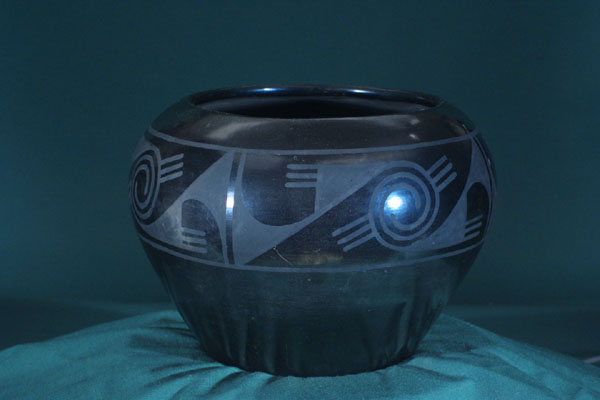
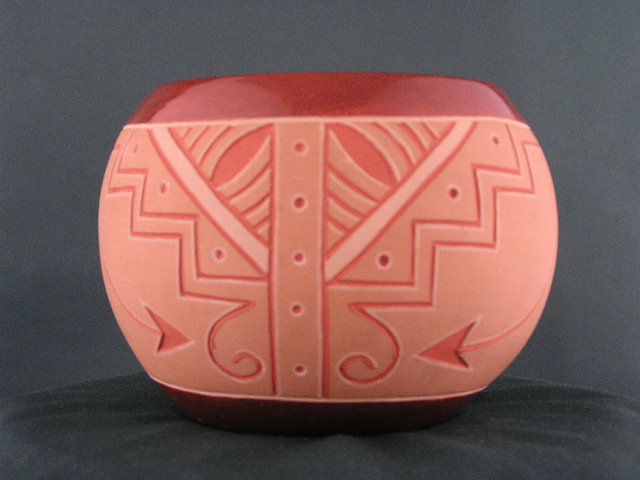
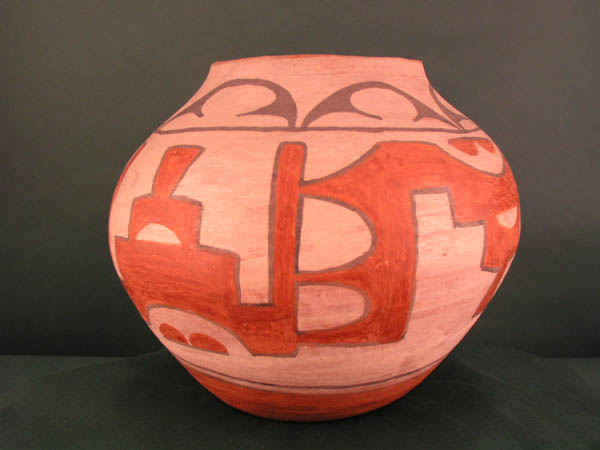
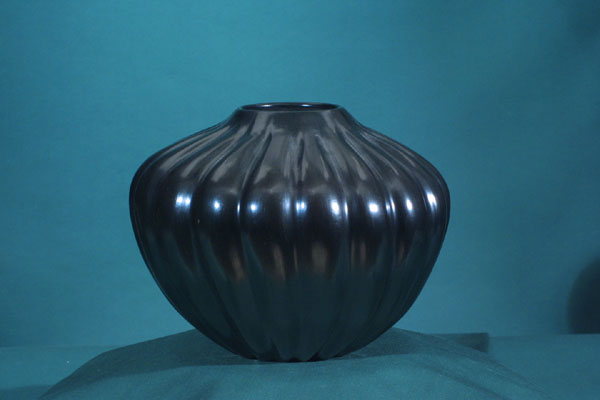
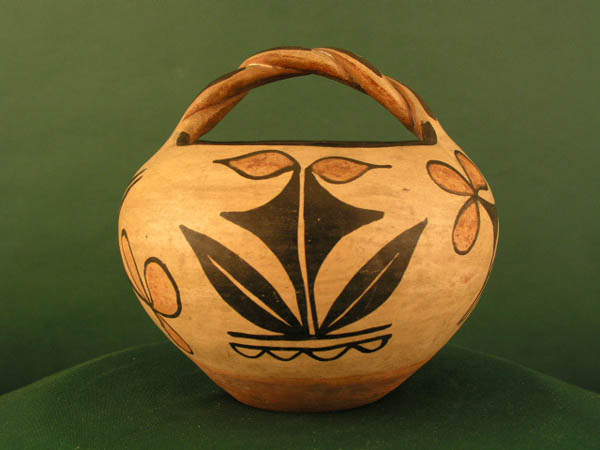
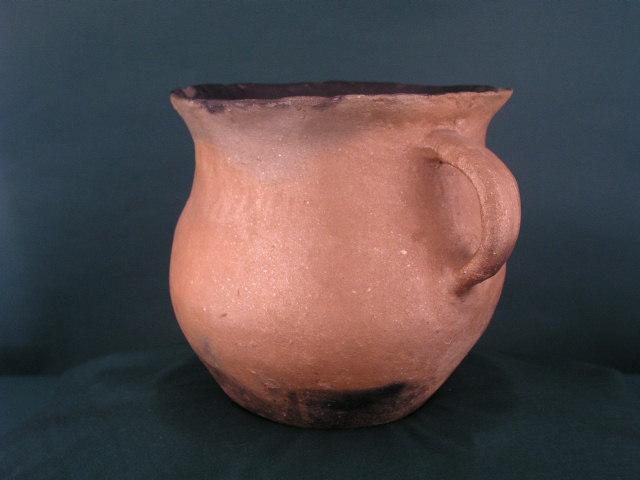
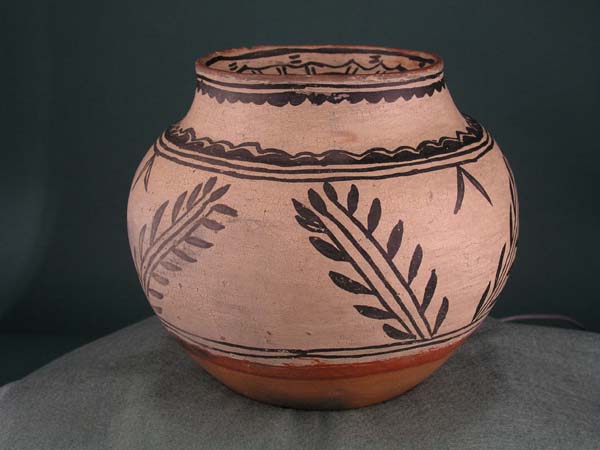
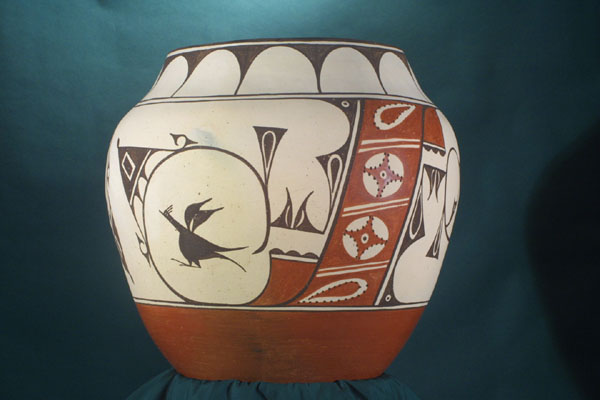
The gallery below is a sampling of the larger Morgan collection. For research inquiries, email holmes.museum@wichita.edu.
Clicking the buttons in this list will open the gallery lightbox.
Click to open the gallery lightbox.
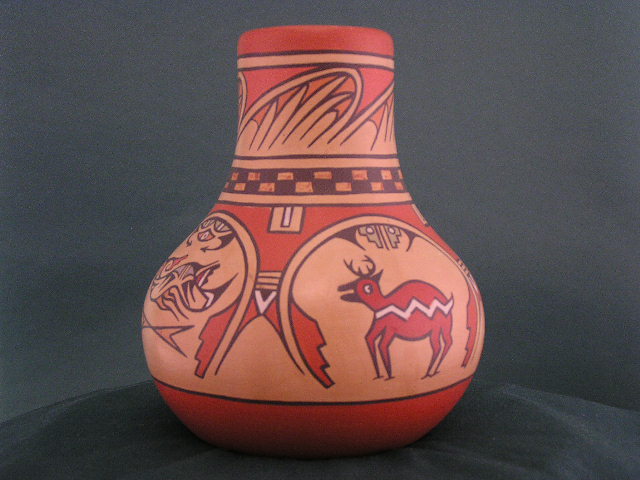
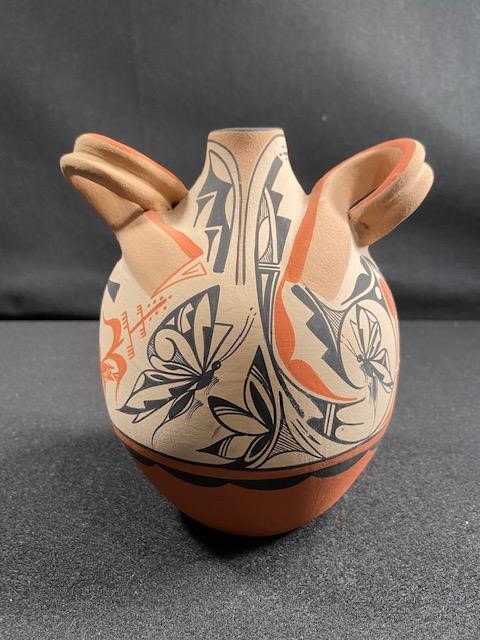
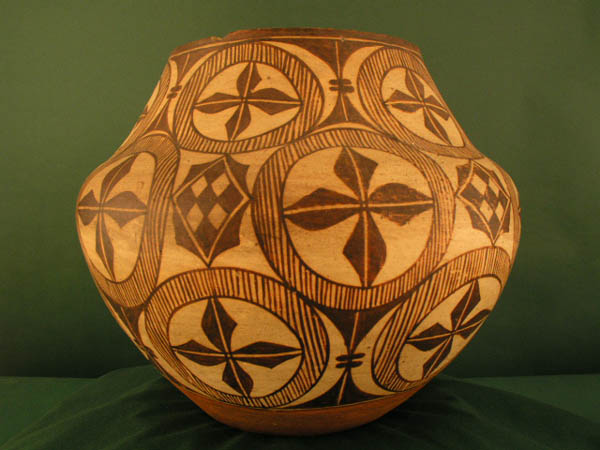
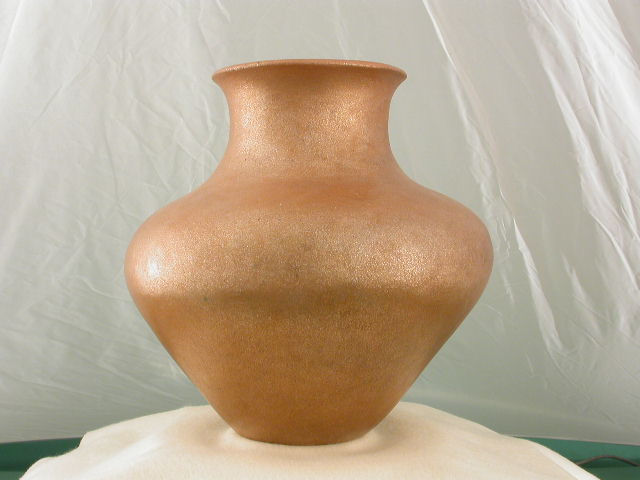
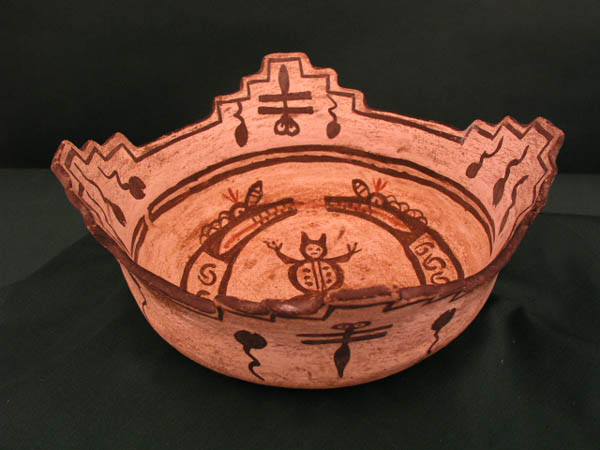
About the pueblos
Acoma
About the Acoma pueblo
Aak'u: "A placed prepared."
Language: Keresan
Size: 375,000 acres
Population: 6,000
Acoma artists in the collection
Lucy M. Lewis
Marie Z. Chino
Vera Chino Ely
B. Concho
The Acoma history
Located 60 miles west of Albuquerque, the pueblo of Acoma consists of “Sky City” atop Acoma Mesa and the villages of Acomita, McCarty, and Anzac lying along the Rio San Jose River, a tributary of the Rio Grande. Acoma’s Sky City and Old Oraibi of the Hopi reservation both contend to be the oldest continuously inhabited settlements in the United States, dating back to the 12th Century A.D. The 376 foot high sandstone mesa provided excellent defense against Navajo and Apache raiding parties. The first recorded contact between Acoma and the Spanish occurred in 1540 when Capitan Hernando de Alvarado and Fray Juan Padilla arrived at Acoma along with an escort of soldiers. Hernando claimed no army would ever be strong enough to capture the village as it was built upon a high rock with steep sides in every direction.
Eventually the Spanish captured the village in 1599 after three days of fighting. In 1629 a mission church was established, San Esteban del Ray. Acoma like the other Rio Grande Pueblos participated in the 1680 revolt against the Spanish. They also took in refugees from other pueblos who had abandoned their homes. The refugees that had managed to escape to Acoma pueblo left between 1697-1699 and established the settlement, which has become known as Laguna.
In the 1930’s James Paytiamo wrote a book that combined his tribal customs with the tales of the elders. “Flaming Arrow’s People” is an account of the traditions of the Acoma people and how they relate to the transitions of the times. Though modernization has brought some changes to the tribe many of the concepts of community and culture have not changed. Many of the customs predate the Spanish conquest.
Today only around 30 people, mostly children and the elderly, live fulltime on the Old Acoma mesa top. There is no running water, electricity or sewage disposal. Almost every family on the Acoma reservation has a home on the mesa top, which they maintain and occupy during traditional pueblo ceremonies, but most live fulltime in the villages below the mesa.
Acoma is approximately 80 miles southeast of the pueblo of Zuni. They have had continuous contact since prehistoric times. Red ware and glaze painted decoration were quite common at both Zuni and Acoma locations in prehistoric times. They both abandoned the glaze method in favor of matte painted designs during the seventeenth century.
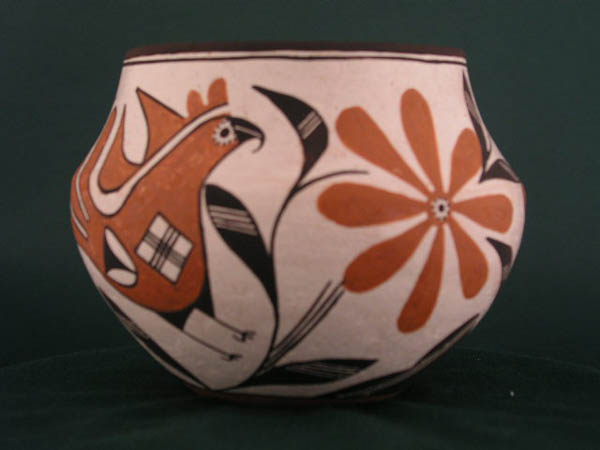
Acoma pottery went through several transitions in styles and forms from the seventeen hundreds to nineteen hundreds. A mineral matte pigment replaced glaze paint, the bottoms of the jars went from convex to concave and changes occurred in jar forms. During the nineteenth century Acoma pottery evolved into the common forms we see today. Designs became more floral with paintings of birds and parrots in beautiful patterns. Acoma is known for its thin-walled white pottery with beautiful designs. The clay used for making their pottery is plain white and sources remain a secret.
In the 1900s Lucy Lewis and Marie Chino became famous for adapting designs of the ancient Mimbres and Ancestral Puebloans to the modern shapes of their vessels. They created geometric patterns and motifs that have become the signature for most Acoma pottery today.
While pottery is still made at Acoma in the traditional method of hand coiling, using natural paints and outdoor wood firing, some potters have turned to gas kilns while others are buying or making slip-cast pottery. This type of pottery is often called contemporary style, greenware, or ceramic-style and is not considered authentically traditional. To purchase authentic traditional pottery always inquire about the process of how the piece was made.
In addition to making pottery, artists at Acoma pueblo also make jewelry, baskets and some also weave belts.
References and Further Readings
Dillingham, Rick
1992 Acoma and Laguna Pottery
Harlow, Francis
1977 Modern Pueblo Pottery: 1889-1960
Paytiamo, James
1932 Flaming Arrow’s People
James, H. L.
1988 Acoma: People of the White Rock. Revised Edition
Cochiti
About the Cochiti pueblo
Katyete or Ko-Chits: "Stone Kiva"
Language: Keresan
Size: 175 square miles
Population: 1,500
Cochiti artists in the collection
No known artists in collection.
The Cochiti history
Located in north-central New Mexico, 25 miles southwest of Santa Fe, Cochiti (with Santo Domingo) is the most northern of the Keresan language villages.
Some experts believe they originally came from Tyuonyi, an Ancestral Puebloan village in the Jemez Mountains and later migrated to their present location. Their first experience with the Spanish was not until 1581 when Frey Rodriguez arrived to set up a mission. The mission of San Buenaventura, built around 1630, lasted until it was burned in the Pueblo Revolt of 1680. After the Pueblo Revolt the inhabitants of Cochiti and Santo Domingo set up a hidden mountain stronghold at Cienguilla that was later attacked by the Spanish in 1693. Many of the men were killed and most of the survivors were returned to the Cochiti village where they were put to work building a new mission, which still stands today. Those who managed to escape from the Spanish attack established the pueblo at Laguna in 1699.
Cochiti and Santo Domingo developed their pottery on a parallel course until around 1830, when Cochiti evolved from the Kiua Polychrome of Santo Domingo to their own distinctive style known as Cochiti Polychrome around 1850. The initial differences between Kiua and Cochiti Polychrome were principally seen in the designs. Design lines on Cochiti Polychrome became lighter and finer with motifs as isolated decorations often unrelated to one another, whereas Kiua Polychrome designs were formed of heavy, bold lines with geometric patterns. Cochiti Polychrome secular pottery also contained images of sacred symbols such as clouds, rain, lightning, serpents, mammals and even humans, which was strictly forbidden at Santo Domingo.
In addition to their pottery Cochiti potters also produce ceramic animal figurines in the form of owls, turtles, bears, frogs, coyotes and other animals, which are quite popular with the tourists. One of the most popular pottery figurines originating in Cochiti is the storyteller made famous by the late Helen Cordero. Today they make an enormous variety of people and animals as storytellers. Although Cochiti is best known for producing storyteller figures and traditional drums, they also have talented artists who are painters and jewelers.
References and Further Readings
Gibson, Daniel
2001 Pueblos of the Rio Grande: A Visitors Guide
Harlow, Francis H.
1977 Modern Pueblo Pottery: 1880-1960
Hopi
About the Hopi pueblo
"Hopituh - The Peaceful People"
Language: Hopi
Size: 1.6 million acres
Population: 9,000
Hopi artists in the collection
Rachel Sahmie
Joy (Frog Woman) Navasie
Les Namingha
Helen Naha
Elva Nampeyo
Fannie Nampeyo
Dextra Quotskuyva
Priscilla Namingha
Sadie Adams
Garnet Pavatea
Eunice (Fawn) Navasie
Rondina Huma
The Hopi history
The Hopi reservation is located in a remote area approximately eighty miles northeast of Flagstaff, Arizona. Surrounded on all sides by the Navajo reservation the Hopi have lived in this area for over a thousand years. The Hopi reservation consists mainly of three mesas arising 7,200 feet from the low altitude desert. These mesas provided the Hopi with protection from invaders. Today there are twelve Hopi villages, which are located on top or at the base of the three mesas known as First, Second and Third mesa. The history of Hopi pottery goes back over a thousand years. The village of Old Oraibi located at Hopi Third Mesa and Sky City Pueblo at Acoma both claim to be the oldest continually inhabited settlements in North America. Atop Hopi First Mesa are the villages of Hano (Tewa), Sichomovi, and Walpi. The Hopi village of Polacca is located at the base of First Mesa. First Mesa villages have dominated Hopi pottery making since the late 1800s.
The Spanish had less impact on the Hopi than any of the other pueblos. When Coronado stopped at Zuni during the expedition of 1540 he dispatched a small party led by Pedro de Tovar and a Franciscan friar Juan de Padilla to the Hopi area. They were unable to find the legendary Seven Cities of Gold among the Hopi so they soon left the area. In 1629, Franciscan friars established a mission at the Hopi village of Awatovi in an attempt to convert the Hopi to Christianity.
One thing that the Hopi consistently and successfully rejected was the ideologies of Spain. They were quite successful at resisting their conversion to Christianity. During the Pueblo Revolt of 1680 the Hopi villages banned together with their Pueblo neighbors and destroyed the San Bernardo de Awatovi mission church in Awatovi. The Spaniards attempted to re-established the mission in 1700 but the Hopi villages again banned together and destroyed Awatovi altogether. It was never resettled. Although the Spanish re-conquest of 1696 established missions in the other pueblos, they did not successfully reestablish full controll over the Hopi. Some Hopi did convert to the Christian religion, which made them enemies in the eyes of their fellow Hopi which kept the number of conversions relatively small.
Around 1700 Tewa-speaking villagers from the Rio Grande area wanted to escape the turmoil of the revolt and the subsequent reconquest by the Spanish. They fled and sought refuge among the Hopi. The Hopi leaders decided to let them stay if they would agree to guard the access path to the mesa. This agreement led to the establishment of several new villages known as Payupki and Hano. While the village of Payupki did not last long, the village of Hano, located near Walpi Pueblo on Hopi First Mesa, is still active today. Unlike the other Hopi villages, the inhabitants of Hano still speak the Tewa language of their Rio Grande ancestors. This makes them a “wrong-language” minority among the Hopi.
Along with Christianity, the Spaniards also introduced metal plows and hoes, wool weaving methods and new wood working techniques. Among the new agricultural products that the Hopi assimilated were melons, apples, peaches and apricots. Domesticated animals such as horses, burros, sheep and cattle were introduced and changed the Hopi way of life.
The earliest known pottery of the area is 1200 years old. Several books on the prehistoric pottery of the area have also been published. The introduction of sheep would have far reaching impact on the Hopi pottery tradition. Sheep dung provided fuel for cooking, heating and for firing their pottery, where coal had previously been used. Most Hopi potters continue to use sheep dung to fire their clay today.
The Hopi assimilated European pottery forms into their own designs, imitating ring based bowls and shallow, flare-rimmed stew bowls. While the Europeans molded pots using a potter’s wheel, the Hopi (as well as the other pueblos) continued to use hand coiled molding techniques.
Droughts in the early 1800s forced many Hopi to temporarily move to nearby Zuni, Zia and Acoma settlements. During this time they learned new methods and their unslipped light yellow, orange and tan pots shifted towards white slips that resembled the Zuni and Acoma pots of the period.
New designs were introduced during this period. Bowls with outward curving rims were used especially for serving hominy and lamb stews. On the interior of the rim there was a tendency to feature geometric designs. The outside often features arabesques, geometric band designs or “rainbird” figures. Large, deep bowls with interior decorations also began to appear during this period. These pieces were used exclusively for cornmeal.
This acculturated form continued until it was replaced by a Hopi revival of their original traditions. This revival was inspired by the Jeddito Yellow ware discovered at archaeological sites in the region. Archaeological research in the area has been extensive over the last one hundred years. In addition to pottery the Hopi are known for their basketry, textiles and jewelry.
Perhaps one of the most important developments for pottery came from one woman, Nampeyo (1858-1942) of the village of Hano. She revived the pottery style of the abandoned village of Sikyatki, occupied from 1375 – 1625 C.E. This involved using a fine textured yellow clay instead of the heavier yellowish–white crackled slip that the Hopi had adopted from the Zuni. This clay allowed her to create an unslipped yellow body of high polish. She also used prehistoric stylized images of birds, butterflies and other designs to decorate her pottery. She began a dynasty of important Hopi potters that is still dominant today.
References and Further Readings
Allen, Laura Graves
1984 Contemporary Hopi Pottery
Gregory Schaaf
1998 Hopi-Tewa Pottery: 500 Artist Biographies
Harlow, Francis H.
1977 Modern Pueblo Pottery: 1880-1960
Willard Walker & Lydia L. Wyckoff
1983 Hopi, Tewas, and the American Road
Isleta
About the Isleta pueblo
TUE-I: "Town"
Language: Tiwa
Size: 211,000 acres
Population: Ca. 4,800
Isleta artists in the collection
All Isleta pots in the Morgan Collection are unsigned.
The Isleta history
The pueblo of Isleta is located in the center of the Rio Grande Valley, 13 miles south of Albuquerque. The pueblo is comprised of two small villages, Oraibi and Chicale, and the main village of Isleta. The name Isleta means “Little Island” in Spanish. It has connections to the pueblo of Sandia, 14 miles north of Albuquerque on the opposite side of the Rio Grande. Both are Tiwa speaking pueblos.
Many villages were established in the area during the 1300s, but the original pueblo site cannot be dated earlier than 1500. The people of Isleta did not participate in the Pueblo Revolt of 1680 and many fled with the Spanish when they retreated to the El Paso area. Some sources claim the Isleta people were forced to join the Spanish while others say they joined voluntarily. The Isletans who had managed to evade the Spanish, re-occupied the village after the Spanish left. The re-occupied Isleta village was attacked again by the Spanish in 1681, and more than five hundred people were captured. The remaining Isletans fled the area and settled with the Hopi in Arizona. The Isletans who chose not to return home in 1692, when the Spanish left to re-occupy New Mexico, established the village of Ysleta del Sur near El Paso, Texas where they still reside today. In the 1700s additional Isletans returned to re-occupy the original pueblo and were joined by refugees from other pueblos.
The Isleta church, originally built in the 1613 was dedicated to San Antonio. It was partially destroyed during the Pueblo Revolt, rebuilt in 1716, and is now known as San Augustine Catholic Church. It remains their parish church. In 1880 the Isletans gave land to a group from the Laguna pueblo (Kersean speaking). Who eventially intermarried and were absorbed into the Islata population.
The Isleta potters made a plain redware before the arrival of the immigrants from Laguna. From them they learned polychrome methods and today generally produce polychromes based on the Laguna style. Their modification of the Laguna brown, black and tan method is the addition of white to the paints, which gives them a softer tone. Today the pueblo is largely known for its storyteller figures made by Stella Teller and her children. The Jojolas family, Caroline Carpio, and Diane Wade also make traditional Isleta pottery.
References and Further Readings
Gibson, Daniel
2001 Pueblos of the Rio Grande
Hucko, Bruce
1999 Southwestern Indian Pottery
Toulouse, Betty
1977 Pueblo Pottery of the New Mexico Indians
Jemez
About the Jemez pueblo
Walatowa: "This is the place."
Language: Towa
Size: 90,000 acres
Population: 3,400
Jemez artists in the collection
P. Loretto
The Jemez history
The historic Jemez Pueblo is located 55 miles northwest of Albuquerque, New Mexico. It lies in a narrow valley near the Jemez River surrounded by magnificent red sandstone mesas. The Jemez people migrated to the Canyon de San Diego region from the four corners area in the late 1200s. By the time the Spanish arrived in 1541, the Jemez nation was one of the largest and most powerful in the region with a population of around 30,000 people. The Spanish found numerous large masonry pueblo villages situated on the high mountain mesas and canyons. Some of these early pueblos were as tall as five stories and contained more than three thousand rooms. There were also hundreds of smaller living units.
Their power in the region was largely based on their role as being important traders throughout the area. Due to the Pueblo’s rocky terrain they had to create products such as pottery to trade with their neighbors to supplement their food crops of beans, corn and squash.
The creation of the present-day Pueblo itself was a result of the Spaniards attempts to convert the Indians of the Jemez Canyon. The Indians opposed Spanish rule, with numerous uprisings resulting in Spanish military action. Jemez was one of the last tribes to submit to Spanish rule, often moving west and living among the Navajo when the Spaniards approached their area. Those who stayed in the Pueblo held off the Spanish for 4 years before eventually being defeated by Spanish guns. Due to the contact created by the fleeing Jemez there still exist certain ties between the Jemez and Navajo. The historic Jemez pueblo village known as Walatowa was established in 1400 as a trade center. Today it is the sole remaining village out of six original sites that were once occupied by the Jemez people. Jemez is also the only remaining pueblo that speaks the Towa language.
Before the people of Jemez settled in the Jemez Canyon they had produced a fine black-on-white pottery as well as some plainware. By the time they had settled in their current location they were only producing a small amount of plainware. In the mid- eighteenth century pottery production ceased altogether and the Jemez relied on pottery from Zia, which they obtained through trade. In the 1920s a few potters made an effort to revive pottery making but failed. During the 1960s when interest in Native American art had risen significantly among tourists and collectors, Jemez potters set about learning to make higher quality pottery. Several potters excelled at making traditionally coiled well-made pottery including Mary Small and Mary E. Toya. Other potters also took up the art and since the 1980’s traditional pottery at Jemez has made a comeback. While most Jemez ware today is red they also use some tan and black tones. Traditional designs include feathers, plants and wildlife. Jemez potters have become very proficient and are now producing a wide variety of forms and types of fine pottery.
Jemez’s historic main village of Walatowa is no longer open to the public, although people are welcome to visit the Jemez pueblos Walatowa Visitor Center located a few miles north of the historic pueblo, which has a museum and gift shop.
References and Further Readings
Gibson, Daniel
2001 Pueblos of the Rio Grande
Toulouse, Betty
1977 Pueblo Pottery of the New Mexico Indians
Laguna
About the Laguna pueblo
Ka-waikah: "Lake People"
Language: Keresan
Size: 425,000 acres
Population: 7,700
Laguna artists in the collection
Thomas Natseway
The Laguna history
The pueblo of Laguna is located 46 miles west of Albuquerque, New Mexico. Laguna is not only the youngest of the Rio Grande Pueblos it also has one of the largest land reserves of all the pueblos. In 1692, after the 1680 revolt, refugees from Cochiti, Cieneguilla (a now abandoned village near Santa Fe), Zia, Jemez and Santo Domingo fled the reconquest lead by General de Vargas and took refuge with the sympathetic Acoma on their isolated mesa top. By 1697, some of the refugees had moved to Zuni Pueblo while the remainder moved 14 miles northeast of Acoma to establish the pueblo of Laguna. In 1698, the Laguna people offered to make peace with the Spanish and in 1699 the Spanish took control of the pueblo and the mission of San Jose was begun and finally completed in 1701. Although Laguna was officially established as a pueblo in 169, oral history and archaeology indicate that various native peoples occupied the area around Laguna off and on for thousands of years.
Laguna Pueblo today consists of the main village, Old Laguna, and five smaller villages including Paraje, Paguate, Mesita, Encinal and Seama. Each village within the pueblo community celebrates its own feast day except on September 19 when all villages celebrate the Feast of St. Joseph.
Laguna’s pottery tradition was similar to that of Acoma. Pottery making in Laguna nearly disappeared due to several reasons. In 1880 the Santa Fe Railroad laid tracks through the reservation and many Laguna men found employment working for the railroad. From 1950 to 1968 one of the largest open-pit uranium mines operated on the reservation employing many Laguna people. The lure of jobs in Albuquerque also had an effect. Fewer than half of Laguna’s tribal members live and work on the reservation. By the 1960s the art of pottery making at Laguna was almost gone.
During the 1970s, an effort was made to revive pottery making at Laguna by Nancy Winslow, a native New Mexican. She set up an arts and crafts project that lasted for two four-month sessions in 1973 and 1974 at the pueblo. Evelyn Cheromiah and her daughters were among the 22 students who attended the first class. By the 1980s, others had taken up the art of making traditional Laguna pottery. Evelyn, her daughters, Lee Ann and Mary, and her grandson, Brooke, have all become accomplished traditional potters as well as Gladys Paquin, another traditional Laguna pottery artist.
The tradition of pottery making has now been revived at Laguna Pueblo. In addition to pottery making a few artisans work as jewelers, woodcarvers, painting, basketry and moccasins making.
References and Further Readings
Dillingham, Rick
1992 Acoma & Laguna Pottery
Hucko, Bruce
1999 Southwestern Indian Pottery
Toulouse, Betty
1977 Pueblo Pottery of the New Mexico Indians
Picuris
About the Picuris pueblo
We-Lai
Pikuri: "Those who paint."
Language: Tiwa
Size: 17,000 acres
Population: Ca. 340
Picuris artists in the collection
Anthony Durand
The Picuris history
Near Penasco, in north central New Mexico, this now small mountain pueblo was once larger than Taos. Today its population is around 340. It is located in the Sangre de Cristo Mountains, 25 miles southeast of Taos. The village itself is within a very high mountain pass. Located in the center of the Pueblo is the San Lorenzo church, originally built in the 1770s. In the 1980s the church was discovered to be in danger of collapsing due to water damage. The old structure couldn’t be saved and was consequently torn down. Tribal members spent eight years rebuilding the church, by hand, on the existing foundation.
Spanish explorer Don Juan de Onate referred to the village of Picuris as the “Grande Pueblo de Picuris.” The neighboring southern pueblos called them “pikuria” meaning “those who paint.” Some sources also cite that the name may have derived from the unrelated Jemez language, meaning “at the mountain gap.” Reports from the Spaniards, who visited in 1598, claim that the original pueblo structure was nine stories tall. In the 1960s the original pueblo was excavated and is now an archaeological site. The pueblo is Tiwa speaking, connecting it to its Taos neighbors.
The clay that both Taos and Picuris Pueblos use for their traditional and historic pottery is high in mica content. This micaceous clay creates the distinctive metallic luster that sets their pottery apart from all other pueblo pottery. These clay pots and bowls are the only pueblo pottery that can be put directly on the fire or stove for cooking. The Tewa Pueblos sometimes copied the Taos/Picuris style but used different clays and temper. Taos and Picuris pottery are very similar. The main difference is that the unpainted functional Picuris pots tend to be thinner than those found in Taos. On some of their pots they apply a slip of mica over the pot before it is fired.
Often the clouding from the firing process will be the pots only decoration, though sometimes they applied rope, beads, or molded clay animals to the pot. The striations they sometimes used were achieved by several methods. The clay could be pressed into a basket, or combed to produce an unusually “roughened” surface. The surrounding Spanish villages often purchased their functional pottery for household use.
Though this unpainted functional ware has been in production since 1600, it didn’t become dominant after the Pueblo Revolt of 1680. In many ways they copied the spartan pots of their Apache neighbors. Picuris continued to produce a fair amount of pottery using their traditional styles until the mid 1900s, when their traditional source for the micaceous clay was almost destroyed by an industrial mica-mining project. This nearly ended the Picuris pottery tradition. Recently Anthony Durand who was raised in Picuris by his grandparents has taken on the job of reviving their pottery. His grandmother showed him another source for the micaceous clay. Now many non-Picuris artists are also using micaceous clay to create beautifully shaped pots, figures and sculptures.
Recently there has been a movement to create more aesthetic and artistic styles of pottery using the micaceous clay. The artists hope that this will create a market for their pottery as works of art rather than just functional utility ware.
References and Further Readings
Anderson, Duane
1999 All That Glitters: The Emergence of Native America Micaceous Art and Pottery in Northern New Mexico
Hucko, Bruce
1999 Southwestern Indian Pottery
Santa Ana
About the Santa Ana pueblo
Tamaya
Language: Keres
Size: 79,000 acres
Population: 700
Santa Ana artists in the collection
Dora Montoya
The Santa Ana history
Santa Ana pueblo is located approximately 27 miles northwest of Albuquerque, New Mexico. The Santa Ana people migrated south from a place they call White House, in the early sixteenth century and established the historic village of Tamaya. In 1680, Santa Ana warriors participated in the Pueblo Revolt against the Spanish. In 1687 the Spanish retaliated by destroying the village and scattering the people. The Santa Anans fled to the nearby Black Mesa and Jemez mountains. In 1693 they returned to the present day pueblo location and submitted to Spanish rule. In 1709, the tribe of Santa Ana purchased additional land along the Rio Grande for agricultural purposes.
Being a Keres speaking pueblo, they maintain a matrilineal set of clan memberships, which form the Squash and Turquoise ceremonial groups. In spite of all the Spanish influence and early destruction, many traditional customs have been retained. They have Kachinas, divided into 5 groups, each of which is controlled by a medicine society made up of a voluntary membership. An unusual feature of Santa Ana society is that the women also participate in the masked Kachina dances. This is unique among the pueblos. The pueblo remains well known for the high quality of its dances.
The historic village of Tamaya located along the Jemez River, is closed to visitors, except for a few feast days. Very few tribal members live in the old village of Tamaya year round. Most of the Santa Ana tribal members live in a village called Ranchitos, located on the east side of the Rio Grande just north of the town of Bernalillo. Many of the people work in Albuquerque and commute each day. They are proud of their organic farm products and are working hard to develop the areas economy. The Santa Ana people were early users of ditch irrigation.
The making of pottery is not a large cottage industry in Santa Ana. As an agricultural community they traditionally traded crops for pottery from neighboring Zia pueblo. Historically Santa Ana and Zia potters both made Puname Polychrome ware. After the Santa Anans moved east to the Rio Grande River, they began using a fine sand temper instead of a crushed basaltic rock as a temper agent, which is still used by Zia potters today. This difference in temper is the easiest way to distinguish between Santa Ana and Zia pottery. In the 1800s they adopted an architectural style of design with a white slip. By the 1920s Santa Ana pottery seemed extinct. There were no pieces entered in the Santa Fe Indian Market until 1925. As of 1940 hardly any pottery was produced. In 1970, Eudora Montoya was the only potter in the pueblo. In the 1970s she began teaching other women of Santa Ana how to make pottery, but still today very few pots are made. In the 1980s a few Santa Ana women opened the Ta-Ma-Ya Crafts Cooperative in the village of Los Ranchos where visitors can purchase traditional embroidered cloth and clothing, silver and turquoise jewelry, and occasionally pottery.
References and Further Readings
Gibson, Daniel
2001 Pueblos of the Rio Grande
Hucko, Bruce
1999 Southwestern Indian Pottery
Toulouse, Betty
1977 Pueblo Potter of the New Mexico Indians
Santa Clara
About the Santa Clara pueblo
Kha-P'o: "Valley of the wild roses."
Language: Tewa
Size: 47,000 acres
Population: Ca. 2,600
Santa Clara artists in the collection
Tina-Garcia Trujillo
Helen Shupla
Lela & Van Gutierrez
Joseph Lonewolf
Margaret Tafoya
Margaret & Luther Gutierrez
Camilio (Sunflower) Tafoya
Lorencita Naranjo
Teresita Naranjo
Anita L. Suazo
Nathan Youngblood
Sara Fina Tafoya
The Santa Clara history
The second largest of the Tewa speaking pueblos, Santa Clara's original location was the Puye Cliff Dwellings, now a National Historic Landmark, about 10 miles away from their current locale. In 1550 A.D. because of a serious drought they moved off their mesa to the banks of the Rio Grande. Coronado first encountered them in 1540. The Spanish missionaries had established the first mission by 1622, which was destroyed during the Pueblo Revolt in 1680. Two subsequent churches also fell and the present day adobe church was built in 1918. When the Spanish returned in 1692 they fled and joined their San Ildefonso neighbors atop Black Mesa holding off the Spanish until 1696. When the siege at Black Mesa ended many Santa Clara people escaped to the west joining the Hopi and the Zuni. By 1702, most had returned to their homes on the Rio Grande. Today, many Santa Clarans work outside the pueblo in adjoining Espanola or in Santa Fe. Farming at Santa Clara still takes place along the valley floor and livestock graze in the foothills and mountains.
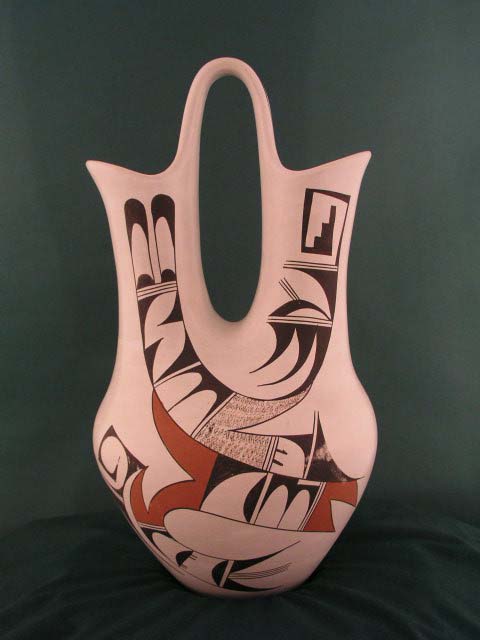
Pottery making has become an important part of the Santa Clara economy. Today, more than 200 potters work in the pueblo. Their flag depicts a ceremonial wedding vase designed by tribal governor Edwin Tafoya. In the 19th century most of their pottery was an undecorated blackware, redware or made from natural micaceous clay. Today most pots are still solid black or red, but with very distinctive decorations. The most recognizable design is the Santa Clara “Bear Paw” imprint made famous by Margaret Tafoya (1904-2001) and her mother Sara Fina Gutierrez Tafoya in the late 1920s. They were also the first to develop deep-carved blackware. While other pueblos followed the trend of producing smaller wares, Sara Fina and Margaret produced some of the largest vessels of which some exceeded two feet in height. Very few Santa Clara potters make vessels this large today.
There has also been extensive experimentation with styles and design schemes, resulting in some unique productions. Miniature pottery forms with elaborately painted and etched designs known as sgraffito were developed by the Camilio “Sunflower” Tafoya family. These were made famous by Camilio’s son, Joseph Lonewolf. Today the descendants of Camilio Tafoya (1902-1995) including Joseph Lonewolf, Grace Medicine Flower, Greg Lonewolf, Rosemary Lonewolf, and Susan Romero make a variety of styles of beautiful miniature pottery. Their designs depict a wide range of images including animals, nature scenes, pueblo dancers, ancient Mimbres designs and even their personal interests. Miniatures have now become common in all of the pottery producing pueblos.
Santa Clara is home to many artistic families who continue to produce outstanding pottery. While best known for their pottery other artists also work in woodcarving, sculpture, beadwork, weaving and embroidery.
References and Further Readings
Dillingham, Rick
1996 Fourteen Families in Pueblo Pottery
Gibson, Daniel
2001 Pueblos of the Rio Grande
Harlow, Francis H.
1977 Modern Pueblo Pottery: 1800-1960
Schaaf, Gregory
2000 Pueblo Indian Pottery: 750 Artist Biographies
Toulouse, Betty
1977 Pueblo Pottery of the New Mexico Indians
Santo Domingo
About the Santo Domingo pueblo
Khe-Wa
Language: Keresan
Size: 81,000 acres
Population: Ca. 4,500
Santo Domingo artists in the collection
Arthur & Hilda Coriz
Santana Melchor
Robert Tenorio
Monica Silva
The Santo Domingo history
The pueblo of Santo Domingo is located approximately 30 miles south of Santa Fe, New Mexico in the Rio Grande Valley. Today’s people are considered the descendants of immigrants from villages atop the nearby Parajito Plateau. They have occupied the same general region since the 1200s. The present pueblo site is relatively recent, having been occupied since around 1866. Major floods in 1606, 1700, and 1855 destroyed previous villages causing the residents to move to higher ground and rebuild. Santo Domingo pueblo’s original native name is Guipi, “The Unknown.”
Participating in the Pueblo Revolt of 1680, Santo Domingo people were led by Alonzo Catiti. In 1681 Spanish Governor Antonio Otermin led a reprisal mission to Santo Domingo. Upon finding the pueblo empty, Otermin burned it. The residents had taken refuge on a nearby mesa-top. When the Spanish, led by Diego de Vargas, returned in 1692, they attacked the mesa-top refuge burning it as well. The Santo Domingo leader, Alonzo Catit, was killed during the attack. Some survivors fled westward to establish the pueblo of Laguna, while others took refuge at Acoma, but as time went by many returned to rebuild.
Being located not far from the ancient Cerrillos turquoise mines, Santo Domingo is home to many talented jewelers. Historically they traded turquoise as far south as central New Mexico. Jewelers specialize in handmade heishi (shell) and turquoise beads. They also work in mosaic inlay, where cut stones are laid over a backing. While Santo Domingo artists are famous for their jewelry, they are also noted for their pottery.
Since the 1880s Santo Domingo has made black-and-red on-cream pottery in several different styles. Kiua Polychrome typically has black, geometric patterns divided into vertical panels painted on a cream-colored slip body with a solid red slip confined to the underbody. Around 1910, the Aguilar family began a technique known as “reverse-painting,” which covered the cream-colored slip almost entirely with black and red.
Today’s Santo Domingo Polychrome designs include flowers, leaves, and animals. The use of sacred symbols or human forms is strictly forbidden on Santo Domingo pottery.
In the early 1900s, most Santo Domingo residents were making jewelry and pottery production nearly died out. Santana Melchor, taught by her mother, began making pieces in the 1920s. By 1945, she was the most important potter in Santo Domingo. She continued the tradition, teaching her children and grandchildren.
The most current revival of Santo Domingo pottery began in the 1970s with the help and inspiration of Robert Tenorio. Coming from a family of jewelers he learned to make pottery from his Aunt Andrea Ortiz. Deciding to become a full-time potter he also coaxed his sisters into becoming potters. Today, other families are also making pottery.
References and Further Readings
Gibson, Daniel
2001 Pueblos of the Rio Grande
Harlow, Francis H.
1977 Modern Pueblo Pottery: 1800-1960
Hucko, Bruce
1999 Southwestern Indian Pottery
Toulouse, Betty
1977 Pueblo Pottery of the New Mexico Indians
San Ildefonso
About the San Ildefonso pueblo
Po-woh-ge: "Where the water cuts through"
Language: Tewa
Size: 26,000 acres
Population: Ca. 600
San Ildefonso artists in the collection
Rosalie & Joe Aguilar
Rose Gonzales
Juanita Gonzales
Maria (Poveka) Martinez
Julian Martinez
Santana Martinez
Popovi Da
Russell Sanchez
Crucita (Blue Corn) Calabaza
Isabel
The San Ildefonso history
Located in Santa Fe County New Mexico, 25 miles north of the city of Santa Fe, San
Ildefonso Pueblo has been inhabited since around 1300 A.D. Their structures are unique
because on their buildings they construct “vigas” (columned porches). Traditionally,
corn and beans were grown and stored in pots covered with rawhide. Several archaeological
sites have been found in the area containing such pots.
The Spanish attacked the settlement in 1694. The people sought refuge on top of Black
Mesa, located a short distance to the north, and successfully repelled the Spanish
advance. Eventually they were brought under Spanish rule. Disease took a terrible
toll on the people. By 1864 only 161 inhabitants were left. Smallpox brought the number
below 100 in 1918. In 1880, it’s small size and isolation relegated it to a farming
community. Contemporary crops of San Ildefonso include corn, beans, squash and chilies.
Potters also visit the region for it’s red clay.
For hundreds of years San Illdefonso women were known for making beautiful polychrome pottery. By 1890, they began using a red slip. Red ware pots with black designs were the norm until about 1920. By 1905, the stone polish slip, a method used continuously for over three hundred years, was replaced by a rag-applied slip.
In 1919, the well-known potter Maria Martinez with her husband Julian, discovered a technique to create a matte black paint on a polished black surface. This technique has become highly prized and sought after by collectors of southwestern pottery. The making and selling of pottery has become an important industry for the San Ildefonso economy.
References and Further Readings
Alice Marriott
1984 Maria: The Potter of San Ildefonso
Gibson, Daniel
2001 Pueblos of the Rio Grande
Toulouse, Betty
Pueblo Pottery of the New Mexico Indians
San Juan
About the San Juan pueblo
Ohkay Owingeh: "Village of the Strong People"
Language: Tewa
Size: 12,230 acres
Population: 2,000
San Juan artists in the collection
Leonidas C. Tapia
Reyecito A. Trujillo
Rosita Cata
The San Juan history
San Juan is located approximately 30 miles north of Santa Fe, New Mexico. The pueblo has been continuously inhabited for over 700 years, and more then 100 of its original buildings still survive.
The first contact with the Spanish was in 1598, when Juan de Onate arrived on an exploration survey. Impressed by the friendly people of San Juan he named the pueblo San Juan de Caballeros (Saint John of the Gentlemen) and decided the area would serve as the first capital of the New Mexico territory under Spanish rule. The capital was later moved in an uninhabited area in 1608 by orders of the Spanish governor, which became known as Santa Fe.
Po’Pay, an important leader of the Pueblo Revolt of 1680 was from San Juan. After being flogged by the Spanish for performing traditional religious ceremonies, which had been banned by the Spanish, Po’Pay and leaders from other pueblos organized a rebellion against Spain. When the Spanish learned of the plan through an informant, Po’Pay took refuge at the pueblo of Taos where he finished his plans for the revolt. The revolt took place simultaneously in all of the Pueblos with the exception of Isleta and the Hopi of Arizona. Priests and Spanish settlers were killed and churches were burned. The Spanish that survived the attack fled to Santa Fe, taking refuge in the Palace of the Governors. The pueblo warriors followed them laying siege to the Palace and cutting off their water supply. Fighting their way out of the palace the Spanish retreated down the Rio Grande Valley to El Paso, Texas. In 1692, the Spanish returned led by Don Juan de Vargas and re-conquered New Mexico.
The pueblo of San Juan today has two churches. The Chapel of Nuestra Senora de Lourdes was built in 1898 and made of cut-stone. The San Juan Bautista church, made of red brick, was built in 1913. San Juan is home to the Bureau of Indian Affairs Northern Pueblos Agency. It also houses the Eight Northern Indian Pueblos Council, which coordinates many programs including education, health, social services and economic development among the northern pueblos. San Juan organizes and holds the well known Eight Northern Indian Pueblo Arts and Crafts Fair each July.
During the Spanish control of the region, pottery from San Juan was prized as sturdy utilitarian ware. Many Hispanic households in New Mexico used it regularly, due to its durable construction. San Juan pottery before 1900 was either red or black and normally undecorated.
In the 1930s a new style of pottery was introduceded by Regina Cata, a Spanish woman who had married into the pueblo. Regina organized a group of potters including, Crucita and Reyecita Trujillo, Gregocita Cruz, Crucita Talachy, Luteria Atencio, and Tomasita Montoya to study ancient Potsuwi’i incised pottery shards, dating from around 1450-1500. There shards were discovered in the abandoned ancestral village of San Juan, located across the Rio Grande from the current pueblo. The new pottery style is heavier than earlier San Juan pottery and consists mostly of redware. The base and rim of the pots are usually polished red with an unslipped, buff-colored band in between. The band is either incised with a micaceous slip applied before firing or carved and decorated with red, buff, and white matte paints. Typical designs include: geometric patterns, floral, feathers, spirals, steps and scallops.
References and Further Readings
Gibson, Daniel
2001 Pueblos of the Rio Grande
Harlow, Francis H.
1977 Modern Pueblo Pottery: 1800-1960
Hucko, Bruce
1999 Southwestern Indian Pottery
Toulouse, Betty
1977 Pueblo Pottery of the New Mexico Indians
Taos
About the Taos pueblo
Tuah-Tah: "Our village," or "At Red Willow Canyon mouth."
Language: Tiwa
Size: 99,000 acres
Population: 2,200
Taos artists in the collection
Juanita Suazo DuBray
The Taos history
The historic pueblo of Taos is located approximately 3 miles north of the town of Taos and 65 miles north of Santa Fe, New Mexico. Rising behind the pueblo, to the east, are the peaks of the Sangre de Cristo Mountain range. One of the prominent peaks called Taos Mountain is sacred to the Taos people. The Rio Pueblo river, which the Taos people call Red Willow, runs through the middle of the pueblo providing water for drinking and cooking in the pueblo. The river flows from Blue Lake, considered sacred to the Taos people, behind Taos Mountain.
The two main structures of the historic pueblo, located on the banks of the Rio Pueblo, are called Hlaauma (North House) and Hlaukkwima (South House). These adobe structures rise as high as five stories and are considered one of the oldest and largest continuously inhabited structures of North America, along with Acoma’s Sky City mesa and the Hopi’s Old Oraibi village. The old pueblo has no running water or electricity and only around 50 people still live their fulltime. Most Taos people live outside the old pueblo in modern homes but still maintain family residences in the old village returning for sacred ceremonies. At one time the old village was enclosed in a ten-foot high wall with four large watchtowers, built for protection against marauding tribes. The only entrance into the village was through a large gate. A much lower adobe wall still surrounds the village today. A marvel of architecture the multi-storied old adobe pueblo was declared a National Historic Landmark in 1965 and designated as a World Heritage Site by the United Nations in 1992.
Whenever Spaniards and Europeans invaded their territory, the people of Taos made every attempt to expel them. During the Pueblo Revolt of 1680, the leader of the revolt, Pope of San Juan hid at Taos Pueblo while finalizing plans. The warriors of Taos also took part in the revolt, destroying the San Geronimo Mission, which had been built in 1619. It was quickly rebuilt in the same spot soon after the revolt. In 1847, after the American occupation of New Mexico, a group of Spanish-speaking residents and natives of Taos Pueblo joined forces in an attempt to overthrow the Americans. They attacked and killed the first United States territorial governor of New Mexico, Charles Bent, who was living in the neighboring town of Taos. The U. S. Army responded with a counterattack. When the troops entered the pueblo many of the natives sought refuge in the San Geronimo Mission Church. The army fired a canon at the mission, blowing down the walls. Tragically, the women, children and old men who had sought refuge inside the church all perished. Today, a crumbling bell tower is all that remains of the old chapel. The present San Geronimo de Taos Chapel, was built in 1850 at a nearby location.
Many Taos Pueblo residents make a living as artists. Micaceous pottery has been made by Taos potters for hundreds of years and has traditionally been used for cooking and storage. Micaceous clay pottery is unique in that it can be put directly on the stove and used as a cooking vessel. Being close to a mountain pass, which linked the pueblo with the Great Plains, they often traded pottery vessels, blankets and other goods with the Apache and Comanche and other nomadic tribes for buffalo meat and hides.
Traditional Taos micaceous pottery has no painted decoration but often contains sculpted details and is known for its glittery tan or yellow gold appearance. In recent years Taos micaceous pottery has taken on new shapes and forms. Some are even fired as blackware. Taos potters today are making a variety of traditional micaceous pots, mudhead figurines, miniature seed jars and storytellers.
While a majority of Taos pueblo residents are potters there are also jewelers, leather crafters and sculptors.
References and Further Readings
Bodine, John J.
1977 Taos Pueblo: A Walk Through Time
Gibson, Daniel
2001 Pueblos of the Rio Grande
Tesuque
About the Tesuque pueblo
Te Tsugeh Oweengeh: "Village of the narrow place of cottonwood trees."
Language: Tewa
Size: 17,000 acres
Population: Ca. 400
Tesuque artists in the collection
All Tesuque pots in the Morgan Collection are unsigned.
The Tesuque history
Only 10 miles north of Santa Fe, in north-central New Mexico, this pueblo is surprisingly conservative for being located so close to a major modern city. It is positioned in the foothills of the Sangre de Cristo Mountains. The name Tesuque is derived from the Spanish word “tecuge,” meaning “at a narrow place.” Today their reservation covers 17,000 acres with a population of around 400. Their native language is Tewa. Nearby is a large, naturally eroded sandstone rock formation known as Camel Rock.
Archaeological sites in the Tesuque Valley area have been dated back to 850 A.D. By 1200 A.D. there were many villages in the area. When the Spanish arrived in 1541 they found six villages including the original Tesuque village, which was located approximately 3 miles east of the present day village. The Tesuque warriors struck the first blow during the Pueblo Revolt of 1680 when two of their messengers were caught by the Spanish and forced to reveal plans about the upcoming revolt. The Tesuque warriors responded by killing a Catholic priest and a public official. During the Spanish re-conquest of 1692, their old village was virtually destroyed. In 1694 the Tesuque people abandoned the old village and moved to their present site.
Once they made the same clay and slip as their Tewa neighbors in San Ildefonso. This was black on cream plus some polychrome ware. Tesuque pottery tended to have flatter bases, a more rippled surface and sometimes crystalline fragments in the paste. In the 1830s the Tesuque style began to change. Tesuque Polychrome evolved which was quite popular until the 1880s.
In the 1880s a trader named, Jake Gold, convinced Tesuque potters to begin making small figures called Rain Gods that were often decorated with commercial paint. They were neither traditional nor ceremonial figures and were made strictly to sell. Mr. Gold did an outstanding job of marketing and soon potters were making them by the thousands. Rain Gods were distributed nation wide. They could be purchased by the barrel and many were given away by manufacturers as promotional items. This mass production of Rain Gods basically ended the making of traditional pottery at Tesuque. In the 1920s, the demand waned for the figures and potters began producing small, usually low fired pots decorated with commercial poster paint. In the 1930s and 40s Catherine Vigil was among the rare potters still making traditional polychrome ware. During the 1960s a few potters went back to making traditional micaceous pieces and the old polychrome ware. Today there are still a few potters making an effort to return to the tradition of producing “old” style Tesuque pottery.
References and Further Readings
Gibson, Daniel
2001 Pueblos of the Rio Grande: A Visitor’s Guide
Hucko, Bruce
1999 Southwestern Indian Pottery
Toulouse, Betty
1977 Pueblo Pottery of the New Mexico Indians
Zia
About the Zia pueblo
"Tsia"
Language: Keresan
Size: 122,000 acres
Population: Ca. 800
Zia artists in the collection
Sofia Medina
Helen Gachupin
The Zia history
This small pueblo is located 35 miles northwest of Albuquerque at the base of the Jemez and Nacimiento mountains. The Zia have occupied their current location for over 700 years. For many centuries, Zia was a center of pottery manufacturing and trade. Because of the poor quality of their land they traded ollas and bowls to San Felipe, Santa Ana, Jemez, and other pueblos for agricultural products.
Coronado’s men reached Zia pueblo in 1540. In 1598, they estimated the population of Zia to be around 2,500. The Zia Catholic mission church, Nuestra Senora de la Ascuncion (Our Lady of the Assumption) was dedicated in 1612. Zia’s participation in the Pueblo Revolt of 1680 was similar to the other pueblos but the later reprisals were devastating to the Zia population. In 1688, Domingo Cruzate made an attempt to recapture New Mexico for the Spanish. Before retreating Cruzate launched a major attack on Santa Ana and Zia. Within a few days six hundred were dead, some were enslaved, and the rest fled into hiding in the mountains. The Zia village was burned. The church that was damaged but not totally destroyed was restored after the re-conquest in1692. In the 1800s, raids by nomadic tribes, and diseases introduced by the Spanish and Europeans devastated the Zia and by the 1890s their population was reduced to ninety-eight people. Once the largest of the pueblos numbering over three thousand the population of Zia today numbers around 800.
There is considerable continuity of design among their pottery for the last 300 years. Zia and Acoma pottery are very similar in style and design, but Zia pots are much heavier with thicker walls. They often use very stylized designs of water and birds with red and black arches. While the bird design used by Acoma and Laguna is the parrot, Zia’s bird is the roadrunner. In the late 1800s, a more naturalistic bird design began to appear. Experts believe this was influenced by Euro-American folk arts.
The brick red clay that they use is tempered with crushed basaltic rock and then hard-fired. Their wares were very popular because of their durability and artistic beauty. The fact that a very large number of vessels have survived from a relatively small number of craftsmen is a testament to the quality they achieved. Zia still has a flourishing pottery making population. Among those who have helped keep the tradition alive include the Pino, Gachupin, Medina, and Toribio families.
References and Further Readings
Gibson, Daniel
2001 Pueblos of the Rio Grande
Toulouse, Betty
1977 Pueblo Pottery of the New Mexico Indians
Zuni
About the Zuni pueblo
She-we-na: "The middle place."
Language: Zuni
Size: 418,000 acres
Population: 10,500
Zuni artists in the collection
Most Zuni pots in the Morgan Collection are unsigned. One pot is attributed to Tsayutitsa.
The Zuni history
Located approximately 35 miles south of Gallup, New Mexico this Pueblo is still considered one of the Rio Grande Pueblos even though it is a considerable distance from the river. The Zuni reservation covers roughly 700 square miles, making it the largest of the pueblos, close to the size of Rhode Island. The pueblo of Zuni also has the largest population. Nearly 80% of its population of around 10,500 is involved in the production of native arts. Most of its people live in the Zuni village proper or the nearby community of Blackrock. Zuni may also be the oldest pueblo in New Mexico with pit houses dating back to A.D. 700. The present Zuni village has been occupied since the 1690s.
The Zuni speak a distinctive language unrelated to the other Pueblos. Zuni Pueblo features a large mission church, Our Lady of Guadalupe, built in 1629. In the 1960s the church underwent extensive restoration. The inside walls feature 24 murals of traditional kachina dancers above the Stations of the Cross. Zuni is well known for their annual Shalako ceremony and dance held in late November or early December. It begins in the evening and goes until noon the next day, despite the cold and bitter weather of the season.
The Zuni village of Hawikuu, ten miles southwest of the present village, was the first pueblo that Spaniard Fray Marco de Niza and his subordinate, Esteban the Moor encountered in 1539. Estaban’s ill manners led to his being killed by a Zuni warrior and Fray Marcos returned to Mexico City with tales of riches and gold. Coronado and his army arrived at Zuni in 1540 killing 20 Zuni people as they fight to gain entrance. The Zuni had a short-lived revolt against the Spanish in 1632 long before the major Pueblo revolt of 1680. Later, attacks by marauding bands of Apache became such a problem that by 1692 they welcomed the protection of Spanish troops.
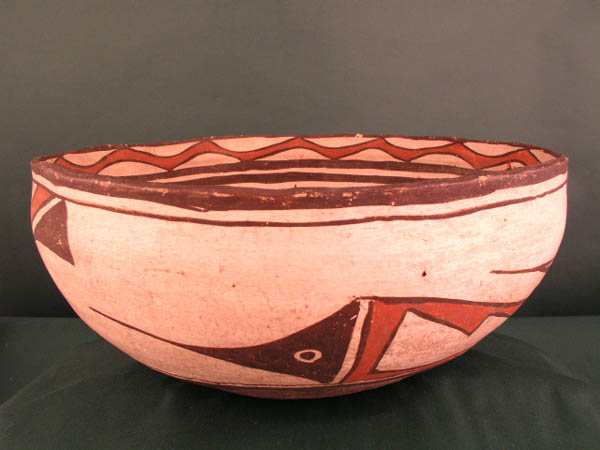
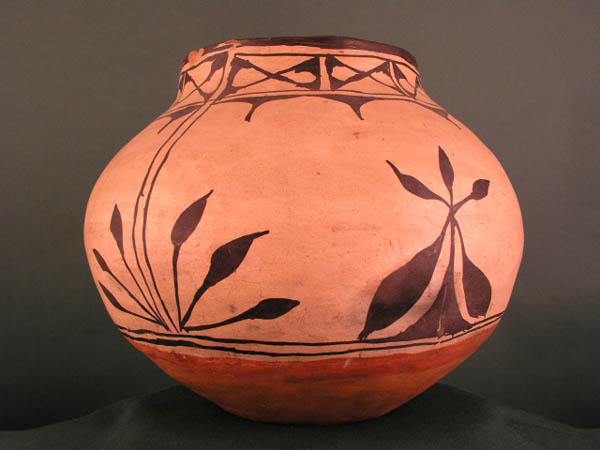
The color of Zuni pottery tends towards black, brown or red paint on a white or red slip. A few of the most commonly used designs include rainbirds, deer with heartlines, flowers, feathers and cross-hatching. Much like Acoma and Laguna they use crushed potshards to temper their clay. Beginning in the 18th century they switched to using mineral matte paint for their decorative designs. This is known among scholars and collectors as Ashiwi Polychrome.
A rare style found among the Zuni is a white on red that is believed to be a holdover from prehistoric days. The entire surface was slipped in a reddish color and decorated with motifs in white paint. Some examples of this type can be found as late as 1900.
By the 1940s, pottery was seldom being produced. What little was made was for ceremonial purposes. A Hopi potter named Daisy Hooee began its revival. She was daughter to Annie Healing Nampeyo and granddaughter to the famous Hopi potter Nampeyo. Receiving an arts scholarship in the 1920s, she studied ceramics for 2 years in Paris. Upon returning to the United States she married a Zuni man, Sidney Hooee, and lived in Zuni pueblo. Teaching pottery at Zuni High School during the 1960s and 1970s, mostly to older women, she reintroduced the traditional methods she had learned from her mother and grandmother. Later, another Zuni potter named Josephine Nahohai, studied traditional designs from archaeological findings and museum pieces and reintroduced these ancient designs into Zuni pottery. In the 1990s pottery classes at Zuni High School continued under the instruction of Noreen Simplicio, who, for several years in a row, had over a hundred students in her classes.
Contemporary Zuni pottery includes a large variety of shapes and forms using traditional water or rain figures of tadpoles and frogs. Ceramic figures of owls, and sometimes fish are also popular.
In addition to pottery, the Zuni artisans are famous for their silver and turquoise jewelry. Other materials they use to make their intricate inlayed jewelry include jet, coral, mother of pearl and shell. They also produce carved stone fetishes of animal figures and kachina dolls.
References and Further Readings
Gibson, Daniel
2001 Pueblos of the Rio Grande
Milford Nahohai and Elisa Phelps
1995 Dialogues with Zuni Potters
Toulouse, Betty
1977 Pueblo Pottery of the New Mexico Indians
About John A. Morgan
John A. Morgan, known to his many friends and associates as “Jack,” was born in Wichita, Kansas in 1915. He was raised in Wichita and graduated from Wichita State University in 1937. He went on to attend Harvard Business School and was awarded an MBA in 1939. That same year, Mr. Morgan moved to Kansas City and began working at Butler Manufacturing Company in the advertising department. Mr. Morgan left Kansas City to serve as a lieutenant in the Navy for two years. In 1946, on returning from World War II, he married “Pat,” Martha Patricia Crowe, of New York. The couple made Kansas City their home and Mr. Morgan returned to Butler Manufacturing Company. He became president of Butler in 1957 and served as Chairman of the Board from 1967-1974. Mr. Morgan retired from Butler in 1974. After his wife’s death in 1975, Mr. Morgan remained actively involved in the community of Kansas City until recent years. Always, he was a strong advocate for the arts, education and the community.
Jack Morgan had long admired the Native American culture, in particular, its deep appreciation and respect for nature. He himself had a great love of the outdoors and spent much of his leisure time hiking the trails of Rocky Mountain National Park. In the early 1970’s, Jack and his wife built a home outside of Estes Park, Colorado, and they made the acquaintance of Charles Eagle Plume, a Native American who owned a gallery down the road from his home. Jack would spend time visiting with “Charlie,” learning more about Indian artwork and life. The Pueblo pottery, in particular, captured his attention.
Up until 1981, Jack Morgan had no real plans of assembling a major collection of Pueblo pottery. It started with the simple purchase of one pot from Charles Eagle Plume at his gallery outside of Estes Park. Jack was intrigued by the look of the pot, the person who created it and Pueblo culture. He began reading books, learning more and more about the pueblos. The following year, Jack purchased five more pots from Charles Eagle Plume. From that time on, his passion for collecting grew and continued until he had assembled a major collection of nearly 130 Pueblo pots and over 250 books on Puebloan culture. He sought to build a collection representing most of the pueblos and the most noted potters producing pottery from 1900 to the present. He kept very detailed notes on each purchase; he researched each pot and when possible, he recorded the provenance. Jack traveled to several pueblos and met the potters. He treasured the art and the tradition of the pueblos.