Wichita State University
More information
About the Asmat
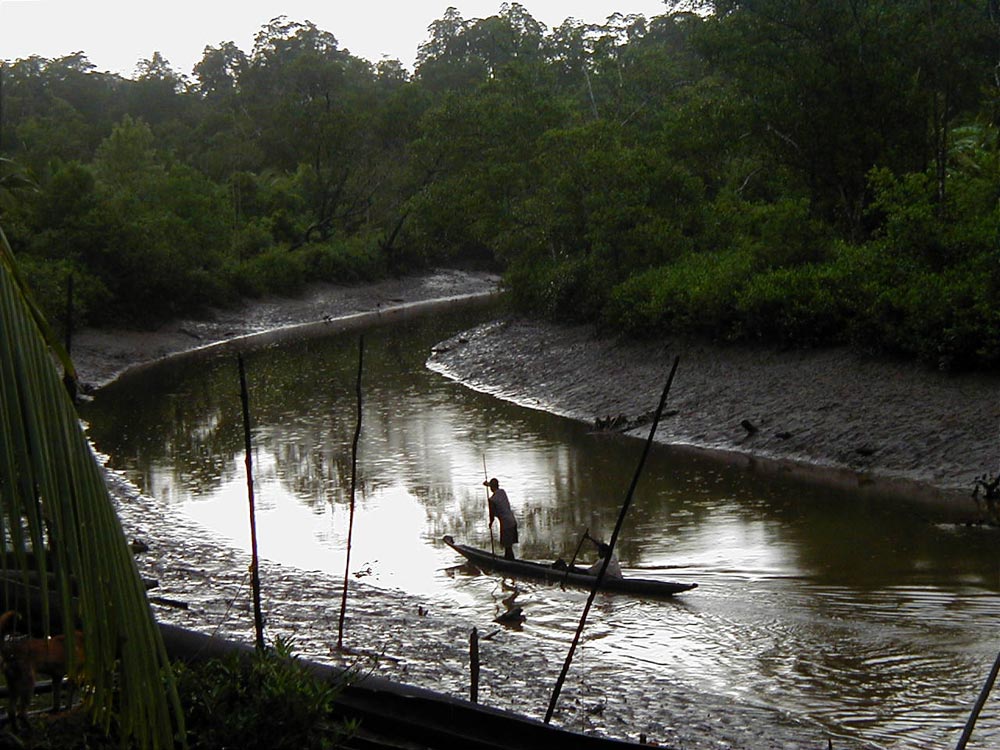
The Asmat are a semi-nomadic tribal group in the southwestern coastal sections of New Guinea. They inhabit a tidal jungle - a lush tropical region filled with many species of birds, plants and animals. Most important to the Asmat is the Sago Palm (Metroxylon sagu), whose pith is used as a main dietary staple. The Asmat hunt and fish, as well as gather native foods. Most areas are unsuitable for farming, as the nearly constant rains leech the soil of nutrients needed for growing anything but native plants.
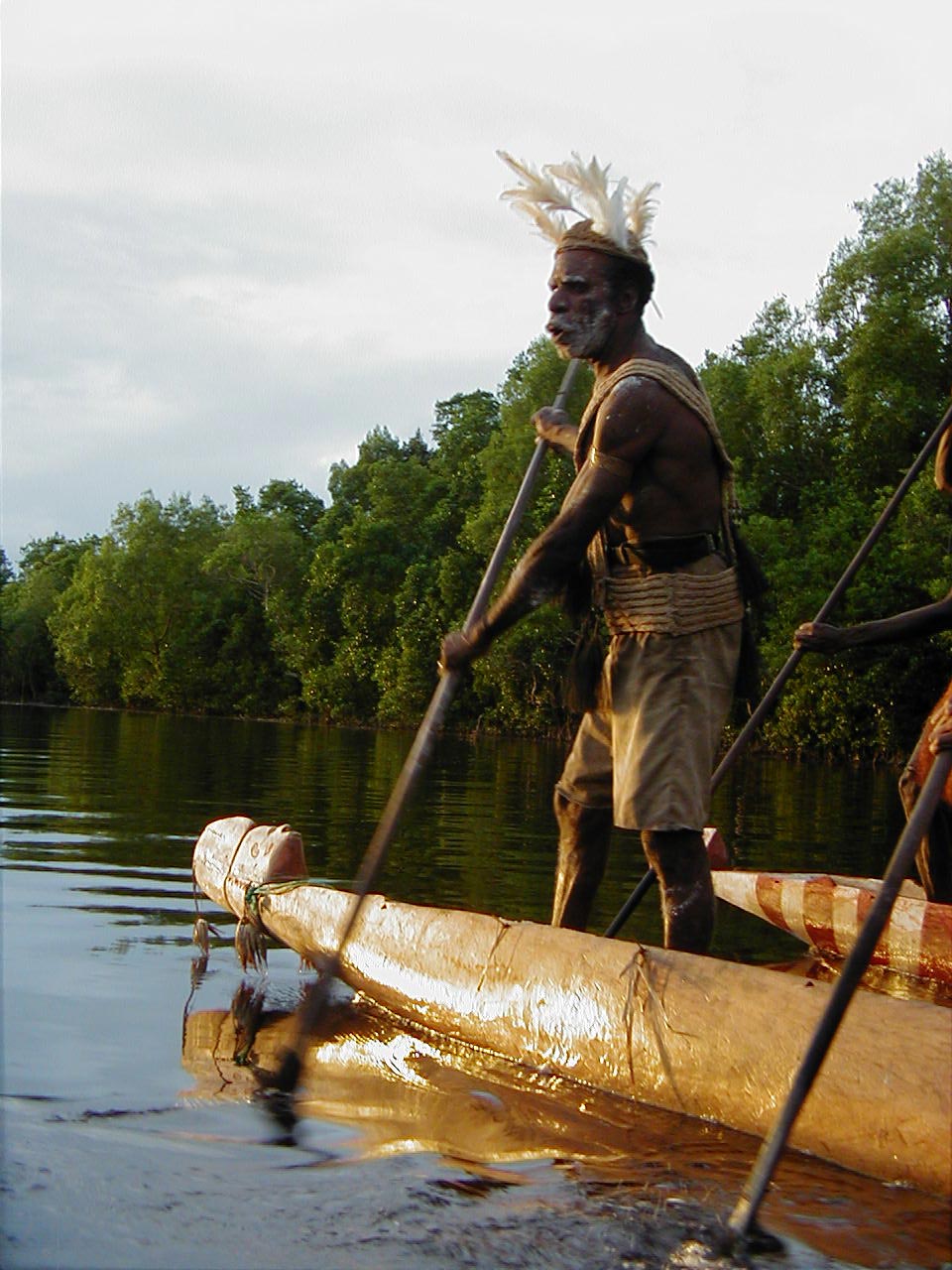
There are no roads in Asmat, so the networks of rivers in the area serve as travel routes for their canoes. Asmat villages are located on these rivers, and the population of each can vary greatly - generally from a few hundred to, less commonly, a few thousand persons. Their total current population is estimated at around 40,000.
The Asmat build houses from the abundant timber in the area. Most are home to an extended family consisting of a couple, their children, and the husband's parents. In addition there is at least one large men's house in each village, called a Jeu. This building has several partitioned areas, with separate entrances and cooking areas for each family group's personal use. Asmat men spend much of their time in the Jeu organizing ceremonies, telling stories, planning hunting and fishing expeditions, as well as carving the incredible artwork for which they are known world wide.
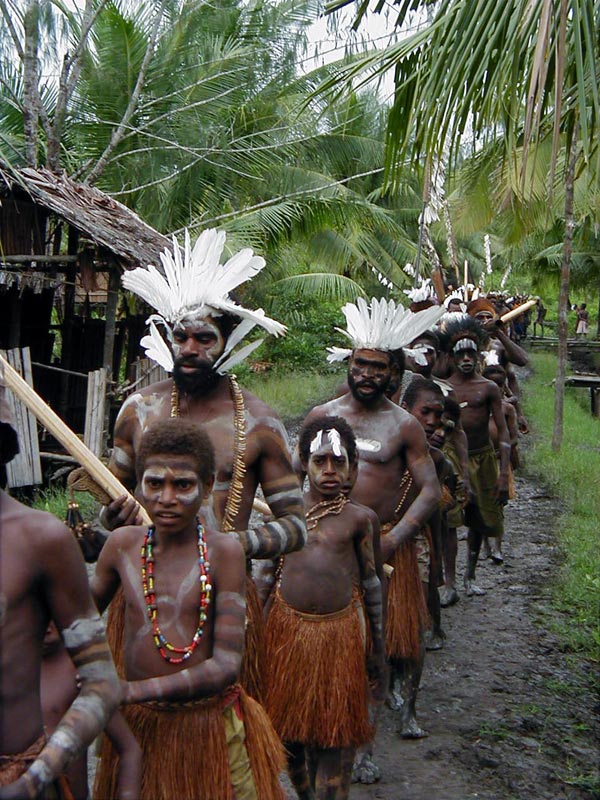
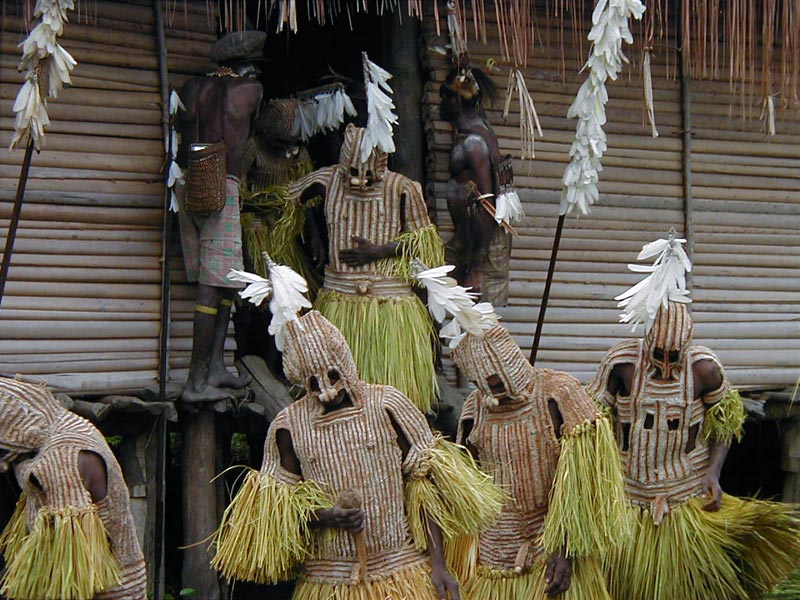
For the Asmat, the physical and spiritual worlds are constantly intertwined. Every carving, decoration or tool of daily life represents some aspect of the spirit world. The Asmat believe that it is only when the spiritual and physical worlds are in harmony that the village will be happy and healthy. Therefore, ceremonies are the focal point of their lives. These ceremonies remind them of their earthly obligations to relatives who have passed away, and create a link with ancestors who can be called upon to assist them in their daily lives.
Prior to the coming of missionaries, the Asmat were a cannibalistic and headhunting group. The Catholic Crosier Brothers were the first group to open a lasting missionary settlement, begun in 1953, and have been instrumental in documenting Asmat culture. After ministering to the Asmat for many years, the tribes gave up the headhunting aspect of their culture. However, the Crosiers have encouraged the Asmat to keep most of their traditions alive and vibrant. Toward this end, the Brothers have sponsored a highly popular yearly auction and art contest to showcase Asmat talent to the world, and promote a greater understanding of their culture.
Asmat History
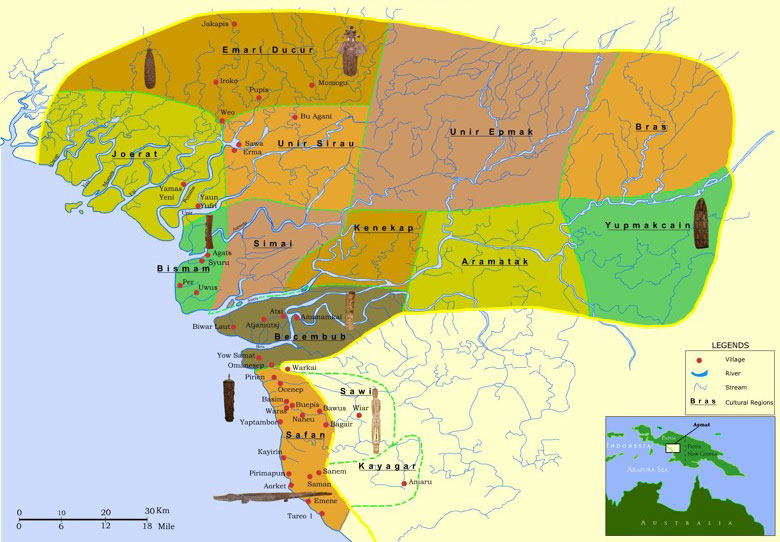
The Asmat people live in the southwest part of the island of New Guinea, which is now a province of Indonesia. There are 12 distinct cultural regions, with a population in 2000 of approximately 65,000-70,000 individuals.
First contact with the Asmat was a sighting from the deck of a Dutch trading ship in 1623. Captain Cook later landed in Asmat territory on September 3, 1770, but the fierce display by the Asmat so frightened the crew that they made a hasty retreat.
The Dutch controlled the Asmat territory from 1793-1949, but did not begin explorations of the area until the early 1900s. The first explorers sent zoological and artifact specimens back to Europe, where they were received with curiosity and enthusiasm. The Dutch eventually established a colonial post in 1938. During World War II the post was temporarily closed.
In 1953, Fr. Zegwaard, a Dutch missionary, reestablished the post at Agats, to serve as both a government center and a base for missionaries. Agats became the permanent post of the Catholic Crosier Brothers in 1958. The Crosier missionaries, who often had anthropology degrees, discouraged the traditional practices of headhunting and cannibalism, while encouraging the Asmat to retain many other traditional rituals and festivals. Some of these were eventually incorporated into the local Catholic practices.
Indonesia received its independence from the Dutch in 1949, but the Dutch retained control of the western half of New Guinea, including the Asmat region, until 1962. Then the Asmat area became part of Indonesia. In 1963, to end headhunting, the Indonesian government burned down all ceremonial houses (jeu), actively discouraged Asmat ritual and festivals, and severely limited dancing and drumming. This crackdown lasted until 1968.
The Crosier Brothers, with Bishop Sowada as their lead spokesperson, intervened to stop the destructive policy of the Indonesian government. The bishop expressed the importance of ceremony and ritual in Asmat life, declaring that “without art and ritual the Asmat culture could not survive”.
To aid in the resurgence of Asmat art and ritual, the United Nations underwrote a project from 1968 to 1974 to encourage wood carving. Later, under the combined efforts of Bishop Sowada, Tobias Schneebaum, Gunter and Ursula Konrad, the Asmat Museum for Culture and Progress was opened in the early 1980s. Today, the Museum hosts an annual woodcarving competition and auction that has stimulated artistic creativity among the Asmat, and has become an economic boon to the carvers, who are recognized throughout the world for the richness and quality of their carvings.
In 2000, the Asmat founded the Lembaga Musyawarah Adat Asmat (LMAA) to work with the Indonesian government on behalf of the interests of the Asmat people. In 2004, the Asmat region became a separate governmental administration, with its own elected head.
Asmat Geography
The Asmat region of Western New Guinea
The Asmat occupy an area on the Western half of New Guinea Island, which is the Indonesian province of Papua, and covers roughly 10,425 square miles (27,000 km2).
To the north are the Maoke Mountains, with the island's highest peak rising 16,500 feet and to the south west is the Arafura Sea. Asmat is located on a gentle alluvial plain that extends far out into the sea. Because of this, the coastal region is made up of mud and swamp with the water raising and lowering with the tide. During high tide, the sea can cover up to 1.2 miles (2 km) of land along the coast. Further inland the ground is higher and covered by dense jungle. There is an extensive network of wide and deep rivers running through the Asmat territory which create dangerous cross currents where they flow into the Sea. As there are no roads in the region, the people make use of the rivers and travel by canoe.
The Asmat live just a few degrees south of the equator, so there are no true seasons. The daily temperature all year ranges between 70º F (21º C) at night to 90º F (32º C) during the hottest part of the day. The rainy season in the eastern portion runs from April to June, and in the west from December to March. Yearly rainfall is approximately 200 inches (500 cm).
Asmat Artists
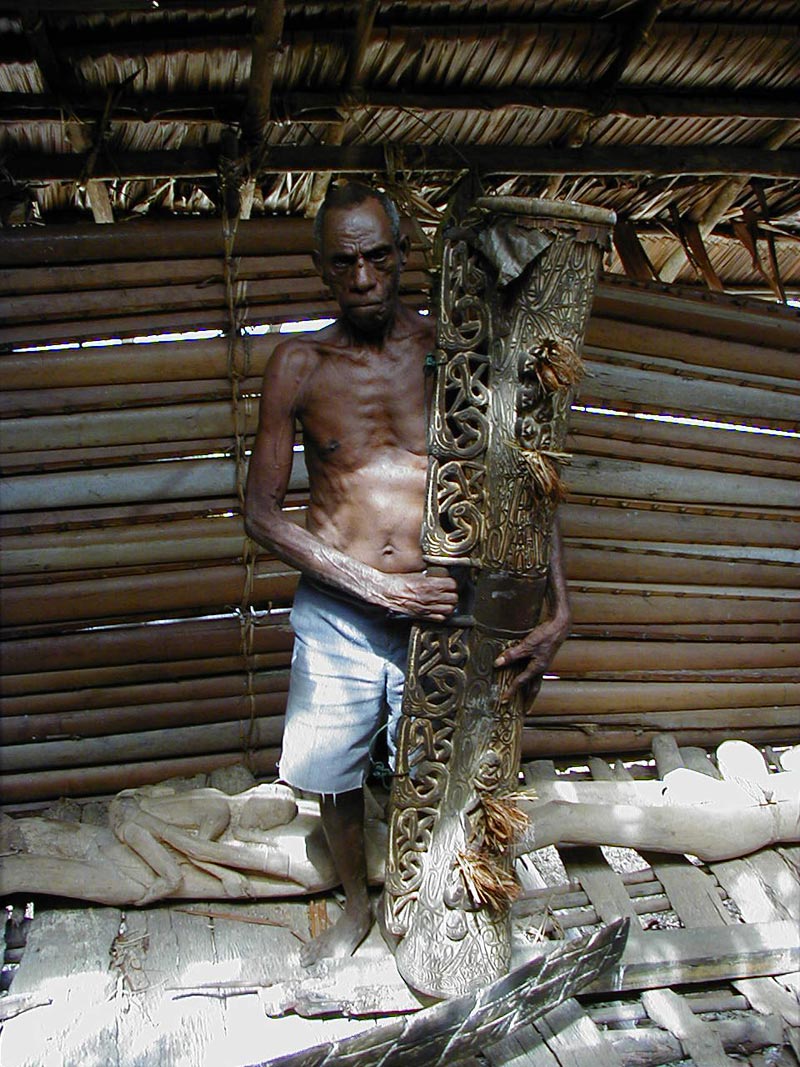
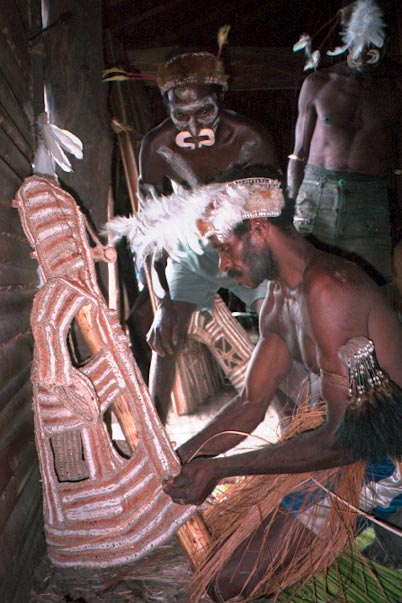
All Asmat men carve the items that they use on a daily basis, such as pipes, spear shafts, bowls and sago pounders. However, when it comes time to make ritual objects, such as bis poles, wuramon (soul ships), drums or horns, there are only a few men within each village who have the needed skills. These men are called wow-ipits, and are greatly honored as an important part of the Asmat spiritual tradition.
In addition to their high-status role as master carvers, wow-ipits are often song leaders called soarmacipits. Song leaders own the traditional ritual songs, usually passed down along the line of male ancestors in the family. They are the only men allowed to sing these songs, and only in the context of the appropriate ritual. Soarmacipits sing to the carvings as they work, telling the ancestor each represents what stage in the carving they are currently working on, and reminding the ancestor that village and family obligations to them have not been forgotten.
During the months-long carving process of the larger objects, the family that commissions the carving will provide all the food the carver needs so that he can continue working without interruption. Near the end of the process, family members put the finishing touches on the work by painting in the traditional colors of black, white and red.
About the expedition
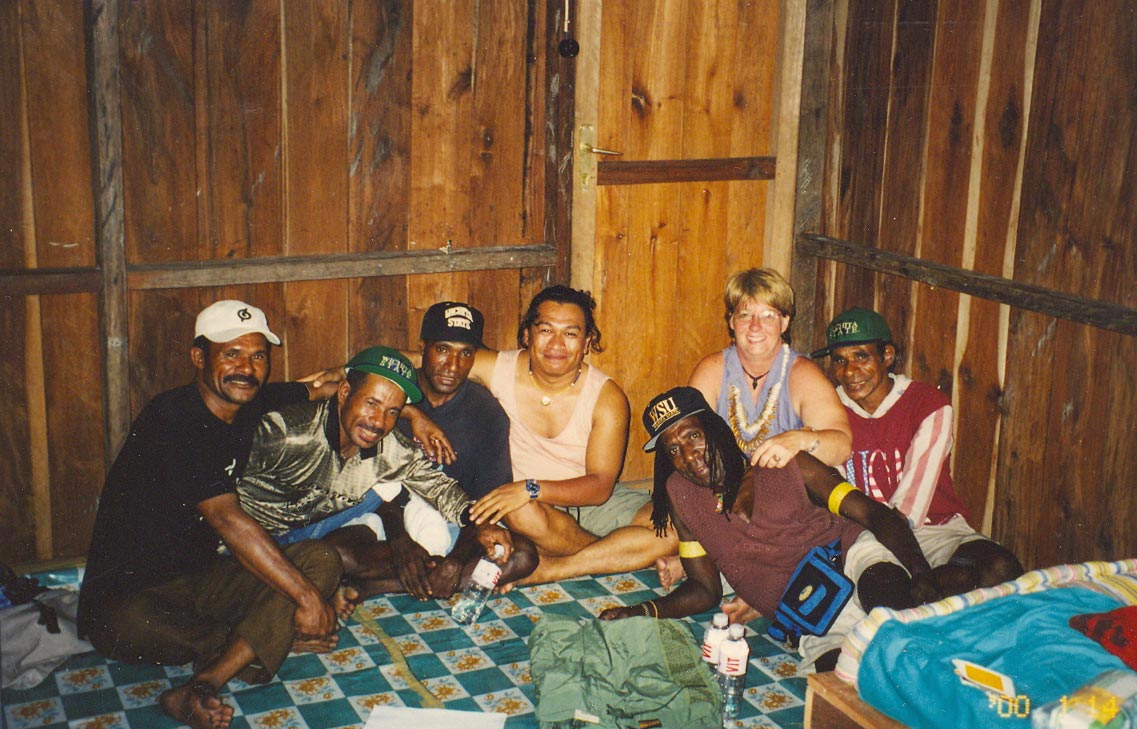
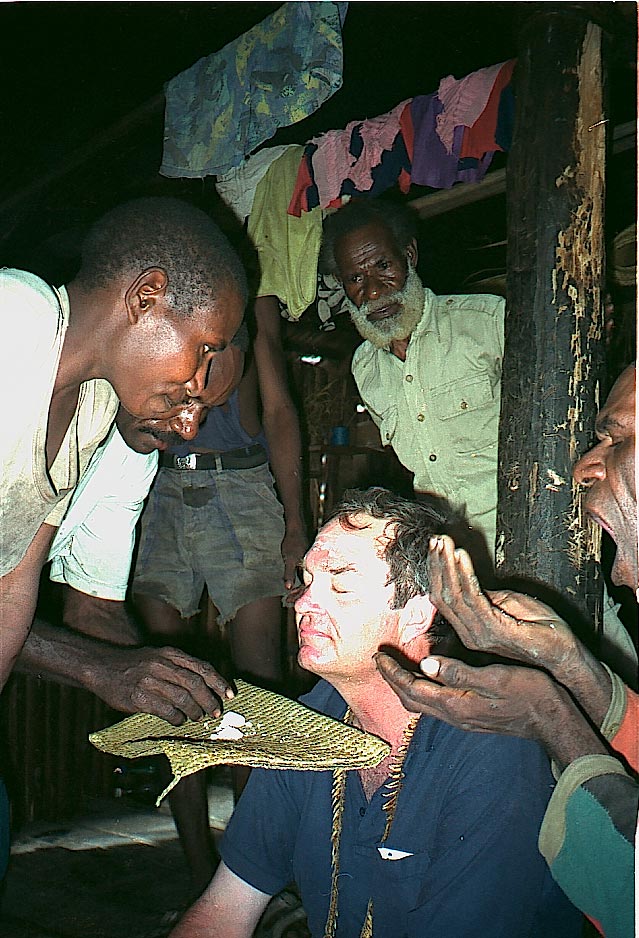
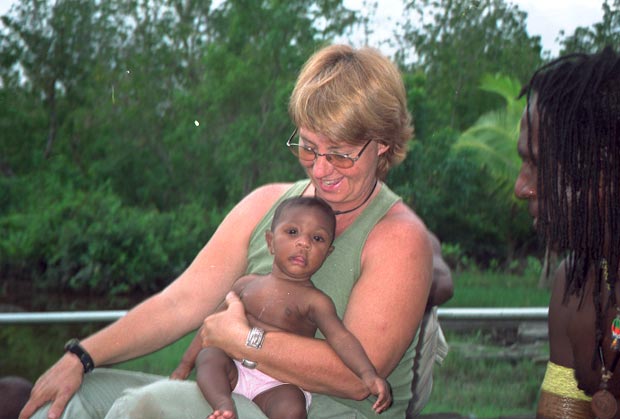
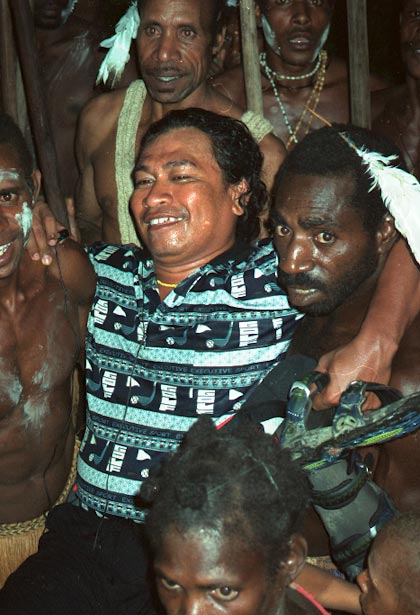
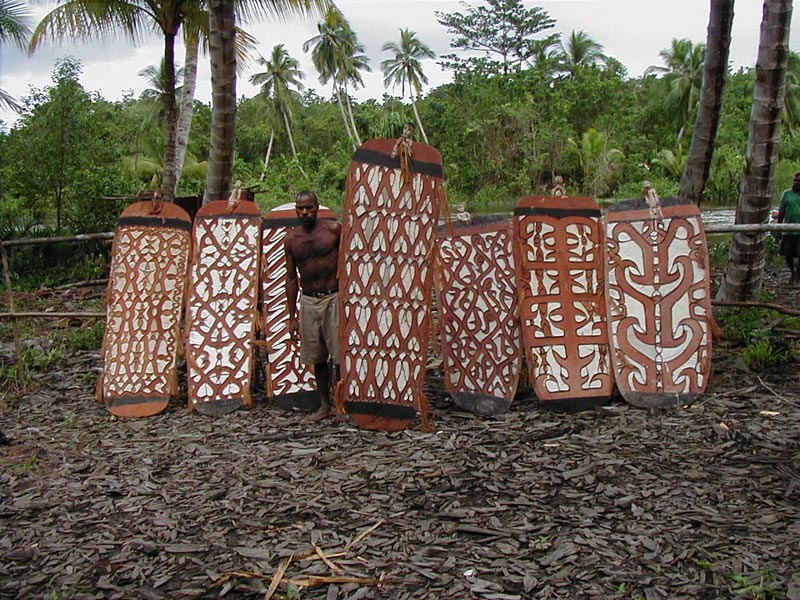
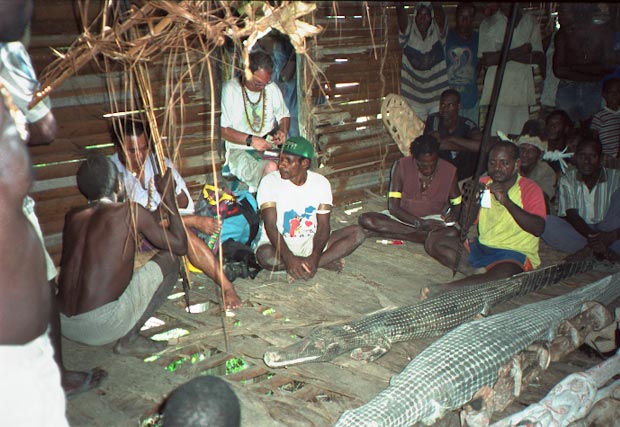
In the summer of 2001, Wichita State University became the first university in over forty years to mount an extensive expedition to collect traditional art in the isolated Asmat area of Southwestern New Guinea. The Asmat area comprises a remote, harsh environment of mangrove swamps, jungle, mud and meandering river systems that provide the only access to the villages. After their initial journey to Asmat, Paula and Barry Downing made the decision to underwrite a Wichita State Asmat Expedition. Patti Seery, an expert in Asmat art and culture, organized and led the expedition. Jerry Martin, Director of the L. D. Holmes Museum of Anthropology, joined the expedition representing the university. Over 950 diverse cultural objects were collected and documented thus forming the basis of the Downing Collection of Asmat Art. WSU now possesses one of only three significant collections of Asmat art found in the United States. The purpose of this expedition was to gather a collection of Asmat objects that can be used by scholars to learn about Asmat art and culture. Creating a research collection involves gathering objects that have been used by the people and recording the items cultural context. During the past 75 years museums have rarely undertaken the difficulties and cost of acquiring large ethnographic collections that can provide the basis for academic research, comparative studies and publications. The following photographs will illustrate the expedition and explain the different steps in the process of museum field collecting. These photographs were taken by Jerry Martin and Patti Seery during the expedition.
Planning and selecting the expedition crew
Before a museum expedition can take place, the people organizing the expedition need to research the culture and determine what type of items will be collected for the museum and which areas will be visited during the expedition. Once this has been accomplished, the next step is to plan and implement the complex logistics for the trip based upon the cultural regions selected and the amount of time allotted. Since there are 12 local dialects and almost no one speaks English in the Asmat region, the expedition needed multiple interpreters to translate from the various dialects to the national language of Bahasa Indonesian and English. During this stage, it is also necessary to choose who will represent the museum's interests when selecting the items for the collection and establish how the items will be sent safely from Asmat to WSU.
In the Downing Expedition, Patti Seery was the expedition leader, co-curator, logistics organizer and interpreter. Her expertise in West New Guinea Island cultures and knowledge of the area and language enabled the team to select a large number of culturally important items that had been used in rituals or in everyday life and helped ensure the success of the expedition. Jerry Martin, Director of the Holmes Museum of Anthropology at Wichita State University, was the co-curator in charge of actual purchasing and training any field personnel to record adequate information about the items.
Ronny Fordatkosu, a native Indonesian from Tanimbar Island, managed the bookkeeping, helped with logistics, acted as interpreter and recorded traditional music. Ronny was responsible for packing and shipping the objects from Asmat to Wichita. Other important members of the expedition included two men to interpret the local dialects into Indonesian, two boatmen and their respective assistants and a cook.
To navigate the myriad of rivers that traverse the Asmat region, the expedition used one speedboat and two hollowed-out wooden longboats with 40 HP outboard motors. Other equipment that was required for the trip included fuel and spare parts for the boats, tents, rations of drinking water, tobacco for gifts and non-perishable food to supplement the local staple diet of sago and first aid supplies.
Field collecting ethnographic objects
Once in the Asmat region, the expedition members needed to build rapport and create mutual respect within the different villages they visited. By making their intentions clear to the local people before collecting any items for the museum, expedition member were able to establish good relations with them. The expedition maintained rapport with the Asmat by approaching the toku adat or ceremonial leaders first, explaining their motives for being there, offering tobacco, sharing food in their ceremonial houses and establishing a fair price for the items they wanted to buy.
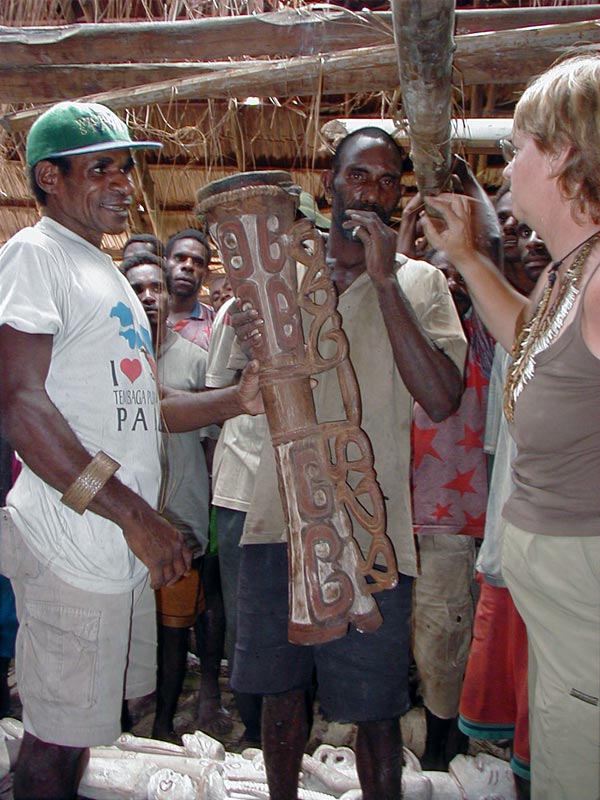
To maintain harmony and avoid creating any jealousy, the expedition members were very careful to select objects from as many different individuals as possible. The goal of the Downing expedition was to collect items that would reflect who the Asmat are and how they live, so they selected a wide range of objects actually used in ceremonial rituals and daily life. When selecting objects, the expedition members gave priority to items that were made in the traditional way and had traditional motifs. Rarely, they would purchase an object made for sale to highlight the differences between traditional and tourist objects.
Recording cultural information
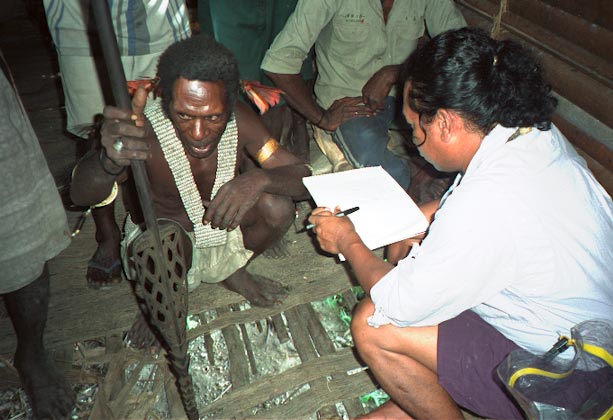
After selecting an item, the researchers needed to record where it was collected, who was the maker or owner, when and where it was made and what materials were used. Other important information included how the object was used, and any special cultural or ceremonial meaning associated with the object. Recording this information allows future researchers to recreate the cultural context of the object and learn about the people who made it. It is important to note that museums must follow a code of ethics when collecting. Doing so helps to avoid any complications with the local people, maintains mutual respect and helps establish the integrity of the collection. For example, the WSU Asmat Expedition made the decision not to collect any ancestor skulls or human bones out of respect for the Asmat and to comply with import/export restrictions.
Transporting the collection
Many of the items were collected in remote villages far from the main base of the expedition and involved extraordinary planning to transport them safely by longboat back to Agats, the regional capital. Communication between the different longboats of the expedition was non-existent once they separated from the main expedition team. Fraught with worry about the safety of small wooden longboats at sea, enormous tides and frequent breakdowns made each time a longboat reappeared a cause for celebration.
Packing and keeping the objects dry was especially difficult in the case of the extremely large and spiritually charged ritual objects like the 33 foot long soul ship or wuramon. Special taboos associated with their removal from the villages needed to be honored and bis poles could never be transported at night. Offerings were always made to the spirits at the mouth of rivers to ensure their safe passage. Once back in Agats all the items were temporarily stored, tags were rechecked and rudimentary packing materials were used to wrap the most fragile items. There was no safe and convenient way to ship the goods out of Asmat to a place where they could be properly packed and fumigated.
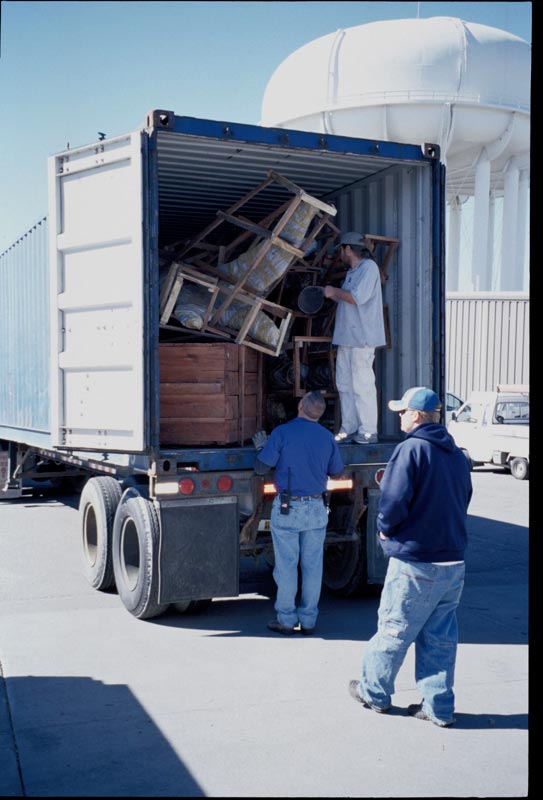
The crew of a small inter-island sail boat was chosen to carry the collection without the aid of modern navigation or any radio equipment to a major port on the island of Java three weeks away by sea. Once the ship arrived, legal permission from the authorities to unload and then export the goods outside the country became a bureaucratic nightmare handled adroitly by Ronny. In Java, the 950 items of the Downing Collection were properly insured and then loaded into 2 containers for their voyage to Wichita State University. The collection left Asmat in July and arrived in Wichita, Kansas in October of 2001.
Curating the collection
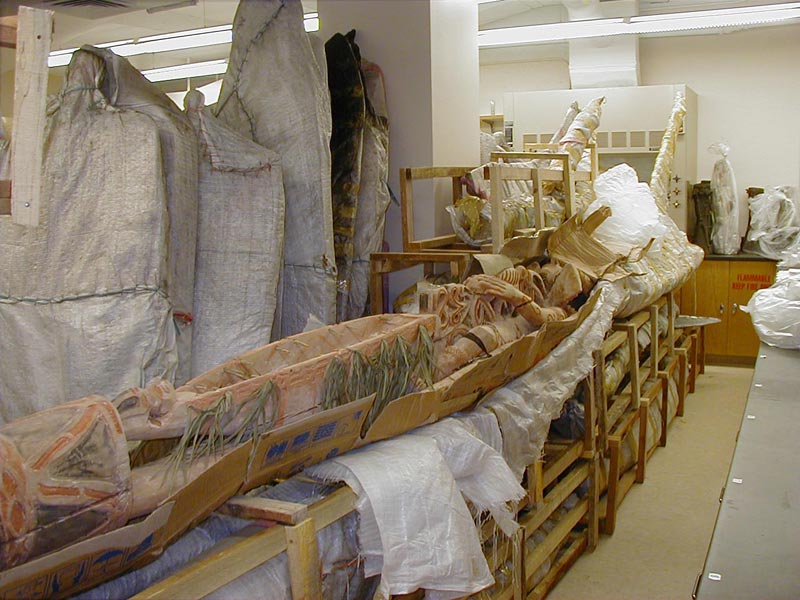
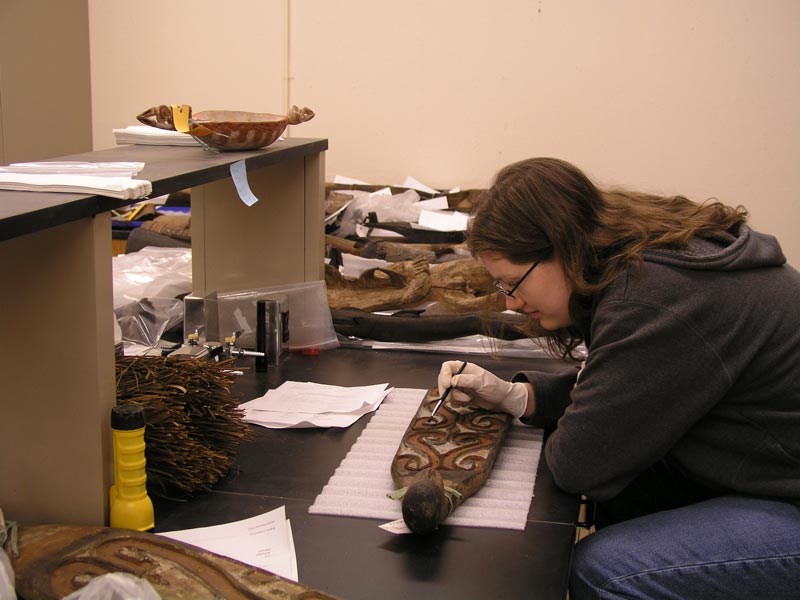
The conclusion of any field collecting expedition ends when the objects arrive at the museum. Then, the time-consuming curation process begins. This involves cleaning, preservation and conservation work, as well as cataloging the items. Since the items in the Downing Collection had been wrapped and in-transit for three months, the preservation process needed to start as soon as possible. Because most Asmat objects are made of wood, natural pigments and plant fibers they need to be checked for insect infestation and mold. Each object was kept in a plastic bag until it could be processed so contamination from one object could not be transferred to another. Once an object was cleaned and treated, condition reports, treatment forms and catalog sheets were completed. The object was also photographed. Museum personnel and students have been busy with the Downing collection since its arrival in October 2001. After almost three years of hard work, a portion of the Downing Collection of Asmat Art was ready to be put on exhibition. The nearly six year process of cleaning and cataloging the entire collection was finished in July of 2007.