


Wichita State University
The Fairmount College newsletter is published two times a year. For information, contact Cheryl K. Miller, writer and coordinating editor, at 316-978-6659 or cheryl.miller@wichita.edu.
Photo credits: Cheryl K. Miller; courtesy photos; Wichita State University Libraries, Special Collections and University Archives
Newsletter Section Menu
Undergraduates gain work-related skills and knowledge through research mentoring
At Wichita State, undergraduate research experiences differ by project and by discipline. One thing is certain: Students gain skills and knowledge that help prepare them for careers.
Undergraduate research can look like
- Sorting archaeological artifacts
- Studying properties of new magnetic materials
- Analyzing large data sets
Which can lead to
- Co-authorship on papers
- Conference presentations
- Clarity of career options
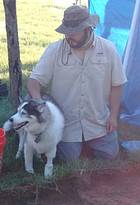
Ben Amezcua-Cabrera
Ben Amezcua-Cabrera has in hand an entry-level job offer as an archaeology technician with Stantec. A senior anthropology major, Amezcua-Cabrera works with Crystal Dozier, associate professor and department chair, on the extensive Etzanoa collection of artifacts. The settlement of approximately 20,000 indigenous Wichita existed from 1450-1700, and was discovered by Don Blakeslee, professor emeritus, in 2015. Faculty and students have been collecting artifacts related to the site since.
“I sort the artifacts, wash and clean them, and then catalog them,” Amezcua-Cabrera said. “At my stage, I don’t necessarily go too specific, so I'm just saying ‘what’s a pottery sherd? What’s a flake? What’s a debitage?’
“I'm kind of like the first stop. We’re on remants collected in 2022 now, and I’ve gotten to see some of my own artifacts that I helped excavate at field school.”
He’s handled nearly 1,000 Etzanoan artifacts, and he finds it good practice for identifying the pieces and types of material. Some of what he’s collected in the field include points and patterned pottery. In cataloguing, he uses what fellow anthropology students refer to as the “Dozier method,” which follows standard procedures within the archaeology profession.
For Amezcua-Cabrera, the practical experience has also shaped the way he learns.
“It’s all a little piece in the puzzle. Even no information is good information,” he said. “Look at everything in an almost holistic manner to see the value in every little thing. Even if it’s a simple piece of debitage, it can tell us something in the long run.”
As he sorts through the artifacts, he sees glimpses of possible interactions among the Wichita and other tribes, such as the Pawnee. This provides him with ideas of the interconnectedness among other indigenous cultures in Etzanoa and around Kansas.
Amezcua-Cabrera points out another aspect of his research experience: teamwork.
“We all depend on one another to be able to do our individual tasks,” he said. “It’s all interconnected. I’m more than happy to see other people succeed. I’m just one piece of the larger picture.”
Dozier agrees.
“Archaeology is a collaborative science,” she said. “Ben’s work is consistent and solid, and it really propels us to that next step. We can’t move forward without this work being done.”
Crystal Dozier
Dozier plans to include Amezcua-Cabrera in making information about their research available, first to the archaeological community and then to the public.
“Ben has been involved from the very beginning, excavating the artifacts,” Dozier said. “The next step is the study and the publication of the results.
“Not only is he working in the lab, but his independent study is working on the analysis. He’ll be writing the first draft of what will go into the publication.”
Amezcua-Cabrera's work in the lab is supported by the Jackman Endowment Fund. Dozier said the anthropology department returns most of those funds to its students through paid applied learning opportunities.
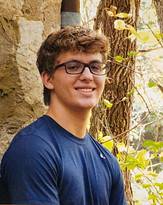
Zane Hubble
Zane Hubble has enjoyed his physics research experience so much that he saw the value in adding physics as his second major to chemistry.
He’s helping Assistant Professor Kapildeb Ambal with his National Science Foundation-funded research project to perform ferromagnetic resonance spectroscopy on a two-dimensional magnetic material. Hubble has been able to learn and apply aspects of physics, chemistry and engineering to his work.
“My project right now is to make a good flake out of the two-dimensional bulk material we’re working with,” Hubble said. The flakes he seeks are exceedingly fragile, as a single flake may measure as small as three micrometers by three micrometers.
Kapildeb Ambal
“The method we use is called the mechanical exfoliation method,” Hubble said. “We are partnering with Dr. Jian Wang (assistant professor of chemistry) to make the flake-making process easier by testing whether his new synthesis method yields better results.”
The end goal, Hubble said, is to perform ferromagnetic resonance spectroscopy on the flake. Ambal and his group believe they will see a difference in magnetic parameters between the bulk material and the flake.
Projects such as Hubble’s are tailored according to the student’s interests, Ambal said.
“Most advising I do with students is in the form of what they want to do in their future life,” Ambal said. “The project is tailored accordingly. Zane is interested in 2D emerging quantum material and research associated with a future PhD career.”
Hubble has learned that failure is part of lab work.
“My experience working in this lab is that when I try something, nine times out of 10 it fails. So, then I have to say, ‘Okay, why did it fail?’ and ‘What can I do to make it not fail next time?’ And then I do that and then the next time it may also fail,” Hubble said. “One thing Dr. Ambal has really reinforced is that every time you fail, it’s not time wasted. It’s a learning opportunity because what you learn from whenever you fail will guide you to the correct answer.”
Hubble hopes that he’ll be able to make presentations at conferences or publish a journal article on his work. Ambal is helping him move that direction.
“The plan is to get Zane enough data so we can submit for a publication,” Ambal said. “We’d like to send him to an international or national conference like the American Physical Society. Having exposure like that is definitely necessary for an undergraduate student if they plan to stay in academia.”
Hubble plans to attend graduate school. He also hopes to hold a post-doctorate position at the National Renewable Energy Laboratory before he returns to an academic setting.
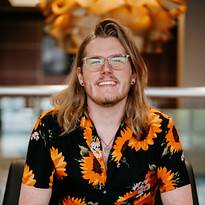
Alec Schon
Alec Schon was originally studying to be a high school English teacher but later decided to pursue a degree in applied linguistics instead, in the computational linguistics and data science track. After working with Mythili Menon on her NSF-funded research project investigating cybersecurity and privacy, he’s thinking seriously about working in academia, to teach and research.
Menon, an associate professor of linguistics, is focusing on the refugee community with non-English speaking populations. Part of her work is conducting phishing studies—figuring out how emails trick people into revealing sensitive information, often with links to fake websites; vishing studies—how phone callers can extract personally identifiable information or money from others; and smishing studies—how people give sensitive information via text-based scams.
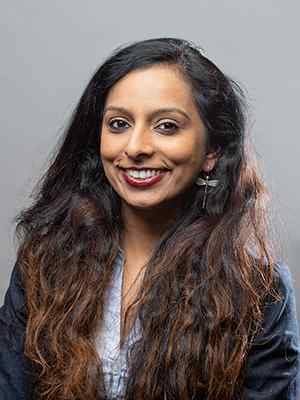
Mythili Menon
The enormous amount of data Menon has culled is where Schon comes in to help.
“I was responsible for generating some of the graphs and organizing the data,” Schon said. “I might spend 30 minutes trying to generate one graph, and at the end of writing the code I see the graph I produced looks like a real scientific paper graph. For me it’s been really satisfying, and I’m happy to be doing what I’m doing."
The work has also enhanced his classroom experience.
“The research projects have been sort of the way I’ve gotten extracurriculars in college and become engaged in class,” Schon said. “In the same way that school clubs are supposed to help students feel engaged in college, research projects help the whole college experience.
“Getting involved in a project that I can see the benefit of, and it feels like I'm doing real work—my going to school under that lens really changes the way,” Schon said. “It makes doing schoolwork easier because it feels like college is more career oriented. I can see the application of everything and what I want to do with my life, and that makes college a lot more fun.”
Menon enjoys working with undergraduate students because of their thirst and curiosity to learn new things.
“Anybody who’s taken a class with me knows this: I love when my students do original research. That’s something that I always push my students to do,” Menon said. “This is different from a lot of English classes. You have to go into the field, create a hypothesis, get the data, analyze the data. It’s a research skill set that a lot of my students don’t possess when they come to my class. They can take the final project, maybe refine it a little and then submit it as a writing sample, which is really competitive in Ph.D. programs.”
Schon is included as a co-author on two journal manuscripts that are under review. Menon said she hopes that she and Schon will give paper presentations at computer science conferences, as her NSF grant is funded by the Division of Computer and Network Systems.
Funding support
Amezcua-Cabrera's paid work on the Etzanoa project is funded by the David and Sally Jackman Endowment for Anthropology. Monies may be used to fund experiments, training, equipment and scholarships.
Hubble’s paid work is funded through Kapildeb Ambal’s National Science Foundation grant “Understanding and controlling decoherence in hybrid spin quibit-magnon systems for advancing education and building workforce in emerging quantum technologies.” Jian Wang and Abdelghani Laraoui, assistant professor of mechanical and materials engineering at the University of Nebraska—Lincoln, are co-principal investigators.
Schon’s paid work is funded through Mythili Menon’s National Science Foundation grant “Studying social engineering attacks targeting vulnerable refugee populations.” Murtuza Jadliwala, associate professor of computer science at the University of Texas at San Antonio, is the co-principal investigator.
WICHITA STATE’S URECA HELPS UNDERGRADUATES DISCOVER RESEARCH EXPERIENCES
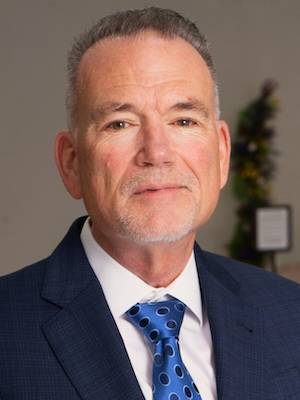
Michael Birzer
Undergraduate students are finding more ways to become involved in research experiences.
Helping undergraduate students learn about these opportunities and potentially matching them with faculty researchers is one of many roles for the Undergraduate Research and Creative Activity Hub. Located in Ablah Library and administratively housed under the Dorothy and Bill Cohen Honors College, the hub opened late last fall.
“When we think about research, we always think about graduate students, and undergraduates are left out of that equation,” Michael Birzer said. “And really, they shouldn’t be.”
Birzer, a professor of criminal justice, serves as the director of the hub, also referred to as UReCA.
“Research experience and creative activities being mentored by faculty really should start at the undergraduate level,” Birzer said. “We’re matching up students with faculty across disciplines who want to take on students to mentor. We also have a couple of groups now doing focus groups all semester. They’re going to learn how to work together as a team, how to code data, how to write up analytic memos and other research processes. Those are skills they can take directly into the workforce.”
“Undergraduate research is an important category of applied learning, which Wichita State promises to include in all degree programs,” David Eichhorn, interim dean, said. “It allows students to utilize classroom knowledge and skills to solve real problems.”
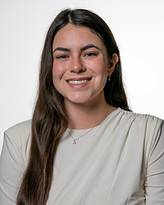
Estella Armenta
Students who use the hub will find plenty of support in their research journey. Working alongside Birzer is Estella Armenta, an academic program specialist. She manages the Connection database, named for the mentoring program which will match faculty and students with shared research interests. She also coordinates the Lunch and Learn series where students can hear about on-campus resources such as the Innovation Hub or the Gateway IP program, which provides students with opportunities to gain intellectual property skills.
“We want to bridge into workshops for faculty to best support undergraduate research,” Armenta said.
Wichita State aims to reach the Carnegie Classification Research 1 status, which signifies funding and expenditures of at least $50 million annually on research and the awarding of 70 or more research doctorates. Birzer believes that UReCA will play a vital role in supporting that goal.
“We can document the number of undergraduate students that are involved in research or creative activities with faculty and how many of those students end up in our graduate programs at Wichita State,” Birzer said. “We’re going to start tracking that as an outcome measurement. We can think of ourselves as boosting our undergraduates and then keeping them here.”
Every discipline lends itself to research or creative activity that can engender faculty-student mentoring, Birzer said.
“You think about the STEM fields and social sciences and behavioral sciences, but humanities? They do research as well," Birzer said. “It’s just another type of research or a different way to do research. They might launch the project and be very self-directed but then come to the faculty member when they get hung up. That’s a type of research that we support as well.”
Dean's Message
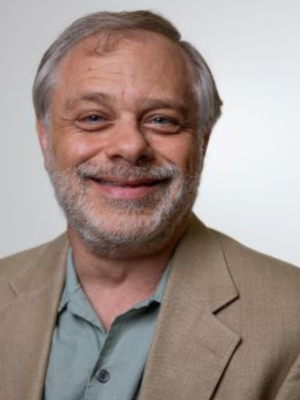
David Eichhorn
Dear Fairmount College faculty, staff, alumni and friends:
This past month, Fairmount College has hosted or participated in a number of events that involve outreach to students. On April 5, mathematics and statistics faculty members hosted Sonya Kovalevsky Day – engaging students from elementary school through high school in a day of exploring math. On the same day, the Kansas Science Olympiad was held on campus, bringing regional winners from middle schools and high schools across Kansas to Wichita State to compete for the right to represent Kansas at the national event.
On April 15 – 16, the Division of Physics hosted David Charbonneau from Harvard University as a Watkins Visiting Professor. Charbonneau was the third Watkins Professor this year as we celebrated the 50th anniversary of this prestigious program. He was preceded in February by Evan Williams from the University of California, hosted by the Department of Chemistry and Biochemistry and in March by Janet Iwasa from the University of Utah. Iwasa’s visit was especially interesting, as it featured her celebrated work as a scientific animator and was co-sponsored by Fairmount College and the College of Fine Arts’ School of Digital Arts and Art, and School of Design and Creative Industries. The Watkins Professorships always include a public lecture designed to appeal to the non-expert and is advertised to the community. In the case of Iwasa’s visit, we also partnered with two faculty members in the College of Engineering as part of a grant from NASA to engage a group of high school students to attend her lecture and interact with the accompanying exhibit.
The above is not intended as a comprehensive list of Fairmount College’s activities in this arena, but it represents a snapshot of the kinds of things that we do to help develop a love of learning and an appreciation of exploration from an early age. These examples were all from the natural sciences and math, but our faculty in the humanities and social and behavioral sciences sponsor similar activities throughout the year.
Once students arrive on campus, it is important to help them engage with their studies in ways that go beyond classroom instruction and provide skills and experiences that will benefit their future. This goal is the basis of Wichita State’s pledge to provide every graduate with an applied learning experience. For many departments in Fairmount College, the opportunity to engage in faculty-led undergraduate research is an important and impactful applied learning option. There are many campus resources to help students engage in undergraduate research, including the new Undergraduate Research and Creative Activity Hub and the First Year Research Experience—both of which are led by Fairmount College faculty—the Kansas Idea Network for Biomedical Research Excellence, the McNair Scholars Program, and the Undergraduate Research and Creative Activities Forum.
Undergraduate research provides students with a myriad of benefits. Fundamentally, engaging in a research project allows them to apply the knowledge and skills they learn in the classroom. In addition, they work closely with faculty mentors, establishing relationships that will nurture them throughout their educational career. Undergraduate research projects can lead to journal publications, conference presentations, and industry collaborations. Participation in undergraduate research can help a student stand out in applications to graduate schools and professional schools and on the job market. And many of our undergraduate researchers are paid for their work. In this issue, we highlight some of the exciting research collaborations between Fairmount College undergraduate students and their faculty mentors. As you read these stories, you will appreciate the fantastic opportunity this provides our students as they continue on their journey to Become More.
Yours,
David Eichhorn, Interim Dean
Fairmount College inducts two alumni into 2025 Hall of Fame
The Fairmount College of Liberal Arts and Sciences inducted two of its alumni into its Hall of Fame on Feb. 4. Induction into the Hall of Fame is the highest recognition of outstanding Fairmount College alumni who have had a significant impact on the region, nation and world.
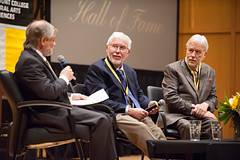
Interim Dean Eichhorn leads the panel of 2025 Hall of Fame Honorees
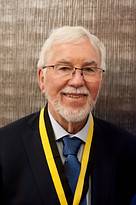
William E. Simon
William E. Simon (1970,1971, BA-Physics and Mathematics, MS-Physics) founded Sun Nuclear Corporation, which specializes in medical physics in radiation oncology.
A native Kansan, Simon grew up in a farming community west of Wichita. When he came to Wichita State as a freshman, he discovered the mathematics and physics programs to be small, nurturing environments. In particular, he found the close relationships between faculty and students in the physics department advantageous for developing self-confidence. Two physics faculty members, Skip Loper and Don Foster, motivated him and supported him throughout his undergraduate and graduate programs.
He moved with his wife, Cathy, to Cleveland for additional study at Case Western Reserve. When his academic plans changed, Simon began his career trajectory in medical physics and radiation safety at Victoreen, Inc., a company that produced radiation measuring products. During his time there, he invented a non-invasive method to measure the high voltage in x-ray machines.
In 1984, the Simons and a colleague started Sun Nuclear Corporation. Its earliest product was At Ease, the world’s first digital and reusable continuous radon monitor available in the marketplace. Ten years later, Sun Nuclear refocused its attention on medical physics in radiation oncology and became a leader in the design and manufacture of quality systems for radiation measurement. Over the years, Simon and his team developed many innovative devices and products that measured the dynamic radiation dose shape relative to the cancerous tumor and the healthy tissue. This work led to improvements in radiation transport calculations in treatment planning software provided by Varian, Elekta and Siemens—three of the largest providers of medical products and services for cancer therapy. Simon is listed as the single or co-inventor for numerous patents with the United States Patent and Trademark Office.
The World Health Organization reports that one in five people will develop cancer in their lifetime, and in 2022, twenty million new cases were reported. Sun Nuclear, now a Mirion medical company, is ranked as the worldwide market leader in radiation oncology quality assurance. More than 5,000 cancer treatment facilities worldwide and more than 90% of cancer treatment centers in the United States use Sun Nuclear products.
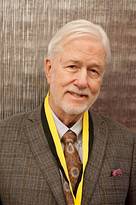
Mark G. Wentling
Mark G. Wentling (1970, BA- Political Science, Economics and Anthropology) spent more than 40 years as an international development and humanitarian assistance specialist, working primarily in Africa for the Peace Corps and the United States Agency for International Development.
After his boyhood in El Dorado and Udall, Wentling enrolled at Wichita State. He began his lifelong career of service before he graduated, serving as a Peace Corps volunteer in Honduras for two years. After graduating in 1970, he returned to the Peace Corps as a volunteer in Togo, and additional assignments followed for Gabon and Niger. They were the first of his many career appointments on the African continent.
Wentling continued his work in international development and humanitarian assistance, and in 1977, accepted an appointment as a foreign service officer with USAID. He held several subsequent positions with USAID, CARE International, World Vision, and Plan International, which made it possible for him to work in or visit all of Africa’s 54 countries. His final positions with USAID took him to Cambodia and Nepal, and in 2015, Wentling returned to the United States. He now works as a senior consultant for Africa with Breedlove Foods in Lubbock, Texas, a commercial-sized nonprofit food processor dedicated to humanitarian aid.
Over his career, Wentling gained in-depth experience in agriculture, biodiversity, natural resources management, health, nutrition, food, governance, and conflict response. His work on the Niamey Department Project resulted in a Superior Honor Award from USAID and commendation from the government of Niger. He received acclaim from USAID, the U.S. Department of State and the government of Guinea for his work with private investment promotion, agribusiness, local farmers and food aid. His work in Togo and Benin aiding with population, child survival, export promotion and agricultural policy reform, earned meritorious awards from USAID and the U.S. ambassadors to both countries. His participation in peace talks with warlords in Somalia, Kenya and Ethiopia received high praise from the U.S. Special Envoy to Somalia. More recently, in 2014, Wentling received Wichita State’s Alumni Achievement Award. He is the author of 12 books.
Wentling also holds a master’s degree in international agricultural development from Cornell University. He completed a master’s course of study on security and international strategic issues at the National War College.
Student Accolades
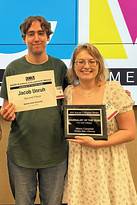
Jacob Unruh and Allison Campbell
Allison Campbell, senior in journalism and media production and editor-in-chief for The Sunflower, was named Journalist of the Year by Kansas Collegiate Media. Jacob Unruh, senior in journalism and sports editor, earned second place.
Julie Tran, senior in chemistry, was selected for the RosaLee and Alvin Sarachek Award for Scholarly Excellence in the Natural Sciences.
Arland Wallace, senior in anthropology, was named Adult Learner of the Year by the Office of Adult Learning.
The Debate Team concluded its season at the 79th Annual National Debate Tournament in Spokane, Washington.
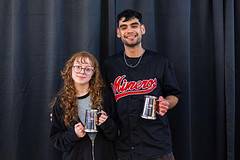
Debate Partners Marianne Griffith and Miguel Molina-Chavez
Marianne Griffith, freshman in communication, and Miguel Molina-Chavez, senior in psychology, ended preliminaries with a record of 4-4, one win short of making it to elimination rounds.
Grace McManus, senior in political science, and Sean Wentling, senior in enconomics, attended the Cross Examination Debate Association in New York, with a record of 4-4, one win short of making it to elimination rounds.
In March, several staff of The Sunflower attended the Associated Collegiate Press Spring National College Media Conference. Allison Campbell served on a panel of editors-in-chief. Ad Manager Kiona Brown served as an event intern for the conference of 800 people. The Sunflower picked up additional awards, which included: second place, Best of Show, website (4-year large schools); third place, Best of Show, advertising media kit; and, second place, Best of Show, feature writing by Allison Campbell, Ainsley Smyth and Maleah Evans for the issue commemorating James Rhatigan, dean of students and senior vice president emeritus, who died in October. For coverage of the American Airlines 5432 crash, additional ACP awards included: People’s Choice, newspaper; second place, Best of Show, newspaper (4-year large schools); and first place, Best of Show, newspaper design by Taliyah Winn and Emma Wilkes. The Sunflower was also honored as one of 31 Online Pacemaker finalists, ACP’s preeminent award.
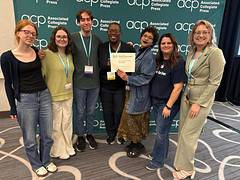
The Sunflower Staff accept their Associated Collegiate Press Awards from Tamara Zellers Buck, ACP Board Member, Center. Ainsley Smith, Kiona Brown, Jacob Unruh, Taliyah Winn, Amy DeVault (Advisor) and Allison Campbell atended the conference.
Science students earn recognition
Two Fairmount College students were among the 26 students recognized at the 23rd annual Kansas IDeA Network of Biomedical Research Excellence Symposium in Kansas City, Missouri. Mark White, senior in biochemistry, received the Award of Excellence. He gave the poster presentation, “Using FRET to Assess Conjugate Binding of Anthrax Toxin’s PA and Antigen Spy0469.” Jim Bann, associate professor of biochemistry, is his advisor. Julie Tran, senior in chemistry, received an honorable mention. She gave the poster presentation, “Structural Elucidation of the Ig3 Domain of Myopalladin by NMR.” Moriah Beck, professor of biochemistry, is her advisor.
Several more Fairmount College students demonstrated their expertise in their fields at the annual Kansas Academy of Science and Central States Entomological Society meetings at Friends University. Among the students who presented, two groups were awarded first place honors for their research:
Brooks Hartsock, graduate student in physics with Nick Solomey, professor of physics, gave a presentation on his research, “Designing a Low-Background Solar Neutrino Detector,” and was awarded $300 for best oral presentation.
Vee Disbro, junior; Syd Downey, junior; Melissa Hernández, senior; and Leónidas Reyes, senior, with Mary Liz Jameson, professor of biological sciences, presented their poster, “Antennae Up! Can Nitrogen Addition Help Reverse Insect Herbivore Declines?” and were awarded $150 for best poster presentation from CSES.
Senior Honors Awards
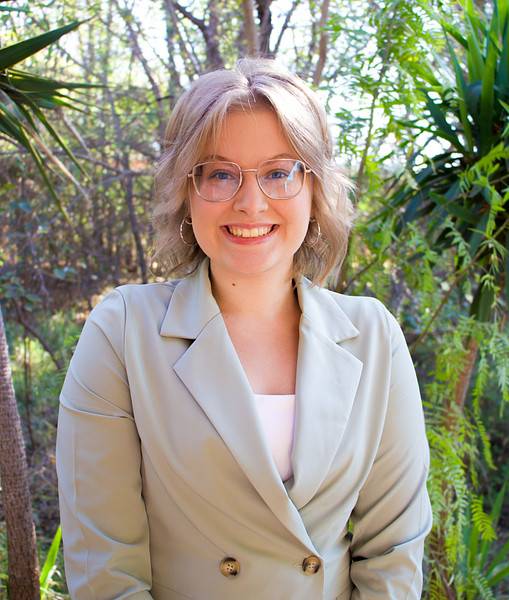
Allison Campbell is a senior studying journalism and media production with a minor in English. She began her journalism career at her hometown newspaper, The Holton Recorder. Since then, she has served as the news editor and editor-in-chief of Wichita State’s student newspaper, The Sunflower. She enjoys writing features, taking photos and covering breaking news. For her work with The Sunflower, Kansas Collegiate Media named Campbell the 2025 Kansas College Journalist of the Year. After graduating, she hopes to pursue a career in journalism, providing invaluable coverage of the stories that matter most.
Vanessa Cheok, senior in philosophy with a minor in creative writing, works as the tutor for all logic courses offered by the philosophy department. She regularly participates in the Philosophy Society and in all philosophy departments functions and events. She excels academically, earning top marks in her courses and a place on the Dean’s Honor Roll. She was awarded the 2024 History of Philosophy Scholarship for her essay, “The Argument of Free Will in Physics.”
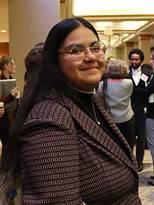
Ayleen Escobedo, senior in political science and women's, ethnicity, and intersectional studies, is a first-generation student and second-generation immigrant. During her time as a student at WSU, she interned at the federal public defender's office in Wichita as an investigative intern, assisting lawyers in defending clients and participating in a court-watching program. Her leadership roles on campus include serving as vice president and president in the Model United Nations and the vice president of Pi Sigma Alpha, the national political science honors society. She received the full-ride Joan Hargrove political science scholarship. She plans to attend law school and is interested in constitutional law.
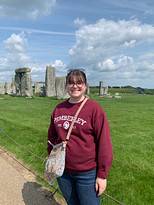
Natalie Feild, senior in English with a French minor. She is the president of the Alpha Theta Omicron chapter of Sigma Tau Delta, the international English honors society. She is also a member of Pi Delta Phi Epsilon Sigma chapter, the national French honors society. She is a recipient of the Folds of Honor scholarship as the daughter of a disabled veteran, as well as a member of the Dean’s Honor Roll for seven consecutive semesters. She will pursue a master’s degree in English literature at Wichita State with a focus on 18th and 19th century British literature.
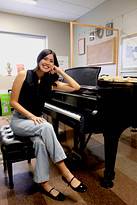
Annie Nguyen, senior in biochemistry pre-dental with a minor in music, has completed undergraduate research under Kandatege Wimalasena, professor of biochemistry. Here, she aided in investigating the causes of cell death involved in Parkinson’s disease, specifically with intracellular acidosis mediated tyrosine hydroxylase activation. She also studied piano under Julie Bees, professor of piano, and played in a chamber ensemble mentored by Leonid Shukaev, professor of cello. She has served as the president of the Pre-Dental Student Association and as a student officer at St. Paul Catholic Student Center. She also leads a bible study. After graduation, she will attend dental school at the Herman Ostrow School of Dentistry at the University of Southern California.
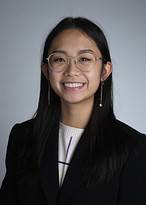
Julie Tran, senior in chemistry with a minor in computer science and mathematics, is a first-generation college student. She recognizes several mentors who helped her understand what kind of scientist and person she wanted to become. From torch-sealing delicate crystals as a first-year student in Jian Wang’s lab to troubleshooting protein purification in Moriah Beck’s lab, she feels immensely grateful for all the moral and financial support that helped her thrive as a student. She is the 2025 recipient of the RosaLee and Alvin Sarachek Award for Scholarly Excellence. After graduation she will study biomedical sciences at the University of Kansas Medical School.
Faculty and Staff Accolades
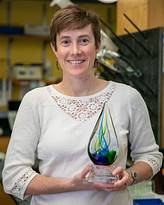
Moriah Beck, Talaty Endowed Research Professor of Chemistry and Biochemistry, received the Meridian Award from the Association for Women in Science for her dedication to research, mentorship, and advancing women in science.
Matthew Howland, assistant professor of anthropology, and colleagues Mohammad Najjar, assistant professor of management information systems; Brady Liss, University of Vermont; Ian Jones, New York University; Thomas Levy, University of California San Diego; and UCSD grad student Anthony Tamberino, awarded the Community Engagement and Public Outreach Award by the American Society of Overseas Research for their work sharing information about the archaeology of Jordan with public and Arabic-speaking audiences.
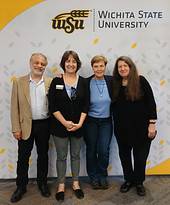
Mary Liz Jameson, professor of biological sciences, was elected as a fellow in the American Association for the Advancement of Science. One of the most distinct honors in the scientific community, the 2024 cohort of 471 fellows includes scientists, engineers, and innovators being recognized for their scientifically and socially distinguished achievements. Jameson was specifically recognized for “distinguished contributions to the field of entomology and an integrative approach to understanding species biodiversity.” She joins other AAAS fellows Coleen Pugh, professor of chemistry and dean of the graduate school, who was elected in 2010; and Susan Sterrett, Curtis D. Gridley Distinguished Professor in History and Philosophy, who was elected in 2016.

Mythili Menon, associate professor of linguistics, was an honoree for the 2025 Wichita Business Journal's 40 under 40 award.
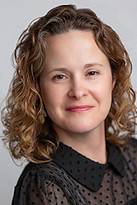
Jenny Pearson, professor of sociology, gave the presidential address, "The joy of sociology in an uncertain future: What we can learn from queer joy" at the 2025 annual meeting of the Midwest Sociological Society in Chicago.
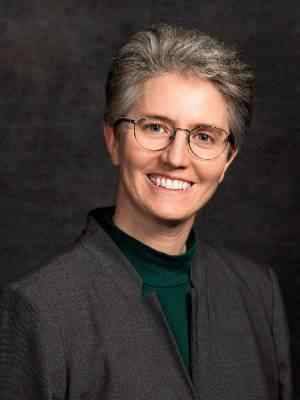
Carolyn Shaw, professor of political science, was elected to the Board for the Reacting Consortium. The consortium develops Reacting to the Past role-playing games to inform and transform student learning in higher education. These games support the achievement of critical thinking, historical and intercultural knowledge, empathy, leadership, integrative learning, effective communication skills, and intellectual curiosity among students.
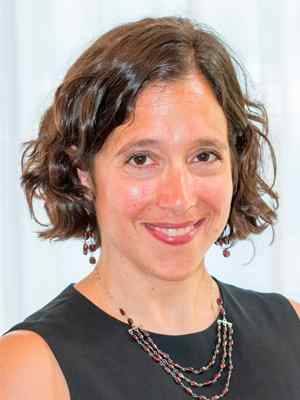
Rachel Showstack, associate professor of Spanish, delivered three invited keynote addresses: the Forging Linguistic Identities Conference at Towson University in Baltimore; the Graduate Students of Language at Temple Annual Conference at Temple University in Philadelphia; and the Graduate Applied Language Teaching Symposium at Kansas State University.
Rannfrid Lasine Thelle, associate professor of religion, was elected the 2025 President of Scholars of Biblical and Related Literatures, previously named the Society of Biblical Literature-Southwest Region.
Kelly Young, assistant educator in social work, gave the keynote address, “Navigating the shadows: Secondary trauma, moral injury, and the embodiment of trauma through the lens of intersectionality theory" for the 22nd Annual POWER Conference at Wichita State University.
College and University Awards
- Xiaolong Li, assistant professor of mathematics, Excellence in Research
Mary Liz Jameson, professor of biological sciences, Academy for Effective Teaching
President’s Distinguished Service Award
- Susan Castro, associate professor, philosophy
- BreAnn M. Gilkey, clinical professor, School of Social Work
- John Hammond, senior educator, mathematics
- Susan McCoy, laboratory coordinator, chemistry
John R. Barrier Award for Distinguished Teaching
- Xiufen Lu, associate professor of philosophy
In Memoriam
Derek Cornish, 85, died April 21, 2025. He served many years in the School of Criminal Justice as a visiting professor. He was a co-developer of the rational choice perspective in criminology.
Mary Nelle Rogers, 85, died Dec. 11, 2024. An instructor of French, she taught more than 20 years at Wichita State and was the lead author of Deux Mondes, the widely-used French college textbook.
Retirements
- John Dreifort, professor of history
- Keith Pickus, professor of history
- Syed Taher, associate professor of physics
- Brian Hepburn, associate professor of philosophy
- Jeffrey Hershfield, associate professor of philosophy
Correction
Twyla Hill, Jodie Hertzog and Derek Wilson won the 2024 Issues in Aging National Council on Family Relations Focus Group Award for their paper “Computers and connectedness: Digital technology and relationships in later life.” Hill and Hertzog are professor and associate professor of sociology, respectively; Wilson is an assistant professor of sociology at Midland University. We regret the error.
Annual Report
Academic initiatives
Aug. 1, 2024 – July 31, 2025
- Associate of Science degree
- Graduation competencies
- Communication (open emphasis) track for the LEAD 3+3 program with the University of Kansas School of Law
- New 3+4 partnership with the Kansas College of Osteopathic Medicine
- Criminal intelligence track for the bachelor of arts in criminal justice
- Minors in text technologies and professional writing and editing, both offered by the Department of English
- Undergraduate certificate in health equity and leadership, offered by the Department of Sociology
- Graduate certificate in law enforcement and in local government administration, offered through the School of Criminal Justice
- Field major in Women’s, Ethnicity, and Intersectional Studies
Academic programs offered
Aug. 1, 2024 – July 31, 2025
- 2 associates
- 58 bachelors
- 21 masters
- 3 doctorates
- 30 certificates
The Fairmount College of Liberal Arts and Sciences continues to grow and provide new academic program offerings.
Our graduates complete their programs having gained the hard-earned skills of critical thinking, analyzing, problem-solving, collaborating, listening and communicating. Our students are equipped to pursue a lifetime of fulfillment in the workplace and in society.
About the college
- 37 student organizations
- 9 centers and institutes
- 18 departments:
- 5 Humanities
- 8 Social/Behavioral Sciences
- 5 Natural Sciences/Mathematics
Faculty
Jan. 24, 2024
- 191 faculty
- 133 tenured or tenure-track
- 58 non-tenure track
Students
Sept. 16, 2024
- 6,520 total students
- 6,027 undergraduates
- 38,110 credit hours
- 493 graduates
- 3,848 credit hours
As the largest college at Wichita State University, we offer the greatest diversity of programs, so all students can find something to fit their interests. For those who want a more individualized program of study, academic advisors can help students tailor a bachelor of general studies degree or a field major — both of which include focus on three content areas.
Undergraduate major headcounts by division
Sept. 16, 2024
- Humanities: 244
- Social/Behavioral Sciences: 1,461
- Natural Sciences/Mathematics: 609
Undergraduate degree production by college division
Aug. 1, 2023 – July 31, 2024
- Humanities: 54
- Social/Behavioral Sciences: 395
- Natural Sciences/Mathematics: 119
- LAS Other*: 207
* Interdisciplinary degrees, bachelor and associate degrees not affiliated with a department.
Ways We Support Students Outside of the Classroom
Liberal Arts and Sciences Advising contacts
Jan. 1 – Dec. 31, 2024
- Advising appointments: 5,978
- Triage meetings: 478
- Campus visits: 106
Our academic advisors do more than show students how to build schedules. They also help students understand the purposes of higher education; define and develop unique abilities, goals, and aspirations; clarify values and educational and life goals; define realistic academic and professional goals; and create an individual academic plan of study for the student’s selected major. The LAS Advising Center offers in-person and virtual advising appointments.
Scholarships awarded
Aug. 1, 2022-July 31, 2024
- 2024: $803,473 — 482 awards
- 2023: $811,326 — 480 awards
- 2022: $775,971 — 430 awards
Scholarship support can make the difference for students who want to enroll in college. Our generous donors have made scholarships possible for hundreds of students.
Fundraising
July 1, 2023 to June 30, 2024
- Undergraduate scholarships (current plus endowed): $5,471,603
- Graduate assistantships and fellowships: $91,928
- Other program initiatives: $854,235
Other program initiatives include projects that are not in direct assistance to students, faculty or staff, such as a speaker series or providing lab equipment.
Thank you for your financial support of Fairmount College!
Social media
Followers or subscribers as of April 10, 2025
- Facebook, started in 2015: 972
- Instagram, started in 2023: 300
- X/Twitter, started in 2016: 372
- YouTube, started in 2020: 74
We use social media channels to inform our followers of upcoming events, study tips, majors and careers, important deadlines, and current event discussions.
Faculty awarded grants
July 1, 2023 – June 30, 2024
- External awards: $9,488,138
- Internal awards: $79,499
|
Principal Investigators |
Department or unit |
Funding agency |
Amount in $ |
|
Amy Alberton/Jodie Hertzog |
School of Social Work/Sociology |
Natural Sciences and Engineering Research Council of Canada |
11,505 |
|
Kapildeb Ambal/Jian Wang |
Physics/Chemistry and Biochemistry |
National Science Foundation |
480,000 |
|
George Bousfield |
Biological Sciences |
National Institutes of Health |
2,236722 |
|
Tonya Bronleewe |
Environmental Finance Center, Hugo Wall School |
Kansas Department of Health and Environment |
758,607 |
|
Tonya Bronleewe |
Environmental Finance Center, Hugo Wall School |
Environmental Protection Agency |
1,388,394 |
|
Brendan Clark |
Psychology |
Regional Institute on Aging |
5920 |
|
Mai Dao/Holger Meyer |
Mathematics, Statistics and Physics |
PetroPower |
20,308 |
|
Zelalem Demissie |
Geology |
National Science Foundation |
66,826 |
|
Crystal Dozier |
Anthropology |
City of Belle Plaine, Gray and Pipe Heritage Management, PEARL |
19399 |
|
Crystal Dozier/Matthew Howland |
Anthropology |
City of Bentley, Reno County |
14,938 |
|
Terrance Figy |
Physics |
National Science Foundation |
50,000 |
|
Rachael Goodman-Williams |
Psychology |
Department of Justice |
411,943 |
|
David Guo |
Hugo Wall School |
City of Kechi |
18,416 |
|
Bill Hendry |
Biological Sciences |
National Institutes of Health |
123,618 |
|
Greg Houseman |
Biological Sciences |
Department of Agriculture |
302,434 |
|
Matthew Howland |
Anthropology |
National Park Service |
11,711 |
|
Kyoung Lee |
School of Social Work |
Regional Institute on Aging |
5440 |
|
Quan Lei |
Psychology |
National Institutes of Health |
55,516 |
|
Xiaolong Li |
Mathematics and Statistics |
National Science Foundation |
359,927 |
|
Raj Logan |
Biological Sciences |
National Institutes of Health |
135,828 |
|
Tom Luhring |
Biological Sciences |
National Science Foundation |
802,982 |
|
Lisa Parcell/Jeff Jarman |
The Research Partnership/Elliott School of Communication |
IMS Consulting, KLC, Sound Jury Consulting, Tsongas, WAA |
74,310 |
|
Mark Schneegurt/Rouwen Shen |
Biological Sciences/Hugo Wall School of Public Affairs |
National Science Foundation |
202,147 |
|
Catherine Searle |
Mathematics and Statistics |
National Science Foundation |
86,009 |
|
Rachel Showstack |
Modern and Classical Languages and Literatures |
Department of Health and Human Services |
300,000 |
|
Rachel Showstack |
Modern and Classical Languages and Literatures |
Kansas Health Foundation |
95,968 |
|
Nick Solomey/Holger Meyer |
Physics |
National Aeronautics and Space Administration |
108,031 |
|
Jian Wang |
Chemistry and Biochemistry |
National Science Foundation |
238,288 |
|
Xiaoheng Wang |
Hugo Wall School of Public Affairs |
National Science Foundation |
80,602 |
|
Haifan Wu |
Chemistry and Biochemistry |
National Institutes of Health |
49,950 |
|
Shang-You Yang |
Biological Sciences |
Flossie E. West Memorial Trust |
14,512 |
|
Li Yao |
Biological Sciences |
Flossie E. West Memorial Trust |
41,000 |
Faculty productivity
Jan. 1 – Dec. 31, 2024
Just as students are expected to engage in activities that support their learning, faculty are expected to remain at the forefront of their research and creative activity. They are also expected to procure funding to support it. Fairmount College faculty have much knowledge to share and strive to add to the knowledge base.
Books
Department of Chemistry and Biochemistry
- Alliston, K., English, D. (2024). Chemistry Lab Manual. New York, NY: Hayden-McNeil.
School of Criminal Justice
- Birzer, M., Holland, R. (2024). A Criminological Guide and Theoretical Exploration of Serial Killers and Infamous Murders (2nd ed.). Dubuque, Iowa: Kendall Hunt.
- Yu, S. D. (2024). Risk management for homeland security. Kindle Publishing.
Department of History
- Owens, R. M. (2024). Killing Over Land: Death and Diplomacy on the Early American Frontier. University of Oklahoma Press.
- Singletary, J.; Cooley, J., and Lasine Thelle, R.I. (eds.) (2024). Advances in Ancient Biblical and Near Eastern Research. Vol. 4, No. 2; Special Issue: Hope.
Department of Mathematics, Statistics and Physics
- Steck, J., Thompson, N., Behrman, E. (2024). Programming Quantum Hardware Via Levenberg-Marquardt Machine Learning. Intelligent Quantum Information Processing (pp. 106-127).
Department of Modern and Classical Languages and Literatures
- Showstack, R., Pascual y Cabo, D., Wilson, D. (2024). Language Ideologies and Linguistic Identity in Heritage Language Learning. Routledge.
Department of Political Science
- Azpuru, D. (2024). Explaining Support for Populism in Contemporary Latin America. London: Routledge.
- Shaw, C. (2024). Cooperation, Conflict, and Consensus in the Organization of American States. New York, NY: Palgrave Macmillan.
Department of Women’s, Ethnicity and Intersectionality Studies
- Okafor, C. (2024). The Gender of Second Chance. Ado Ekiti: Rhema Academic Publishers.
Book Chapters
Department of English
- Behrens, M. (2024). Shaftesbury, women writers, and deism. In H. F. Nelson and A. Johnson (Eds.), Negotiating feminism and faith in the lives and works of late medieval and early modern women (pp. 83–104). Amsterdam University Press.
Department of Mathematics, Statistics and Physics
- Dao, D., Dao, M. (2024). Enhancing communication strategies in online courses: Perceptions from instructors at a university in Iowa. In R. Blankenship and T. Cherner (Eds.), Research Highlights in Technology and Teacher Education 35th Anniversary Edition, Volume 2 (vol. 2). Association for the Advancement of Computing in Education.
- Grady, D. (2024). The geometric cobordism hypothesis. Encyclopedia of Mathematical Physics, 2nd Edition (vol. 4, pp. 145-158). Elsevier.
Department of Modern and Classical Languages and Literatures
- Showstack, R. (2024). Open science and accessible research. In L. Plonsky (Ed.), Open Science in Applied Linguistics. Applied Linguistics Press.
Department of Political Science
- Allen, N. (2024). Jim Wright and civil rights: Gradual support in the face of constituent opposition. In J. Riddlesperger and A. Champagne (Eds.), Reflections on Wright: Essays on the Legacy of Speaker Jim Wright, (pp. 60-84). Ft. Worth, TX: Texas Christian University Press.
Department of Psychology
- Low, S., Gregus, S., Van Ryzin, M. (2024). How innovative instructional methods can reduce victimization: Considerations for novel intervention targets. Handbook of School Violence, Bullying, and Safety (pp. 542-555). Elgar Handbooks in Education.
School of Social Work
- McLeod, D.A., Ozturk, B., (2024). Domestic and relational violence. In McLeod, D.A., Natale, A.P., and Mapson, K.W. (Eds). The handbook of forensic social work: Theory, policy, and fields of practice New York: Oxford Academic.
- McLeod, D.A., Dunnells, Z., Ozturk, B. (2024). Women in forensic settings. In McLeod, D.A., Natale, A.P., and Whitehill-Bolton, K. (Ed.) The handbook of forensic social work: Theory, policy, and fields of practice. Chicago, IL: Oxford Academic.
- McLeod, D.A., Ozturk, B., Dunnells, Z. (2024). Ethics in forensic settings. In McLeod, D.A., and Natale, A.P., Bolton, K. (Ed.) The handbook of forensic social work: Theory, policy, and fields of practice. Chicago, IL: Oxford Academic.
Department of Women’s, Ethnicity and Intersectionality Studies
- Okafor, C. (2024). The politics of gender and colour in Nawal El Saadawi's woman at point zero and a daughter of ISIS. In Ogbijah, C. and Diala-Ogumba, B. (Eds.) Deconstructing boundaries. (pp. 236-250). Ibadan: University Press. 978 978 940 9990
Journal articles
Department of Anthropology
- Thompson, V., Sanger, M., Smith, K., Garland, C., Howland, M. (2024). Shellfishing, sea levels, and the earliest Native American villages (5000–3800 yrs. BP) of the South Atlantic Coast of the US. Scientific Reports (14).
- Garland, C., Thompson, V., Howland, M., Gragson, T. L., Andrus, C. Fred T., Demyan, M., Parbus, B. (2024). Stable isotope analysis and chronology building at the Hokfv-Mocvse Cultural site, the earliest evidence for South Atlantic shell-ring villages. American Antiquity (2024): 1-20.
- Howland, M., Thompson, V. (2024). Modeling the potential impact of storm surge and sea level rise on coastal archaeological heritage: A case study from Georgia. PLoS ONE, 19(2), e0297178.
- Di Chiara, A., Tauxe, L., Gries, H., Helwing, B., Howland, M., Ben-Yosef, E. (2024). An archaeomagnetic study of the Ishtar Gate, Babylon. PLoS ONE, 19(1), e0293014.
- Kreinath, J. (2024). In search for human dignity: The earthquakes of February 6, 2023, and their impact on interreligious relations in Antakya, Hatay. Mission Studies, 41(3), 442-480.
Department of Biological Sciences
- Markley, M., Altergott, E., Beck, J. (2024). The Japanese climbing fern (Lygodium japonicum) invasion in the United States: Insights from chloroplast genome sequencing. NeoBiota, 95, 97-107.
- Bousfield, G. (2024). Differential effects of follicle-stimulating hormone glycoforms on the transcriptome profile of cultured rat granulosa cells as disclosed by RNA-seq. PloS One, 19(6), e0293688.
- Kjaer, E. L., Houseman, G., Luu, K. N., Foster, B. L., Laanisto, L., Golubski, A. J. (2024). Spatial pattern of seed arrival has a greater effect on plant diversity than does soil heterogeneity in a grassland ecosystem. Plant and Soil, 502(1-2), 557-572.
- Watson, F., Houseman, G., Jameson, M., Jensen, W., Reichenborn, M., Morphew, A., Kjaer, E. (2024). Short-term cattle grazing effects on restored Conservation Reserve Program grasslands across a steep precipitation gradient. Rangeland Ecology and Management, 94, 38-47.
- Bento, M., Jameson, M., Grossi, P., da Fonseca, C. R. (2024). Revision of the Neotropical tribe Alvarengiini Frey, 1975 (Coleoptera: Scarabaeidae). Austral Entomology, 63(1), 12-48.
- Peng, D., Jackson, D., Palicha, B., Kernfeld, E., Laughner, N., Shoemaker, A., Celniker, S. E., Loganathan, R., Cahan, P., Andrew, D. J. (2024). Organogenetic transcriptomes of the Drosophila embryo at single cell resolution. Development, 151(2).
- Sawli, P., Buchheim, M., Schneegurt, M. (2024). Molecular analysis of the microbial guild fixing nitrogen in ricefield soils in Missouri. Microbiology Research, 15, 841-849.
- Carte, M., Chen, F., Clark, B., Schneegurt, M. (2024). Succession of the fungal community of a spacecraft assembly cleanroom when enriched in brines relevant to Mars. International Journal of Astrobiology, 23, e15.
- Carte, M., Chen, F., Clark, B., Schneegurt, M. (2024). Succession of the bacterial community from a spacecraft assembly cleanroom when enriched in brines relevant to Mars. International Journal of Astrobiology, 23, e5.
- Yao, L., Flynn, N., Kaphle, P. (2024). Effects of cell culture time and cytokines on migration of dental pulp stem cell-derived chondrogenic cells in collagen hydrogels. Physiological Reports, 12(18), e70063.
- Yao, L., Vishwa Sai, H., Shippy, T., Li, B. (2024). Cellular and transcriptional response of human astrocytes to hybrid protein materials. ACS Applied Bio Materials, 7(5), 2887–2898.
Department of Chemistry and Biochemistry
- Beck, M. R., Pahkrin, S. C., Chauhan, N., Khan, S., Upadhyaya, J., Blanco, E. (2024). Prediction of human O-linked glycosylation sites using stacked generalization and embeddings from pre-trained protein language model. Bioinformatics, 40(11).
- Beck, M. R., Palacios, A. V., Acharya, P., Peidl, A. S., Blanco, E., Mishra, A., Bawa-Khalfe, T., Pakhrin, S. C. (2024). SumoPred-PLM: Human SUMOylation and SUMO2/3 sites prediction using pre-trained protein language model. NAR Genomics and Bioinformatics, 6(1).
- Gong, Y., Gong, M. (2024). Sensitive detection of herbicide residues using field-amplified sample injection coupled with electrokinetic supercharging in flow-gated capillary electrophoresis. Analytical Methods, 16(14), 2025-2032.
- Groutas, W., Dampalla, C. S. (2024). Potent small molecule inhibitors against the 3C protease of foot-and-mouth disease virus. Microbiology Spectrum, 12(3). 1128/spectrum.03372-23.
- Thurman, H. A., Wijegunawardena, G., Berthias, F., Williamson, D. L., Wu, H., Nagy, G., Jensen, O. N., Shvartsburg, A. (2024). Multiplatform high-definition ion mobility separations of the largest epimeric peptides. Analytical Chemistry, 96(6), 2318-2326.
- Celona, B., Salomonsson, S. E., Wu, H., Dang, B., Kratochvil, H. T., Clelland, C. D., DeGrado, W. F., Black, B. L. (2024). Zfp106 binds to G-quadruplex RNAs and inhibits RAN translation and formation of RNA foci caused by G4C2 repeats. Proceedings of the National Academy of Sciences of the United States of America, 121(31), e2220020121.
- Liao, Q. Q., Shu, X., Sun, W., Mandapaka, H., Xie, F., Zhang, Z., Dai, T., Wang, S., Zhao, J., Jiang, H., Zhang, L., Lin, J., Li, S. W., Coin, I., Yang, F., Peng, J., Li, K., Wu, H., Zhou, F., Yang, B. (2024). Capturing protein-protein interactions with acidic amino acids reactive cross-linkers. Small (Weinheim an der Bergstrasse, Germany), 20(20), e2308383.
- Thurman, H. A., Wijegunawardena, G., Berthias, F., Williamson, D. L., Wu, H., Nagy, G., Jensen, O. N., Shvartsburg, A. (2024). Multiplatform high-definition ion mobility separations of the largest epimeric peptides. Analytical Chemistry, 96(6), 2318-2326.
- Shao, Y., Shu, X., Lu, Y., Zhu, W., Li, R., Fu, H., Li, C., Sun, W., Li, Z., Zhang, Y., Cao, X., Ye, X., Ajiboye, E., Zhao, B., Zhang, L., Wu, H., Feng, X. H., Yang, B., Lu, H. (2024). A chaperone-like function of FUS ensures TAZ condensate dynamics and transcriptional activation. Nature Cell Biology, 26(1), 86-99.
- Rabindra Basnet, Taksh Patel, Jian Wang, Dinesh Upreti, Santosh Karki Chhetri, Gokul Acharya, Md Rafique Un Nabi, Josh Sakon, Jin Hu (2024). Understanding and tuning magnetism in layered ising-type antiferromagnet FePSe3 for potential 2D magnet. 10.1002/aelm.202300738
School of Criminal Justice
- Davis, J., Birzer, M. (2024). An ethnographic study of police culture in a rural Kansas police agency. Policing: An International Journal, 47(3), 353-366.
- Suzuki, Y., Tapper, E. (2024). Insights on money mule cases. The FBI Law Enforcement Bulletin. September 9, 2024.
Elliott School of Communication
- Parcell, L. M. and Myers, P. (2024) Women’s entrée into advertising through the brand test kitchen. American Journalism. Vol. 41(3), 321-349.
- Samuels, P. (2024). Miscegenation and militarization: Undoing racial colonial citizenship for the next century. Quarterly Journal of Speech, 110(4), 643-648.
- Samuels, P. (2024). The merits of policy debate. Forensic of Pi Kappa Delta, 109(1), 54-69.
Department of English
- Boynton, T. (2024). Postcolonialism without colonialism: Remnants of a method. The Cambridge Journal of Postcolonial Literary Inquiry, 11(2), 264-269.
Department of Geology
- Demissie, Z., Rimal, P., Seyoum, W., Dutta, A., Rimmington, G. (2024). Flood susceptibility mapping: Integrating machine learning and GIS for enhanced risk assessment. Applied Computing and Geoscience, 23.
- Scruggs, M. (2024). A geodetically-constrained petrogenetic model for evolved lavas from the January 1997 fissure eruption of Kilauea Volcano. Journal of Petrology, 65, egae068.
Department of History
- Weems, R. (2024). The history of Black entrepreneurship in Chicago. History Today (Issue 72/Fall 2024).
Hugo Wall School of Public Affairs
- Abeygunawardane, S., Aravinthan, V., Wang, X., Pahwa, A., Singh, C. (2024). Examining power system resilience from the perspective of consumers: A review. IEEE Access, 12, 182972 - 182997.
Department of Mathematics, Statistics and Physics
- Lamichhane, S., Timalsina, R., Schultz, C., Fescenko, I., Ambal, K., Liou, S.-H., Lai, R. Y., Laraoui, A. (2024). Nitrogen-vacancy magnetic relaxometry of nanoclustered cytochrome C proteins. Nano Letters, 24(3), 873-880.
- B. Karki, R. Timalsina, M. Dowran, A. E. Aregbesola, A. Laraoui, and K. Ambal, (2024). Creation of high-density nitrogen-vacancy centers in CVD diamond using high-energy photons from Ar+ plasma. CLEO 2024, Technical Digest Series (Optica Publishing Group), paper JW2A.92.
- Lamichhane, S., Schultz, C., Timalsina, R., Fescenko, I., Ambal, K., Liou, S., Lai, R.Y., Laraoui, A. (2024). Magnetic sensing of iron in cytochrome C using diamond quantum sensors. SPIE PC12863, PC128630P.
- Lamichhane, S., Timalsina, R., Schultz, C., Fescenko, I., Ambal, K., Liou, S., Lai, R.Y., Laraoui A. (2024). Detection of Iron in Nanoclustered Cytochrome C Proteins Using Nitrogen-Vacancy Magnetic Relaxometry, Nano Lett. 2024, 24, 873.
- Steck, J., Behrman, E. (2024). Quantum generative adversarial networks: generating and detecting quantum product states. arXiv:2408.12620
- Fuentealba, D., Dahn, J., Steck, J., Behrman, E. (2024). Quantum neural network training of a repeater node. arXiv:2408.04709.
- Nola, J., Sanchez, U., Murthy, A. K., Behrman, E., Steck, J. (2024). Training microwave pulses using quantum machine learning. arXiv:2409.03861.
- Dao, M., Nguyen, L. (2024). Variable selection in macroeconomic stress test: A Bayesian quantile regression approach. Empirical Economics. 68. 1113-1169. 10.1007/s00181-024-02668-y.
- Chen, R., Dao, M., Ye, K., Wang, M. (2024). Bayesian adaptive LASSO quantile regression with non-ignorable missing responses. Computational Statistics. 40. 1643-1682. 10.1007/s00180-024-01546-6.
- Zhang, S., Dao, M., Ye, K., Han, Z., Wang, M. (2024). A novel Bayesian computational approach for bridge-randomized quantile regression in high dimensional models. Journal of Statistical Computation and Simulation, 2932-2951.
- Matheswaran, V., DeLillo, T., Miller, L. S. (2024). Vortex shedding from bluff bodies: A conformal mapping approach. Journal of Engineering Mathematics, 146(1).
- Chen, X., Ge, Z., Chen, Y., Bi, S., Yu, J., Yang, W., Ferguson, J., Wu, Y., Li, Y. (2024). VizieR Online Data Catalog: Ages, masses and kinematics of GALAH MS turnoff stars (vol. 929, pp. 124).
- Samarakoon, B., Figy, T. (2024). Double Higgs boson production via photon fusion at muon colliders within the triplet Higgs model. Physical Review D, 109(7), 075015.
- Nasser, M., Green, C. and Vuorinen, M. (2024). Fast computation of analytic capacity. computational methods and function theory. 1-28. 10.1007/s40315-024-00547-2.
- Green, C. C., Nasser, M. M. S. (2024). Towards computing the harmonic-measure distribution function for the middle-thirds Cantor set. Journal of Computational and Applied Mathematics, 448, 115903.
- Hamdeh, H. (2024). Impact of Ca2+, Ce3+ cooping on ZnSnO3-SnO2 heterostructure for dielectric, optoelectronic and solar cell applications. Journal of Electroanalytical Chemistry, 9522024) (117955).
- Hamdeh, H. (2024). Mossbauer spectral analysis and Rietveld structural refinement for cationic distribution of Cr-Co ferrites. Journal of Molecular Structure, 1297(136865).
- Li, X. (2024). Product manifolds and the curvature operator of the second kind. Pacific Journal of Mathematics, 332(1), 167-193.
- Li, X. (2024). Matrix Li-Yau-Hamilton estimates under Ricci flow and parabolic frequency. Calculus of Variations and Partial Differential Equations, 63(3).
- Li, X., Fluck, H. (2024). The curvature operator of the second kind in dimension three. Journal of Geometric Analysis, 34(6).
- Li, X., Zhang, Y. (2024). Kählerity of Einstein four-manifolds. Mathematische Zeitschrift, 307(1).
- Li, X. (2024). Manifolds with nonnegative curvature operator of the second kind. Communications in Contemporary Mathematics, 26(3).
- Li, X., Tu, Y., Wang, K. (2024). On a class of quasilinear operators on smooth metric measure spaces. Communications in Analysis and Geometry, 32(10), 2757-2803.
- Case, J., Khaitan, A., Lin, Y.J., Tyrrell, A., Yuan, W. (2024) Computing renormalized curvature integrals on Poincaré-Einstein manifolds. arXiv:2404.11319
- Lu, T. (2024). Isotropic random tangential vector fields on spheres. Statistics and Probability Letters, 213, 110172.
- Lu, T., Rahmati, S. (2024). Asymptotic errors in the superconvergence of discontinuous Galerkin methods based on upwind-biased fluxes for 1D linear hyperbolic equations. La Mathematica, 3, 536-560.
- Ma, C. (2024). Bifractional Brownian motions on metric spaces. Journal of Theoretical Probability, 37(2), 1299-1332.
- Muether, M., others (2024). Measurement of the double-differential cross section of muon-neutrino charged-current interactions with low hadronic energy in the NOvA near detector. arXiv:2410.10222
- Muether, M., others (2024). Expanding neutrino oscillation parameter measurements in NOvA using a Bayesian approach. Physical Review D, 110(1), 012005.
- Naqos, S., Murid, A., Nasser, M., Yeak, S. H. (2024). Computing the Dirichlet-to-Neumann map via an integral equation with the adjoint generalized Neumann kernel. Partial Differential Equations in Applied Mathematics, 12, 100967.
- Nasser, M. S., Green, C. C., Vuorinen, M. (2024). Fast computation of analytic capacity. Computational Methods and Function Theory, 23(4):456-484.
- Hakula, H., Nasser, M., Vuorinen, M. (2024). Mobile disks in hyperbolic space and minimization of conformal capacity. Electronic Transactions on Numerical Analysis, 60, 1-19.
- Sun, Z. (2024). A uniqueness theorem for inverse problems in quasilinear anisotropic media II. Inverse Problems and Imaging, 18(1), 104-112.
- Zeyani, A. (2025). Fekete-Szegö and second Hankel determinant for a certain subclass of bi-univalent functions associated with Lucas-balancing polynomials. International Journal of Neutrosophic Science, 25(03), 417-434.
Department of Philosophy
- Bondy, P. (2024). Can rational persuasion be epistemically paternalistic? Philosophy and Rhetoric, 57(3), 319-332.
- Hill, S. (2024). Against adoption based objections to procreation. Pacific Philosophical Quarterly. 10.1111/papq.12472
- Hill, S. (2024). Against the double standard argument in AI ethics. Philosophy and Technology. 37. 10.1007/s13347-024-00720-4.
- Hill, S. (2024). Algorithm evaluation without autonomy. AI and Ethics. 1-5. 10.1007/s43681-024-00499-2.
- Hill, S. (2024). Gaslighting and peer disagreement. Journal of Ethics and Social Philosophy, 26(3), 641-647.
- Hill, S. (2024). Particularism and the conventional wisdom. Social Epistemology Review and Reply Collective, 13(12), 12-24.
- Hill, S. (2024). The dominant ordinary use of “conspiracy theory” is narrow: A reply to Censon. Social Epistemology Review and Reply Collective, 13(4), 38-40.
- Hill, S. (2024). Where are the generalists? Social Epistemology Review and Reply Collective, 13(11), 30-35.
- Hill, S. (2024). The relevance of belief outsourcing to whether arguments can change minds. Proceedings of the Aristotelian Society. 124 (2):191-196.
Department of Political Science
- Amos, B., Gerontakis, S., McDonald, M. (2024). United States precinct boundaries and statewide partisan election results. Scientific Data, 11(1173).
- Amos, B., Middlewood, A. (2024). All eyes on Kansas: Voter turnout and the 2022 abortion referendum. American Politics Research, 52(5), 534-545.
Department of Psychology
- Chaudhary, N. (2024). A tale of two generations: Indian and Pakistani immigrant women’s negotiation of femininity. Asian American Journal of Psychology. 15. 308-318. 10.1037/aap0000346.
- Chaudhary, N. (2024). Examining meaning-making and decolonial resistance in Pakistani Women’s stories of navigating coloniality and gender. Feminism and Psychology, 207-227.
- Goodman-Williams, R., Volz, J., Smith, S. (2024). Do concerns about police reporting vary by assault characteristics? Understanding the non-reporting decisions of sexual assault victims who utilize alternative reporting options. Journal of Forensic Nursing, 20(3), 151-159.
- Goodman-Williams, R., Armenta, E. (2024). Sexual assault and domestic violence prevention programming during the pandemic: How prevention educators navigated COVID-19. Journal of Family Violence, 1-12.
- Campbell, R., Gregory, K., Engleton, J., Javorka, M., Goodman-Williams, R. (2024). "This time it was different:" Creating a multidisciplinary, trauma-informed, victim-centered approach to sexual assault cold case investigations and prosecutions. Journal of interpersonal violence. 8862605241284068. 10.1177/08862605241284068.
- Lei, Q., Gage, R., Kersten, D., Legge, G. E. (2024). The effect of illumination on the visibility of steps and ramps for people with low vision. Optometry and Vision Science, 101(6), 399-407.
- Ali, U., Cure Vellojin, L., Lewis, R., Rattani, A., Hill, T., Woods, N. (2024). Examining rurality and social determinants of health among women with GDM: A 15-year comprehensive population analysis. BMC Women's Health(24), 467.
- Lewis, R., Redger Marquardt, C., Fischer, K. Providing faculty to faculty support: Moving the service-learning needle: From limited exposure to implementing a campus-wide program. Journal of Higher Education Outreach and Engagement, 28(2), 5-22.
- Manriquez, A. L., Mankowski, E. S. Social ecological predictors and correlates of Latinos’ IPV behaviors: A systematic review and critique of the research literature. American Journal of Community Psychology, 0(0), 1-18.
- Manriquez, A. L., Mankowski, E. S. (2024). Latinos’ intimate partner violence, abuse, and interventions: Developing a LatCrit analysis and critique. Journal of Latinx Psychology, 1-13.
- Cui, Z., Sato, T., Jackson, A., Jayarathna, S., Itoh, M., Yamani, Y. (2024). Gaze transition entropy as a measure of attention allocation in a dynamic workspace involving automation. Scientific Reports, 14(1).
- Yamani, Y., Long, S. K., Sato, T., Braitman, A. L., Politowicz, M. S., and Chancey, E. T. (2024). Multilevel confirmatory factor analysis reveals two distinct human–automation trust constructs. Human Factors, 67(2), 166-180.
- Sato, T., Jackson, A., Yamani, Y. (2024). Number of interrupting events influences response time in multitasking, but not trust in automation. The International Journal of Aerospace Psychology, 34(4), 1-17.
- Larson, J., Gregus, S., Ali, E., McGill, S. K., Blackhurst, Z., Sensenbaugh, J., Klaus, N. (2024). Preliminary outcomes from an after-school treatment program for children with ADHD. Evidence-Based Practice in Child and Adolescent Mental Health, 1-14.
- Snodgrass, M.A., Smith, S.L., Gregus, S. (2024). Understanding children and adolescents' experiences being bullied: A mixed-methods study. Trends in Psychology. 10.1007/s43076-024-00385-0
- Steggerda, J. C., Kiefer, J. L., Vengurlekar, I. N., Hernandez Rodriguez, J., Pastrana Rivera, F. A., Gregus, S., Brown, M., Moore, F., Cavell, T. A. (2024). Moderators of the link between social preference and persistent peer victimization for elementary school children. Journal of Clinical Child and Adolescent Psychology, 1-15.
- Zettle, R. D., Larson, J. M., Quan, H. Comparing the incremental validity of self-as-context related measures. Journal of Cognitive Psychotherapy, 39(NA), NA.
- Aydin, Y., Uysal, I., Zettle, R. D., Quan, H. Turkish adaptation of the self-as-context scale: A preliminary examination of its psychometric properties. Journal of Cognitive-Behavioral Psychotherapy and Research, 13(3), 229-237.
- Lyons, G. A., Zettle, R. D., Petts, R. A. Investigating determinants of client psychotherapy preference: An analogue study. Journal of Cognitive Psychotherapy, 38(3), 227-242.
School of Social Work
- Ocean, M. (2024). The potential of humor to joyously dismantle ableism+: Considerations for social workers. Journal of Sociology and Social Welfare, 51(1).
- Pierce, R. (2024). Bachelor of Social Work student perceptions of professional licensure: implications for social work education. Professional Development: The International Journal of Continuing Social Work Education. 272060 1097-4911
Department of Sociology
- Flentje, H. E., Billingham, C. (2024). “The political roots of city managers in Kansas.” Kansas History: A Journal of the Central Plains, 47(3), 178-201.
- Billingham, C. M. (2024). “Kansas women are awake”: Charlotte Perkins Gilman’s journeys in Kansas and the origins of women and economics. Great Plains Quarterly, 44(1), 1-32.
- Billingham, C. M., Kimelberg, S. M., Hunt, M. O. (2024). “More about the neighborhood than the school”: Leveraging “don’t know” survey responses to probe parental evaluations of school safety. AERA Open, 10(1), 1-19.
- Ali, U., Cure Vellojin, L., Lewis, R., Rattani, A., Hill, T., Woods, N. (2024). Examining rurality and social determinants of health among women with GDM: A 15-year comprehensive population analysis. BMC Women's Health (24), 467.
- Craig, C., Oertling, E., Hill, T., Clawson, C. (2024). Outside the field, inside the home: Lessons learned from adapting qualitative research strategies during the COVID-19 pandemic. Qualitative Research Journal. 10.1108/QRJ-07-2023-0112.
- Lynne-Joseph, A. (2024). Sameness across difference: A postcolonial feminist analysis of gender-affirming health care in Thailand and the United States. Journal of Health and Social Behavior, 66(1), 75-91.
- Lynne-Joseph, A. (2024). The reproduction of knowledge hierarchies in transgender medicine: Professional, lay, and global expertise in clinical practice guidelines. Social Science and Medicine, 346, 116712.
- Wilkinson, L., Shifrer, D., and Pearson, J. (2024). Family socioeconomic status in adolescence and gender identification in emerging adulthood. Sociological Perspectives, 67(4-6), 314-337.
Department of Women’s, Ethnicity and Intersectional Studies
- Okafor, C. (2024). Theorizing omumu as an indigenous African concept of power. Vienna Journal of African Studies: Current Trends, Uncommon Paths: Decolonizing Academia through Feminism, 37-65.