


Wichita State University
Ethics Shape, Influence Space Exploration
By Cheryl K. Miller
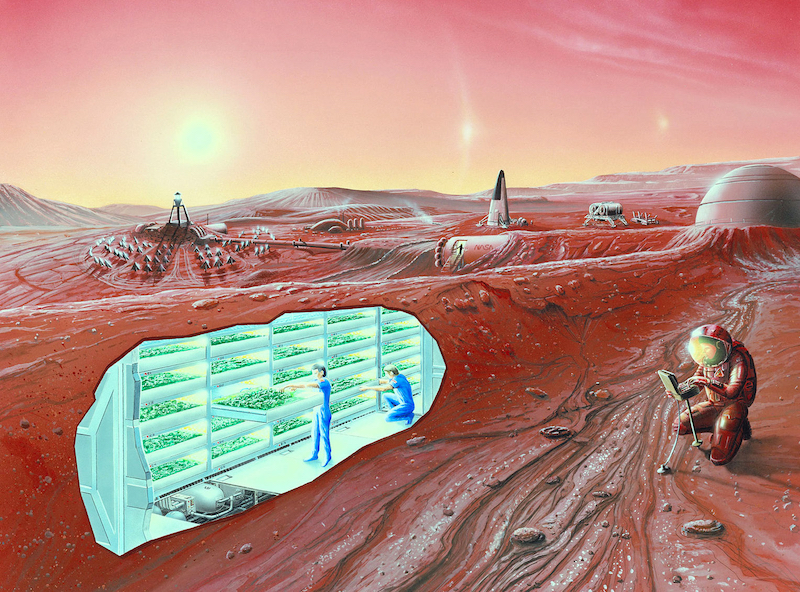
Concept of Mars colony by NASA
While some people may think of space in terms of new planets, new business opportunities or new life forms, others are concerned with the ethics of space exploration.
Jim Schwartz, assistant teaching professor of philosophy, wrestles with questions about the latter.
“Space exploration is a very broad term that covers a huge gamut of activities,” Schwartz said.
For example, he’s considered these questions:
- What are the environmental considerations for space exploration?
- What duties do we have to extraterrestrial microorganisms, if there are any?
- Can we actually reproduce on Mars? If so, would the children be viable for creating progeny? Does this affect the moral permissibility of settling Mars?
- What should a settlement accommodate in terms of preserving some kind of meaningful lives for the settlers, for a meaningful human culture?
Environmental Considerations
Space exploration is not a tidy endeavor. Whatever is sent into space may stay in orbit for decades, centuries or millennia. Space debris, ranging from micrometer specks to defunct satellites, already crowds low Earth orbit. Concerns about safety and additional waste increase when humans are in orbiting spacecraft.
“Reusability and minimizing trash are very important in space,” Schwartz said. “That’s fairly important for life support systems such as on the International Space Station. You have to have a lot of recycling in order to minimize what you send up because it’s very, very expensive to go up into space.”
Also important is how explorers treat the environment when on the Moon or Mars. Schwartz believes that the priorities in space are to engage in scientific examination, to explore and learn. This means that space explorers must be extremely careful to not disrupt or contaminate an environment be-cause it then becomes more difficult to learn about it.
“If you’re trying to look for life on Mars or in the subsurface oceans of Europa, you can’t ever perfectly sterilize the equipment you send,” Schwartz said. “You don’t want to spend multiple billions of dollars on a mission to discover life you brought with you. That was recognized as a concern, all the way back in the late ’50s, before the first satellite was even launched. If we’re hoping to find life, we can’t contaminate these environments.”
Life in Outer Space
NASA’s claim in 1996 that a meteorite from Mars provided possible evidence of microbial life set into motion frenzied discussion about the possibility of other extraterrestrial life forms. Scientists determined that the meteorite contained fossil-like remnants of bacterial cells and mineral deposits linked to biological processes. The rock also contained organic chemicals naturally produced by earthbound microbes and magnetosomes, which some bacteria use to sense magnetic fields.
During the conceptualization phases for NASA’s Spirit and Opportunity missions, Schwartz said, conversations about the potential of Martian life spurred more discussion about protecting life, even if it were found to be microbial.
“That’s a debate that still continues on. What duties do we have to extraterrestrial microorganisms if there are any?” Schwartz said.
Discussions about protecting and preserving microbial ETs are challenging, but conversations about human space settlement are extremely complex and sensitive. Not much is known about long-term space survival other than what is learned from studies conducted on astronauts and International Space Station personnel.
“Space settlement raises all sorts of vexing questions,” Schwartz said. “How little gravity can you have and still be able to bring a fetus to term? Are there gravity thresholds for various human biological functions? Keeping humans as a species is an important goal. It’s maybe a very strong duty overall.”
Schwartz argued some of these problematic issues, and others, at the 2018 Mars Settlement Workshop in London. During this two-day event, Schwartz, former Antarctic research station personnel, and residents of European ecovillage communities deliberated social issues related to space settlement. The conversations centered on considerations for Mars settlers.
Volunteers for settling Mars would need to reflect carefully on what they would be willing to give up and what responsibilities they would be willing to assume. The planet’s environment is harsh and there isn’t much room for mistakes. If someone opened a door at the wrong time all oxygen could be released and result in instantaneous death of the entire colony. Water is not easily accessible. Food would need to be manufactured or created.
And that’s not all. Participants would have specific jobs to fulfill that contribute to the survival of other settlers. In order to secure genetic diversity, reproductive partners would possibly be assigned. Settlers would not be able to return to Earth. In short, these pioneers would lose a lot of individual freedom.
“What worries me most,” said Schwartz, “is what kind of life those people will have to live with. How is it that you interact with this same community over a long period of time in ways that contribute to social cohesion rather than create boredom and tedium? How can you maximize personal liberties?”
Exploration for Science's Sake
Ethics and settlement questions aside, Schwartz believes we should go to Mars because of the research and science opportunities.
“There’s a lot of things to learn about what’s happening on Mars regardless of whether there’s life there,” he said. ”There’s a lot of people who think that if there’s no life, it’s just this cold dead rock. But you should ask the geologists about those cold dead rocks. They can tell you lots of cool things about them.”
Schwartz would like to see the scientific community have significant access to Mars before it is opened to substantial human presence. Research for many projects, including looking for ET life, must be conducted before humans disrupt Mars’ environment or make unalterable changes.
“In the long run, it’s a good thing to have some space settlements and to get human populations that are self-supporting, but I don’t think it’s anything for which we need to devote our resources right now.”
Faculty Spotlight: Jim Schwartz
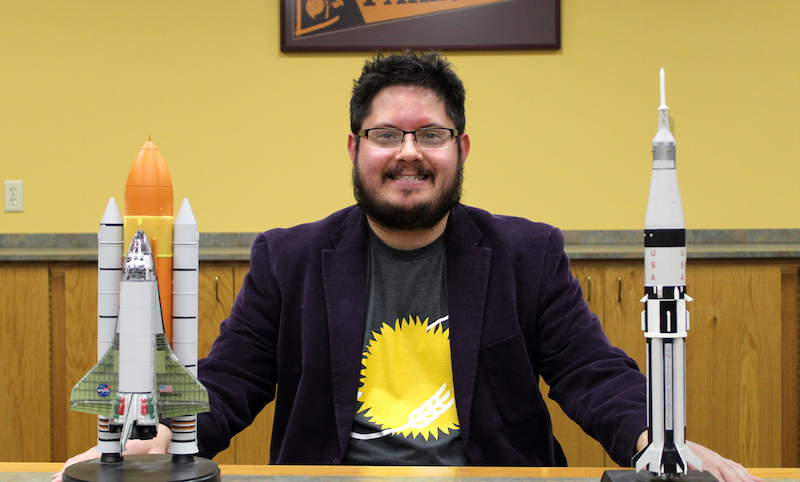
Jim Schwartz, assistant teaching professor of philosophy, shows two smaller scale models of a space shuttle and a rocket.
Jim Schwartz has been fascinated by space for as long as he can remember, but his career trajectory took a unique turn when he was in graduate school.
He wrote a paper, “Our Moral Obligation to Support Space Exploration,” which was published in the philosophy journal Environ-mental Ethics. That led to an invitation to conferences, followed by more papers and conferences, which in turn launched his career in becoming a space ethics expert.
“There’s a market for space philosophy,” Schwartz said. ”It’s a sector that’s only going to be growing over the next few decades and there’s so many open questions. There’s so little work that’s been done and so much to do that it affords individual scholars the ability to really pick what they want to work on.”
Schwartz believes that science must take priority in space exploration.
“Acquiring new scientific knowledge allows us to better understand many aspects of the universe around us and it’s through generating that new knowledge that we end up developing new technologies, devising new solutions to problems that we have,” he said. “Even if, as others have recognized, there is an ethical concern about protecting microorganisms in space, there is still an overarching concern about securing opportunities for scientific advancement. It’s not as though these have to be in conflict.”

This mosaic, taken by the Mars Curiosity rover, looks uphill at Mount Sharp.
The priority of scientific work is the main thesis he’s laid out in his project with Oxford University Press. His book is in the review process, but the working title is “The Value of Space Science.”
He views his area of study as truly interdisciplinary and works frequently with biologists, engineers, physicists and social scientists.
“For my career so far, I’ve had just as many colleagues outside of philosophy as within, and this is something that’s been part of a happy accident here at Wichita State,” Schwartz said. “We’ve got people in lots of different places here that do things related to space exploration: Mark Schneegurt with astrobiology, Nick Solomey with solar research and NASA collaboration, and a few of the faculty in aerospace engineering with space structures and space dynamics such as orbital maneuvering.”
Wichita is not really known as a space place, and Schwartz is working to change that. He recently created the Wichita Space Initiative, a clearinghouse of information for the type of opportunities and space work done at Wichita State. He’s also developed a lecture series, which has featured Jim Remar, the CEO of the Cosmosphere, and Steve Carothers, a former space shuttle flight commander at the NASA Johnson Space Center, as well as WSU faculty and students. Additionally, he’s involved in bringing an interstellar research conference to Wichita in 2020.
Schwartz arrived at Wichita State in 2014. In his free time, he plays guitar and writes mu-sic. He also enjoys carpentry and model build-ing. Smokey, Morris and Elara, his cats, share their home with him. Majoring in philosophy through all of his advanced education, Schwartz earned his doctorate and master’s degrees from Wayne State University, and his bachelor’s from Michigan State University.
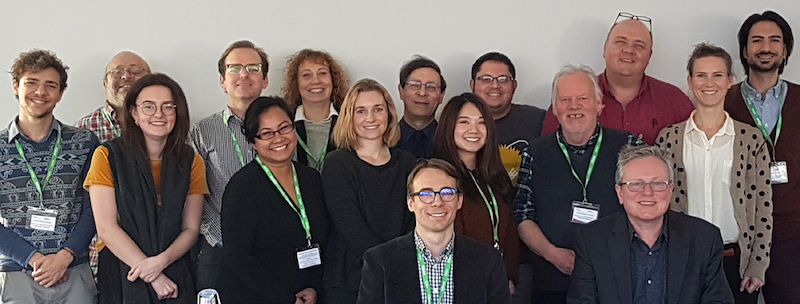
Mars Settlement Workshop, London, 2018. Swartz is in the back row, fifth from right.
Resources featuring Jim Schwartz's work
Wichita Space Initiative: wichita.edu/research/space/
Internet radio featuring Jim Schwartz: thespaceshow.com/guest/dr.-james-schwartz
Personal web page: thespacephilosopher.space/
Accolades & Announcements
Faculty and Staff Accolades
Noell Birondo, associate professor of philosophy, accepted an invitation from the University of Western Australia to give a public lecture and master class on his current research in Perth, Australia in early 2020.
Karen Countryman-Roswurm, associate professor, School of Social Work, and executive director of the Center for Combating Human Trafficking, was an invited keynote speaker at the Indiana Coalition to End Sexual Assault Annual State Conference.
Rocio del Aguila Carreno, assistant professor, modern and classical languages and literatures, and Karen Countryman-Roswurm received the 2019 Phenomenal Woman awards presented by the Office of Diversity and Inclusion. The awards recognize extraordinary and courageous women who inspire and impact the lives of others.
Darren Defrain, associate professor of English, and Aaron Rodriguez, graduate student in English, were winners of the Interdisciplinary Program Competition for the certificate in Graphic Narrative Coding and Accessibility. The courses in the certificate are focused on hands-on learning to produce graphic novel content that is accessible to those with disabilities. The certificate also seeks to meet accessibility needs across the nation.
Cheryl Miller, senior assistant dean for academic and staff operations, won first place for three entries in the 2019 Kansas Professional Communicators Contest: personality profile; feature story; and publications regularly edited by entrant. The personality profile won third place in the 2019 National Federation of Press Women Contest. All entries were from the fall 2018 LAS Newsletter.
Susan Sterrett, Curtis D. Gridley Distinguished Professor of History and Philosophy of Science, was invited to hold a Jemison Visiting Professorship in the Humanities at the University of Alabama at Birmingham in January. She was also an invited keynote speaker at the Rethinking, Reworking, and Revolutionising the Turing Test Conference at the University of Edinburgh in November. She gave an invited keynote speech at the workshop Taller sobre Modelos y Analogia at Autonomous National University of Mexico, Mexico City, in September.
Debbie Willsie, clinical professor, School of Social Work, was reappointed to the Sedgwick County Advisory Council on Aging and Physical Disabilities and sworn in at the Sedgwick County Commission meeting in March
Student Accolades
Sierra Bauman, an honors student in English linguistics and communicative disorders and sciences, presented her project, “Philosophy in Context: Universal and Individualistic,” at the Moral and Political Philosophy at the Border Conference. The international conference on border issues, including immigration and human rights, was held in late April at the University of Texas El Paso.
Alisha Prince, biological sciences, was named WSU’s Graduate Student of the Year. The award recognizes graduate students who have proven exemplary leadership, involvement and service to both the WSU and Wichita communities.
Nine WSU graduate students attended the 16th Capitol Graduate Research Summit in Topeka
in February. The event featured research conducted by graduate students from all Kansas
Board of Regents universities. Students showcased research and projects relevant to
Kansas and of potential interest to state legislators. Heather Forster, biological sciences, won the WSU award for her project,
“Innovative Genetic Approach May Give Crops Resistance to Charcoal Rot Disease.” Bin Shuai is her advisor. Jenny Masias, Spanish, presented “The Immigrants Who Built Kansas: One Spike at a Time.” Enrique Navarro is her advisor.
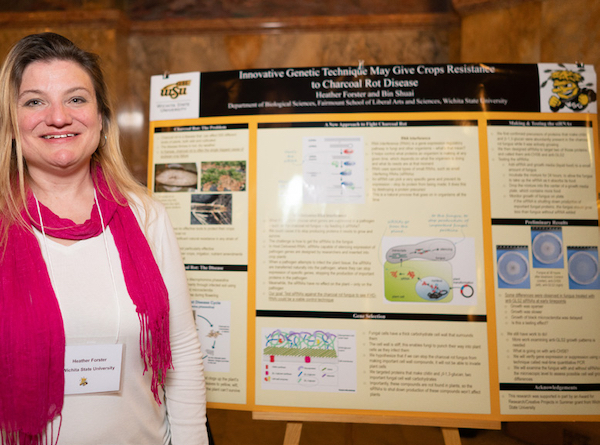
Heather Forster and her award winning poster.
Madeline McCullough, lecturer, Elliott School of Communication, and Josh Perez, Abby Smith, ThaiBinh Ninh and Melvin Kong, communication students, won first place for brochures in the 2019 Kansas Professional Communicators Contest. They won second place for the same entry in the 2019 National Federation of Press Women Contest.
Students in Jim Schwartz’s honors seminar in Philosophy of Space Exploration published their group paper, “The Need for Strict Regulation of Asteroid Mining,” in the European Space Policy Institute’s Voices from the Space Community series.
WSU Senior Honor Awards recognize undergraduate students on the basis of their leadership and high GPA. Fairmount College winners and their areas of study include:
- Jerod Horsch, physics
- Lily Jackson, English with a minor in communication
- Hunter Picard, biochemistry with a mathematics minor
- Morgan Roberts, Honors English with a film studies certificate
- Shelby Rowell, political science
- Gentry Thiesen, anthropology and political science
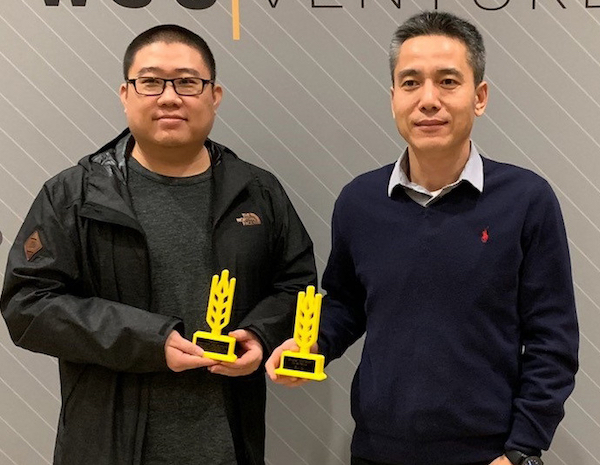
Long Wang, doctoral student in psychology, won the Shocker Innovation Corps Fellow
Award. Rui Ni,
associate professor of psychology, accepted the advisor's award on behalf of Jibo
He.
The WSU debate team finished their season in an impressive fashion. Senior Jamie Welch and freshman Dom Lett qualified for the elimination rounds at the National Debate Tournament in Minneapolis. This is only the third time in the past 25 years a WSU team has reached the single elimination debates. They advanced with a 5-3 record in the preliminary rounds but lost their elimination debate to Northwestern University on a 4-1 decision. Freshmen Bobby Phillips and Alec Hinecker also qualified for the tournament. They finished 4-4 but did not advance to the elimination rounds. However, they are the first team of two first-year students ever to qualify for the NDT from Wichita State. All four men are political science majors. Sam Mauer is the debate team advisor.
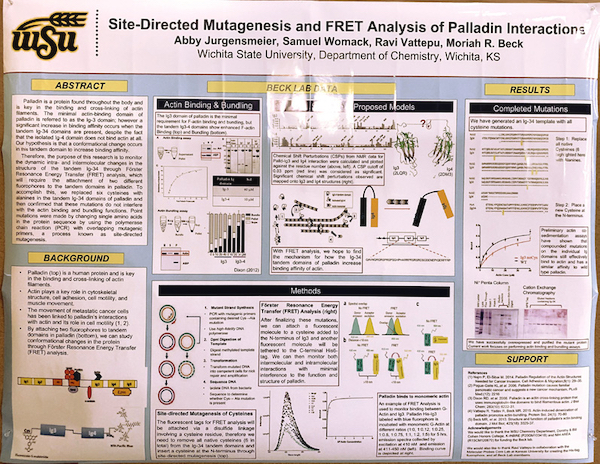
Chemistry students in Moriah Beck's lab created and presented a poster on their work
at the
Undergraduate Research Day at the Capitol event in March.
In Memoriam
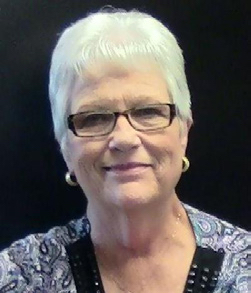
Beverly Alexander, 75, died March 5. She served the Department of Modern and Classical Languages and Literatures as an administrative assistant for 19 years. Memorials may be made to the department in care of the WSU Foundation, 1845 Fairmount, Wichita, KS 67260.
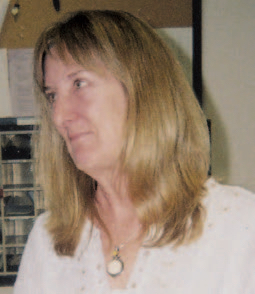
Karen Brown, 66, died March 22. An associate professor of biological sciences, she taught ecology, evolution, aquatic toxicology, and behavioral ecology. She retired December 2013.
James C. “Jim” Duram, 80, died Feb. 25. A retired professor of history, his research and teaching focused on American history, constitutional history and desegregation. Memorials may be made to KMUW, 121 N. Mead, Ste. 200, Wichita, KS 67202; KPTS, 320 W. 21st St., Wichita, KS 67203; Department of History Fund, WSU Foundation, 1845 Fairmount, Wichita, KS 67260; or the Eagle Valley Raptor Center, 927 N. 343rd St. W., Cheney, KS 67025.
Glenn W. Fisher, 94, died Nov. 5. He spent 23 years as the first Regent’s Professor of Public Finance at Wichita State. He retired in 1993, but continued to write and publish scholarly articles and serve on the Consensus Revenue Estimating Group for Kansas. In 2006, he received the highest award in public finance: the Aaron Wildavsky Award from the Association for Budgeting and Financial Management of the American Society for Public Administration.
Frank S. Kastor, 85, died Feb. 6. A retired professor of English, he taught at Wichita State for 30 years. He was a founder of the C.S. Lewis Society of Kansas and helped organize the C.S. Lewis Centennial in Belfast. Memorial contributions may be made to Center of Hope, 400 N. Emporia Ave., Wichita, KS 67202 or The Lord’s Diner, 520 N. Broadway, Wichita, KS 67214.
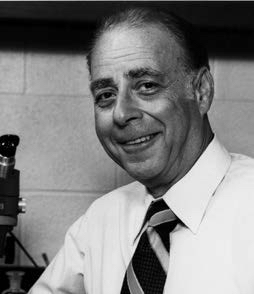
Alvin Sarachek, 92, died Dec. 7. A professor and department chair of biological sciences, he retired from Wichita State in 1992. His service contributions to the university included the design (with A.C. Genova, philosophy) of the first formal tenure and promotion policies for the Fairmount College of Liberal Arts and Sciences, and (with Phil Bowman, biological sciences) the original concept of the Watkins Visiting Professorship. In 2013, he established the RosaLee and Alvin Sarachek Award for Scholarly Excellence in Natural Sciences for the top graduating senior in Fairmount College.
President John W. Bardo
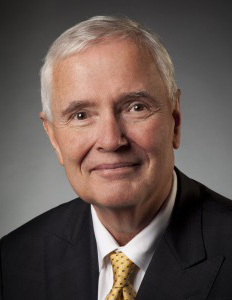
John W. Bardo, 13th president of Wichita State University, died March 12. He was 70 years old. Dr. Bardo was an innovator, nationally recognized scholar and deep believer in the value of public research universities.
He became president in July 2012. He transformed the vision of the university, leading it through a period of rapid growth focused on applied learning for students and the economic growth of the region.
Dr. Bardo began his career at Wichita State as an assistant professor of sociology and also taught and conducted research in what is now known as the Hugo Wall School of Public Affairs. During his time at WSU, he obtained a Fulbright Scholarship to Australia where he and his wife, Deborah, studied Americans as migrants. He also had a sabbatical appointment at the University of Wales at Swansea in social policy.
After leaving WSU, Dr. Bardo held appointments of growing leadership responsibility at Southwest Texas State University, the University of North Florida, Bridgewater State College and Western Carolina University, where he served as chancellor from 1995 to 2011 before returning to Wichita State.
A public celebration of life was held on campus May 9. Memorials may be made to the Deborah J. Bardo Scholarship Fund, Wichita State University Foundation, 1845 Fairmount, Wichita, KS, 67260-0002.
WSU Professor, Student Team Up with Ocean Spray to Stop Tooth Decay
By Seth Crawford
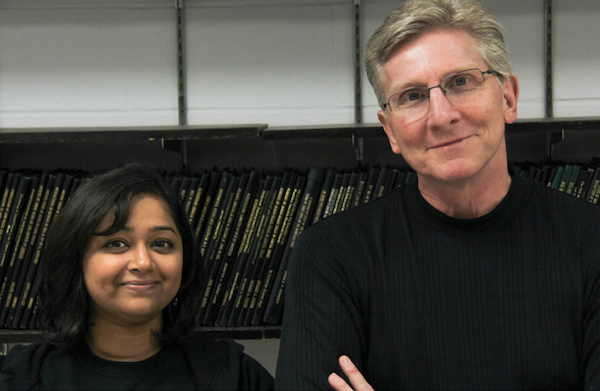
Graduate student Alisha Prince and biology professor David McDonald
Wichita State biological sciences professor David McDonald and graduate assistant Alisha Prince are trying to change the world, one mouth at a time. The pair is teaming up with Ocean Spray to research synergistic properties contained in cranberries and other natural extracts that will, in theory, stop the decay of teeth and provide an alternative to traditional oral health care.
McDonald and Prince hope their findings will one day provide reliable, cheap and tasty alternatives to typical teeth cleaning, as well as unlock the secrets to stopping oral diseases.
“We knew these substances would help aid in the fight against oral diseases, but the synergy of them working together had never really been observed before,” said Prince.
After a summer’s worth of research, McDonald reached out to Ocean Spray, the prominent brand behind many juices and snacks, for support that would continue the team’s inquiries.
Ocean Spray has provided extracts as well as other vital materials for the team’s research and has been a significantly helpful part of their work.
When these extracts are received, Prince measures and observes the different ways bacteria respond to the mixtures of cranberry and other natural extracts. Each individual combination has its own effects on the bacterial growth.
“There is a real disconnect from the dental industry with biological sciences,” said Prince. “Finding the link between these two areas of health care will be essential to stopping bacteria and viruses of the future.”
McDonald said the trial and error of finding the perfect combination is tedious, but knowing that people’s livelihood will benefit from this work is the driving force behind it all.
“So, until then, we will continue to work through each combination, one at a time, until we find the results we’re looking for.”
Prince has been able to combine not only her experience from dental school in India, but also her passion for helping people who have never had an opportunity for reliable oral health care. She knew that she wanted to continue her work as a dental professional, but also realized that combining her area of expertise with the microbiological aspect of the work would help find unique solutions to such a complex problem.
The lack of access to standardized health care is an issue that has caused a plethora of problems in Prince’s home country of India. Gum diseases such as gingivitis run rampant in developing countries where access to health care is limited. The lack of care for teeth leads to impairments in life and social stigmas, as well as the hardships of not providing the body with adequate nutrients.
Dean's Message
Dear alumni, faculty, staff and friends,
On March 18, the university campus paid its respects to John Bardo, Wichita State’s 13th president, as his funeral motorcade solemnly processed through campus, making periodic stops where students, faculty and staff had clustered, standing still to honor and reflect. This issue of the newsletter is dedicated to Dr. Bardo, who supported the role of liberal arts and sciences in innovation and research.
One of Dr. Bardo’s great legacies is his vision of a university that is internationally recognized for its applied learning and applied research. It seems therefore fitting for us to take a moment to reflect on how the Fairmount College of Liberal Arts and Sciences has positioned itself as a carrier of this mission, given its central role in the education of the university’s students.
As the college with the greatest academic diversity, it is appropriate that applied learning is expressed in many ways and at many levels. In the natural sciences we continue to offer enriching undergraduate and graduate experiences in the lab, where students work in teams addressing challenging research questions through experimentation, analysis and collaboration. I was privileged to discuss findings with some of our students displaying their work on neutrinos and the age of the universe at the Undergraduate Research Day at the Capitol in Topeka. Later this summer, undergraduate geologists will be descending on the Bighorn Basin in Wyoming for a four-week field camp. Students of political science continue to be transformed through interning for legislatures in Topeka and Washington, DC. A faculty member and graduate student in English recently won a university-wide competition to create a certificate for developing the technical and design skills to make graphical novels accessible to the partially sighted. These are just a few of the many ways in which our students in the humanities, the natural sciences and social sciences learn by doing.
Applied learning operates at another level: Through exposure to the liberal arts and sciences our students gain career-preparation skills such as analytical thinking, working in a team, the ability to express complex ideas through writing and speaking, and a love of learning new things. Internships provide a natural arena to apply these skills in a real-world setting. We want to ensure that every student, no matter what their major, has a meaningful internship opportunity, making use of our business and industry contacts in Wichita and our nationwide network of alumni.
Fairmount College is where students come to follow their passions and engage their curiosity, be it Shakespeare, how the mind works or the origins of the universe. Their educational experiences should be multilayered so they are truly prepared to pursue a career and lead a fulfilling life. For each of our liberal arts and sciences majors we want to encourage a pre-professional experience by creating pairings between our majors and pre-professional studies in our sister colleges, such as psychology and economics, political science and finance, English and computer programming. “What I love to do and what I ought to do” should never be a dilemma. One of our goals is to provide the framework that allows the student to pursue both.
The college’s applied learning mission continues and expands so that we can prepare our students to serve as positive contributors to society who are qualified to gain entry into and participate fully in an ever evolving workforce.
Sincerely,

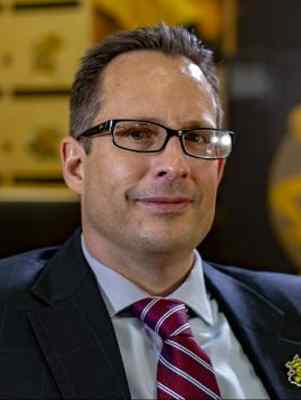
Andrew Hippisley, Dean