


Wichita State University
Texas Archaeological Site Offers Educational and Skill-Building Opportunities
By Cheryl K. Miller
About 3,000-4,000 years ago, a group of indigenous people known as the Caddo lived and traveled along the Sabine River in the Piney Woods of east central Texas. In September, CRYSTAL DOZIER traveled to a privately owned property in the area, known in archaeological circles as the Boxed Springs site.
Dozier, an assistant professor of anthropology, didn’t know what she and her graduate student, CAMBRIA HALEY, would discover during the visit. Dozier found a mound, which the Caddo used for festivals, ceremonies and other gatherings.
“The past Caddo people made it easy for me to recognize the mound as soon as I hit it,” Dozier said. “We found pieces of stone tool in it. Modern construction fill does not have these items.”
During the September visit, which was the initial expedition to the field location, Dozier and Haley conducted some shovel test pits, which involves digging a hole in regular intervals using scientific methods. Although Dozier was ecstatic to find the mound, she is most interested in the Caddos’ waste.
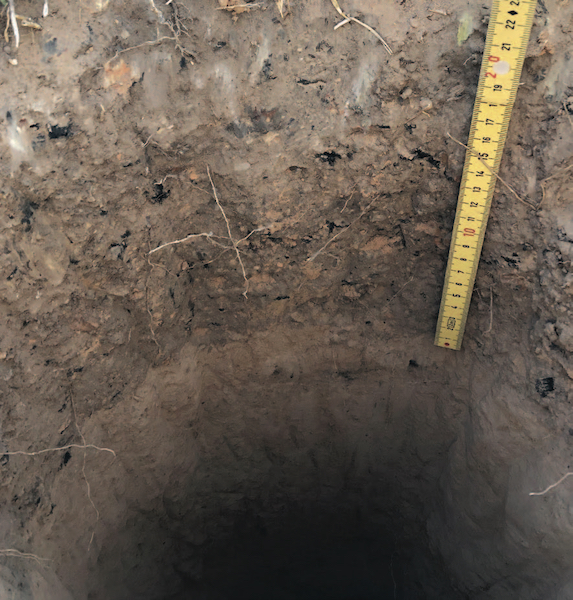
One of the shovel test pits.
“I’m hoping we can find a lot of their trash,” Dozier said of their scheduled return in March. “It will help give us insight into what they were eating, what seasons they were living there, the different kinds of pottery and stone tools that they were using and any indices of if they were trading, which is probably likely.”
During Wichita State’s spring break, Dozier and Haley will return to the Boxed Springs site with 10-14 students who will learn valuable field skills. These student scientists will help Dozier with two goals associated with the project.
The first goal is to establish the location of mounds.
“The half of the property that we’re looking at supposedly has two mounds,” Dozier said. “The mounds are smaller now because over a thousand years that area has been used for pasturing and farming, and there’s been some reworking of the site.”
The second goal is to determine if people lived at the site and for how long. Dozier wants to figure out whether it was a seasonal place that people would come to or a place that people lived year round. These questions can be answered through people’s trash, she said.
Applied Learning for Students
As an educator, Dozier is unwavering in her desire to provide applied learning experiences for students. Thanks to a WSU alum who owns the property where Boxed Springs is located, she has one more option to offer. MARC ROWLAND, the landowner, contacted her with the idea of preserving the land, having it correctly excavated and allowing students to be involved in the process.
As a scientist, Dozier knows how important preservation is. In the late 1980s, a large Caddo cemetery at the site was heavily looted by locals interested in the pottery. Some of the raided earthenware was eventually donated to an archaeological center, and Dozier wants to make sure the rest of the site is protected and excavated properly.
But what is most exciting for Dozier is the experience for students, such as the skill acquisition and refinement her grad student, Haley, describes.
“My survey skills have improved working with Dr. Dozier,” Haley said. “It can be difficult deciding where to dig and you really have to know what you are looking for. I am looking forward to opening up a couple of units in the spring to keep up my excavation skills.”
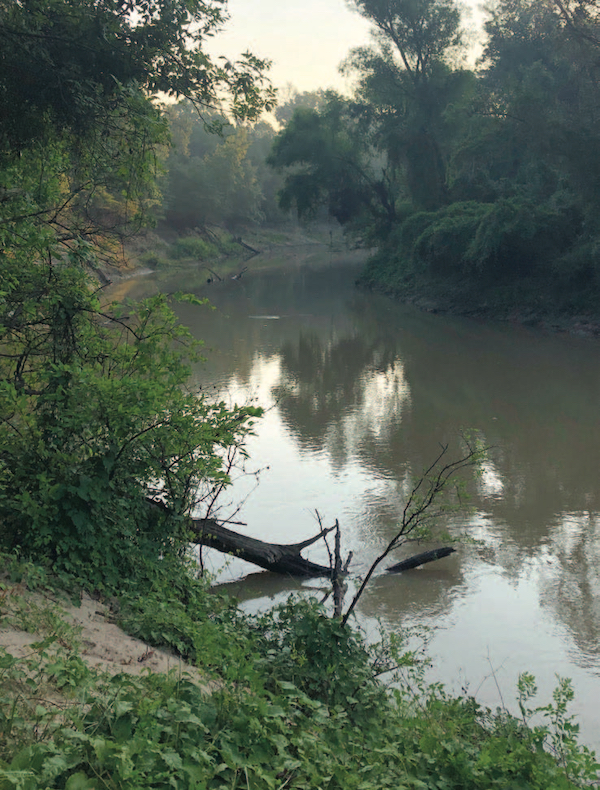
The Caddos lived along the Sabine River. The natural spring for which the site is
named
(Boxed Springs) is below the terrace, close to the river.
For Dozier, teaching students shovel test pitting will be key.
“This is a skill that is not commonly taught in any field school in the United States,” Dozier said. “This technique is the primary way in which professional archaeologists do survey work.”
According to Dozier, cultural research management is the largest employment field for archaeologists. This career path includes surveying potential projects (e.g., roads, airports, natural gas) to ensure that they aren’t going to destroy archaeological sites as those projects progress. Doing shovel test pits is the large majority of entry-level positions.
“Being able to learn this technique in school gives our students a leg up when looking to enter the field,” Dozier said. “I’m particularly excited for that aspect. Students will be able to put this on their resume and say, ‘I know how to do this.’ They then become instantly more employable.”
Students will also have an improved understanding of decision making in the field.
“I’m also excited they will learn the rationale of how fieldwork is done. Each one of them gets to see why I’m making the decisions that I’m making or how to do it,” Dozier said. “They will each take responsibility for one aspect of the research so they can see how their work contributes to our knowledge of the site in a brand-new way. It’s this hands-on logic of how science works.”
The applications students learn won’t end with the fieldwork. Haley will likely use her activity at the site for her master’s thesis.
“I am hoping we find an artifact that will tell us some more about the trade habits or lifestyle of the people that were there before,” Haley said. “As of now, though, my thesis would be about the survey and how this property ties into the site as a whole.”
Students who travel with Dozier and Haley over spring break will be able to earn one to three credit hours of coursework. Students enrolling for three credit hours will meet regularly with Dozier, and each person will be assigned one facet of the project. They’ll complete reading before the trip, do field work, conduct analysis afterward and present their research results at WSU’s Undergraduate Research and Creative Activity Forum or the Alpha Lambda (anthropology honors society) conference, both of which are held in the spring.
Who are the Caddo?
The Caddoan people, closely related or affiliated indigenous groups who share similar
cultural and religious practices and languages, lived from 800-1200 A.D. They were
originally found along the Red River in the southeastern United States, although Caddo-related
cultures are now mostly located in Oklahoma. “Caddo” derives from the word “Kadohadacho,”
which means
true chiefs.
CRYSTAL DOZIER likes to think of the Caddo as the bridge between some of the traditions of the southeast
and Plains Native American people.
The Caddo lived in this borderland between the western half of Mississippi and the
Plains, so they practiced maize agriculture, which you don t see everywhere,” Dozier
said. “They were the only mound building culture in Texas. This is fairly unique this
far west. Dozier is fascinated by the Caddo and the Boxed Springs research site because
of the hints of the complex society that have emerged. This is the beginning of agriculture
and people coming together in increasingly larger groups and increasingly complex
political kinds of events,” Dozier said.
Archaeologists think the site s time period represents the origin of a chiefdom-governed society where you have ‘a big man on the hill. Although there are no published radiocarbon dates from the research site, pottery sherds recovered there have been dated to the early Caddo period. Socioeconomically, the Caddo then reflected a mostly egalitarian culture. “During this period in terms of hierarchy, people still tended to be equal and have equal access to food and resources,” Dozier said. “This is at the very beginning where we start to see some individuals having more power than others. As an archaeologist, that s the process that I’m interested in,” she said. “How does power become entrenched, how do human beings resolve their conflicts over increasing territoriality? This is really interesting from that perspective as well, these new origins of complexity. The complexity is one of many mysteries Dozier and her students hope to unravel.
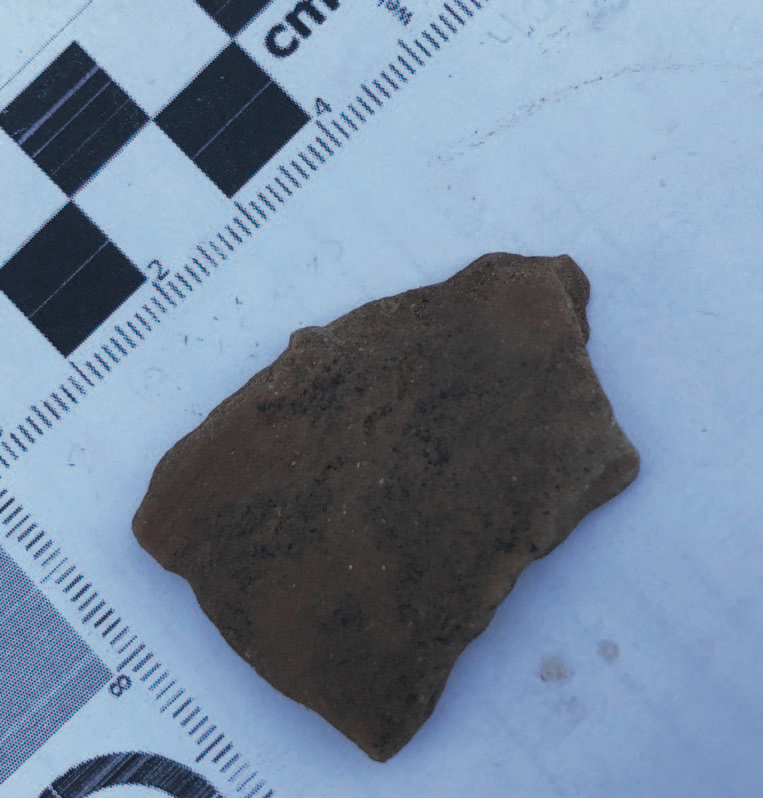
This Caddo sherd shows faint impressions of semi-circle decoration, made by pressing
fingernails into wet clay.
This was the only piece of decorated pottery recovered in the initial survey.
Faculty Spotlight: Crystal Dozier
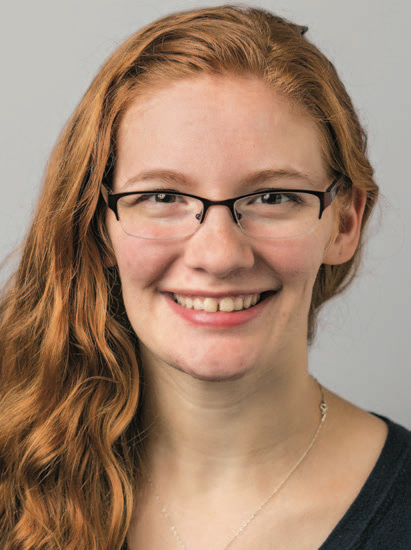
Once CRYSTAL DOZIER starts to talk about her archaeology work, her face lights up and her smile broadens with each recollection. Her passion for science and storytelling began when she was young.
“When I was in elementary school I thought paleontology was awesome and dinosaurs were really awesome!” Dozier said. “When I got to high school, I realized that archaeology is very similar to paleontology in terms of the methods, but tells a human story. It’s even more fascinating to me that humans are such unique animals. We do strange, strange things.” She chose a career path as an archaeologist because it’s the only science that tells the majority of human history. It also provides her plenty of variety in activity. Part of the year she is outside in the field, wearing hats and field pants and getting dirty. The rest of the year she is in a clean lab or office where she can sit, write and think.
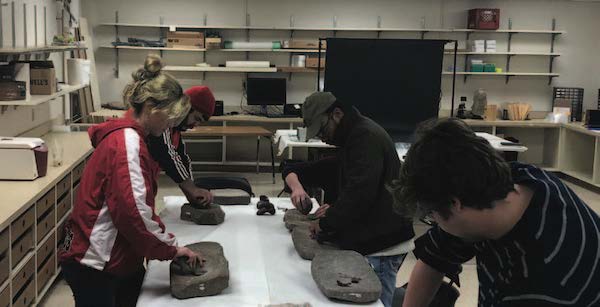
Students in Dozier’s Anth 397 class, Anthropology of Food and Nutrition, grind food
using
artifacts with unknown provenance. Dozier studies foodways and cooking technologies,
which are the habits and practices of people as it relates to eating, food creation
and preparation.
Not only does she admit to loving food, but she learns a lot about the people who
prepare it.
“You can tell an incredible amount about a culture just based on what they’re cooking, how they’re getting their food and who is doing the cooking,” Dozier said. “Food is filled with all sorts of cultural meaning as well. Between food taboos and access to different resources, there are so many different aspects of culture you can understand just through understanding foodways.”
Her most exciting discovery related to eating involved a venomous snake.
“Part of studying foodways is studying residues on pottery, or in people’s trash, but you can also study a more direct way how people ate things by looking at their poop,” Dozier said. “I looked at a coprolite (fossilized feces) that was 1,500 years old from west Texas. Inside the coprolite, we found all sorts of the normal things such as prickly pear and rodents with fur on.”
Most surprisingly, she and her research partners also found parts of a venomous snake in the Viperidae family: a fang, ribs and several scales. It indicated this person ate the head, which is a dangerous act. Her group’s interpretation was that because snakes are powerful images within all sorts of cultures, this was a ritual act.
Outside of Wichita State, Dozier spends her free time with her husband Joseph (“Tex”), gardening, rock climbing, knitting, sewing and participating in sprint triathlons. Naturally, she also cooks and eats and is thrilled that she found Mama Nith’s Crawfish, a Wichita restaurant that serves Cajun-Asian cuisine.
“I can get crawfish pho and that represents the best part of America to me. It’s got Cajun spices cooked like pho,” she said.
Dozier is in her second year at Wichita State. She earned her master’s and doctorate degrees at Texas A&M University and her bachelor’s at the University of Chicago, all in anthropology.
WSU Professor Wins Presigious National Science Award
Career recognition is great any time, but for ALEXANDRE SHVARTSBURG, it has come early in his academic career and from the president of the United States.
The White House announced on July 2 that Shvartsburg, an assistant professor of chemistry, received the Presidential Early Career Award for Scientists and Engineers. It is the highest honor bestowed by the U.S. government to outstanding scientists and engineers beginning their independent research careers and showing exceptional promise for leadership in science and technology.
“I stand truly heartened,” said Shvartsburg. “This is indeed a rare honor.”
It is the first time the award has been received at Wichita State and only the third time in Kansas. Shvartsburg studies ion mobility spectrometry and believes this is the first time someone in his field has been recognized.
“I feel it is an award to the whole IMS community, which I accept as a powerful recognition of our rapidly expanding science,” said Shvartsburg.
In IMS, the ionized molecules are separated by motion in gases driven by electric fields, said DOUG ENGLISH, chair of the department of chemistry. Scientists use IMS (coupled to mass spectrometry) to distinguish and identify various molecules in the environment and biological materials, particularly proteins relevant to human health.
Not only does the award recognize Shvartsburg’s work, but it elevates his visibility and research impact.
“This is the biggest honor a junior faculty member has received in the department,” said English. “More people will learn about his work, and he’ll have increased opportunities for collaboration on additional projects."
Shvartsburg received his award July 25 in Washington, D.C.
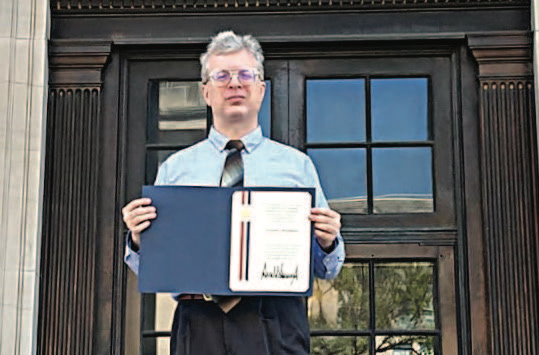
Alex Shvartsburg stands with his PECASE award in front of DAR Constitution Hall.
Faculty-Produced Movie Premiered at Local Film Festival
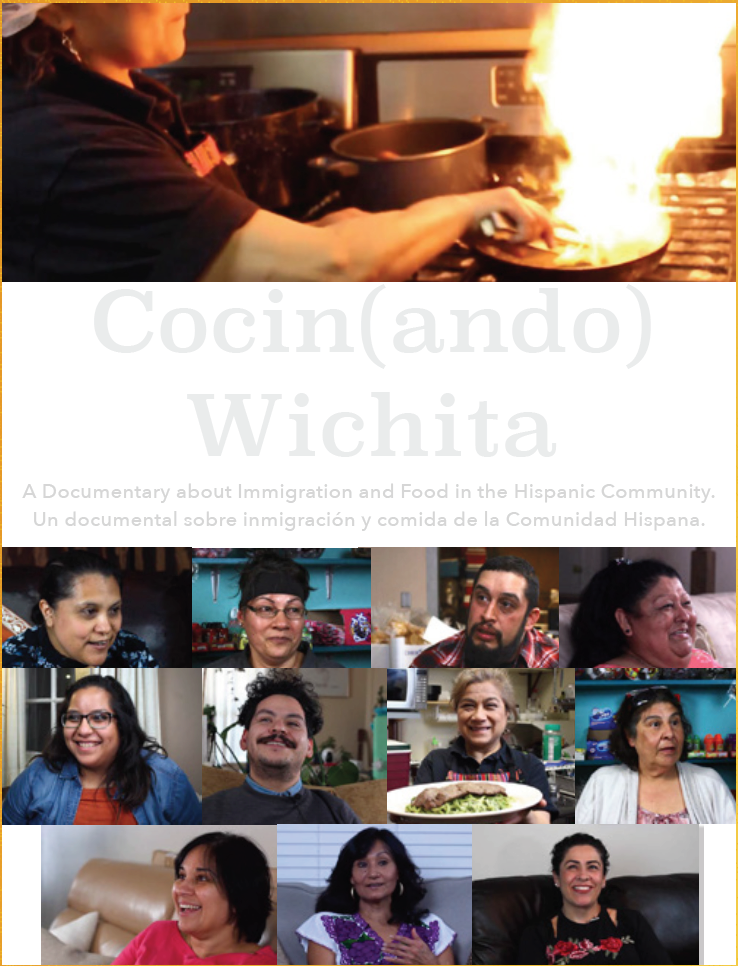
One-Sheet/Promotional Image for Cocin(ando) Wichita
Cocin(ando) Wichita, a 19-minute narrative about immigration and food in Wichita’s Hispanic community, premiered at the 2019 Tallgrass Film Festival. The documentary acknowledges the value of people who have kept their culinary traditions and how that has shaped their culture and their communities. The movie, filmed in Spanish, has English and Spanish subtitles. This project was made possible by a grant awarded by Humanities Kansas.
The film was produced and directed by ROCIO DEL AGUILA, assistant professor of Spanish. ENRIQUE NAVARRO, assistant professor of Spanish, served as the co-producer and creative director. CAROLYN SPEER, manager of WSU’s instructional design and technology, served as the Humanities Kansas consultant, and JAY PRICE, professor of history, provided his insights about Kansas.
JENNY MASIAS and MARGI AULT-DUELL, graduate students in Spanish, collaborated in the screenplay and captions. ELIZABETH HARP, undergraduate, Spanish and elementary education, served as the project assistant.
Faculty and Staff Accolades
JAMES BECK, associate professor of biological sciences, is part of a team of researchers recently awarded a $3.8 million research infrastructure grant from the National Science Foundation Experimental Program to Stimulate Competitive Research. The project, titled “Consortium for Plant Invasion Genomics: Combining Big Data and Plant Collections to Understand Invasiveness,”will investigate the genomic changes that have allowed five exotic plant species to invade North America. The two most familiar in the Great Plains are Johnsongrass (Sorghum halepense) and Russian thistle (Salsola tragus), commonly known as “tumbleweed.” This 4-year project also prioritizes human resource development in the form of a network of workshops providing genomics and bioinformatics training to more than 60 researchers at mid-sized and small universities.
MORIAH BECK, associate professor of chemistry, received the 2019 Partners for Progress and Prosperity Regional Award. Given by the American Chemical Society, it recognizes her work organizing the Expanding Your Horizons STEM conference for middle school girls.
TOM LUHRING, assistant professor of biological sciences, was invited to give two talks at a symposium, “The Interface of Predation and Migration in Aquatic and Terrestrial Ecosystems.” The presentations were given at the joint meeting of The Wildlife Society and American Fisheries Society.
RACHELLE MEINECKE, director of the Lowell D. Holmes Museum of Anthropology, received a $500 grant from the Kansas Museums Association for a tactile display for vision-impaired visitors. This project will be the start of a larger project to make the museum accessible for all visitors. Five artifacts from the collection will be replicated by GoCreate as 3D-printed replicas of the objects.
MYTHILI MENON, assistant professor of English, was invited to give the keynote at Formal Approaches to South Asian Languages 9 at Reed College, Portland.
JAY PRICE, professor of history, received the 2019 Arrington-Prucha Prize from the Western History Association for his article, “Assembling a Buckle of the Bible Belt: From Enclave to Powerhouse.” The Arrington-Prucha Prize recognizes the best article on American western religious history. His work was chosen for its originality, its scope and its significant contribution to the study of the North American West.
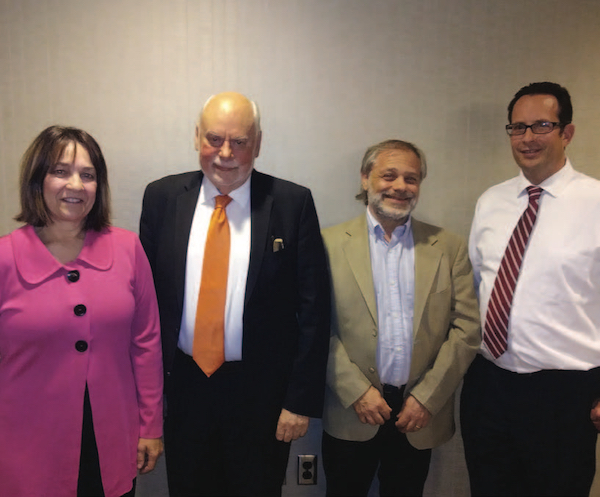
SIR FRASER STODDART, second from left, was the Watkins visiting professor and featured speaker at the Midwest Regional Meeting of the American Chemical Society, held in Wichita. A 2016 Nobel laureate in chemistry, his work features the design and synthesis of molecular machines. Standing with Sir Fraser are COLEEN PUGH, dean of the graduate school and associate vice president for research and technology transfer; DAVID EICHHORN, associate dean for faculty development and research; and ANDREW HIPPISLEY, dean.
Student Accolades
Undergraduates ROBIN CESUR and IRFAN ANSARI, biological sciences, have demonstrated that microbes contaminating spacecraft can grow in brines formed by the deliquescent wetting of salts by humidity alone. These findings are relevant to planetary protection protocols for missions to Mars and to guidelines for habitable regions on Mars, as well as the oceans and ices of satellites in the outer solar system, such as Europa and Enceladus. Cesur and Ansari conducted the experimental work as part of the collaboration between MARK SCHNEEGURT, professor of biological sciences, BENTON CLARK, Space Science Institute, and FEI CHEN, NASA Jet Propulsion Laboratory. The team has been working together for nearly a decade in connection with the Wichita Space Initiative. Since June, their findings have been covered by FoxNews.com, Discover Magazine, AAAS Eureka, Medical Daily, The Daily Mail, The Daily Express and several other news outlets. Their work appeared in more than 125 venues and was presented in at least six languages. Cesur and Ansari also won an Outstanding Abstract Award for their paper, “Demonstration of Bacterial Growth in Brines Formed by the Deliquescence of Salts Relevant to Mars,” given at the 2019 general meeting of the American Society for Microbiology.
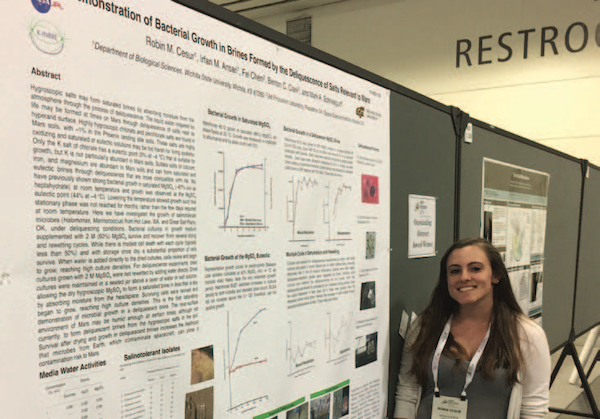
Robin Cesur stands with the poster presentation demonstrating that microbes contaminating
spacecraft can grow in brines formed by the deliquescent wetting of salts by humidity
alone.
Doctoral student NAM NGUYEN, mathematics, received the Dora Wallace Hodgson Outstanding Graduate Student Award for his research on neural networks and quantum machine learning. His advisor is ELIZABETH BEHRMAN, professor of mathematics and physics.
SHOCKER AD LAB, an advertising agency of Elliott School of Communication students, received second-place honors at the National Federation of Press Women annual conference. The award category Brochures: Government, Nonprofit, Educational recognized the group for their series of advising handouts for the Fairmount College of Liberal Arts and Sciences Advising Center. MADELINE MCCULLOUGH, SAL creative director and assistant educator, accepted the award on the students’ behalf.
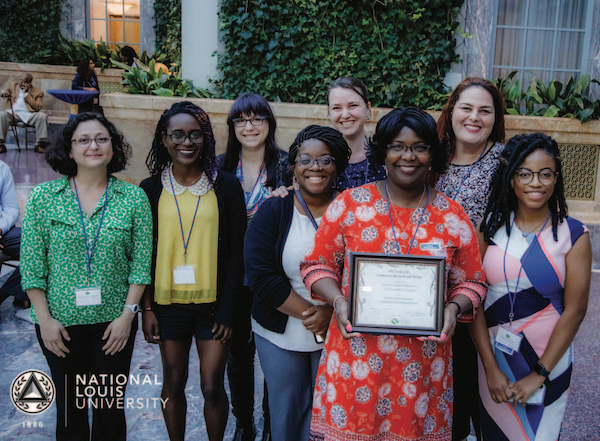
The Student Membership Circle Bronze Ribbon Award was presented to WSU at the Society for Community Research and Action conference. It recognizes schools with the largest number of graduate students who are also members of the society. Pictured are ROSALIND CANARE, ALISSA BEY, ANDREA JAMIEL, CORA OLSON, HANA SHAHIN, KEYONDA BROOKS, PAIGTON MAYES and RHONDA LEWIS, professor of psychology and chair.
In Memoriam
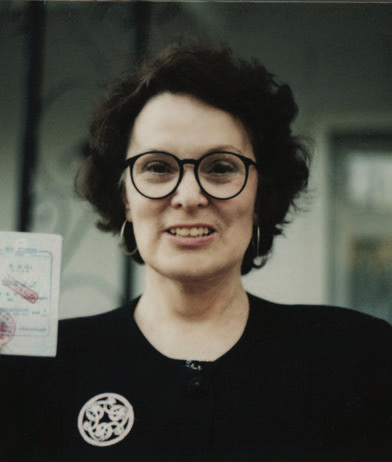
CAROL WOLFE KONEK, 85, died June 27. In 1970, Konek co-founded the Center for Women’s Studies at Wichita State with SALLY KITCH. In 1992, she wrote a memoir, “Daddyboy,” about her father’s struggles with Alzheimer’s disease. The book received national attention at a time when the disease was becoming recognized as a serious health issue. In 1995, she traveled on the Peace Train with 232 women from 45 countries meeting with women’s groups and parliaments in countries from Finland to China. Konek retired in 2005, having taught courses in English composition and women’s studies for 35 years and serving as an associate dean of the college for 19 years. Memorials have been established with the Wichita Family Crisis Center, 1111 N. St. Francis, Wichita, KS 67214, and The Lord’s Diner, 520 N. Broadway, Wichita, KS 67214.
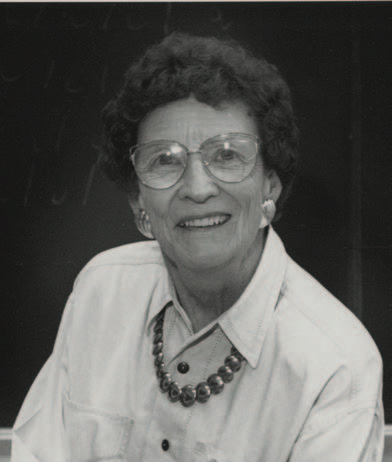
HELEN J. THROCKMORTON, 95, died Feb. 8. She joined the University of Wichita faculty in 1954, teaching English, composition and teacher education courses. She retired from Wichita State University as professor emeritus of English in 1992.
Dean’s Message
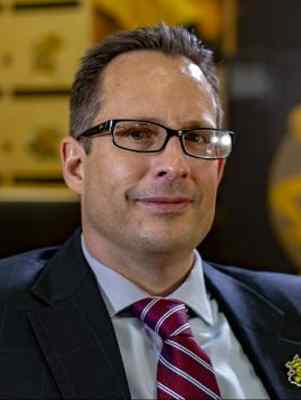
Dear alumni, faculty, staff and friends,
A liberal arts education helps us to see both the world as it is and the world as it should be. More than ever there is a need for higher education to develop global citizens, full members of society who are open to differences, discerning of the familiar and welcoming to those not like themselves. As an undergraduate I spent a few weeks one summer in Moscow. The sights, smells, tastes and the way people dressed were completely foreign to me. I remember feeling utterly disoriented and uncomfortable. Yet I look back now and realize that this was the beginning of a lifelong appreciation of Russia and its people and their stories. The short trip gave me a hunger to return, and I went back for a semester a few years later and many times subsequently.
Those few weeks were an integral part of my education. We talk a lot at Wichita State about equality of access to higher education. My belief is that this access must be to educate the whole, which is the power of the liberal arts. Part of its power is to discomfort, disorient, to force us to engage in what is outside and beyond ourselves, thereby finding a new appreciation for what is different from ourselves. A study abroad experience sets students on a collision path to this dynamic. As such, study abroad mitigates bias and tribalism, and begins the slow and important work of creating a global citizenry. As well as strong writers, clear thinkers and powerful analyzers, global citizens are recognized as a great asset in the workforce.
In the Fairmount College of Liberal Arts and Sciences, our goal is to provide a study abroad opportunity for every student, including first-generation and underserved students who we know are most impacted by such an experience. Many will be unable to take a semester away; working part time they cannot afford the loss of earnings. However, WSU does provide for shorter periods abroad in the form of for-credit travel seminars. These last about two weeks and are led by faculty who are themselves from the destination country or who have a special connection to it. They are transformational and often lead students to go back for longer periods, sometimes again and again and again.
The cost for a student to enter this program is anywhere between $3,000 and $4,000. Most will never pursue a travel seminar because of other financial demands. Though some scholarships exist, greater resources are needed to make study abroad possible for our many first-generation and underserved populations. Sponsoring a travel seminar student is opening the door from their familiar to the beyond, starting them on an educational journey that will change them and help them to change our world. If you’d like to help, please email me at andrew. hippisley@wichita.edu. Please use the subject line “Travel Seminar Support.”
Andrew Hippisley,
Dean