


Wichita State University
The Role of the Media in Maintaining Democracy
Media coverage reaches a fever pitch during presidential election cycles, and that
makes the work of journalists and other media professionals highly visible.
On a given day, national election coverage may include debate broadcasts, a story
on a politician’s threats to restrict media access or projections about voting in
swing states. However, the media usually play a much more fundamental daily role elemental
to the foundation of democracy.
“Most of us have no direct knowledge or access to political information or to the political process, and as a result we are dependent on the media,” said Jeff Jarman, interim director of the Elliott School of Communication. “The media’s main function is to give information to people who in almost every case don’t have access to the information in any other way. Most of us are never going to know enough and are never going to be present for all the things that are happening.”
Sherry Chisenhall, managing editor of The Charlotte Observer, agrees that the media’s main role is to provide accurate information to citizens.
“Finding truth and fact-checking come first,” Chisenhall said. “The average citizen often doesn’t have the time or know-how (or the inclination) to research claims by elected or would-be elected leaders.”
Now that the state and national elections are over, and President Trump will soon take office, the media will begin to focus on other issues.
“Coverage will likely shift to how the new president will work with a divided Congress and a bitter and divided public,” Jarman said. “Nearly half of the country will be very upset with the outcome of the election. Rather than coverage of legislation, it likely will be horse-race coverage of ‘how likely is it that anything can be done in Washington?"
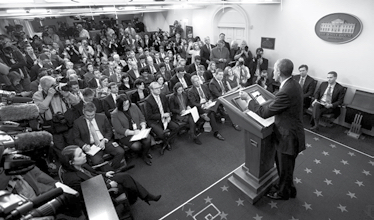
President Barack Obama holds a press conference in the
James S. Brady press briefing room of the White House
Dec. 19, 2014. Photo by Chuck Kennedy.
On a local level, small circulation newspapers may increase coverage of high school sports and city council meetings, as those are events that directly affect the community.
“All the small town papers have legal publication requirements and cover what happens at lower levels of government,” Jarman said. “Those are the things that impact us most. Whether or not your town is going to get highway improvements or whether the highway goes around your town — those are huge decisions that county commissions make. People are dependent on their local paper to let them know what’s coming and what might happen.”
The media’s presence can irritate politicians who would rather operate secretly or withhold knowledge from their constituents. This is not a recent trend. As minister to France in 1787, Thomas Jefferson struggled with the press’ efforts, but recognized its role in keeping government power in check. He impressed this idea upon Edward Carrington, the Virginia delegate for the Continental Congress.
“Were it left to me to decide whether we should have a government without newspapers, or newspapers without a government,” Jefferson wrote, “I should not hesitate a moment to prefer the latter.”
Jarman supports this belief.
“A world in which the media is constrained in providing all the information we need is a world in which democracy is at risk,” said Jarman. “It is clearly idealistic to want people to be fully informed advocates for what they believe in. Policies that undermine that ideal are never desirable. We should always want a vibrant media providing us with information.”
Changes in Media Platforms
Within the past 20 years, traditional forms of mass communication have been joined by blogs, internet forums and social media sites such as Facebook and Twitter. This expansion reflects advances in technology and is a reminder that younger generations have used digital technology most of their lives. Millennials, those born between 1982 and 2014, don’t know a world without the internet.
“Millennials are now the largest living generation,” said Jarman. “They overwhelmingly get their news from social media.”
This presents a new dilemma for people who want to be informed.
“Social media gave every person a platform — it shifted public discourse from a model of a powerful media organization talking ‘at ‘the citizenry in a community to a model of everyone talking to everyone,” said Chisenhall, the Observer’s editor. “The number and volume of voices and ideas are enormously increased.”
The proliferation of social media sites and internet forums makes discerning the truth much more difficult. However, the public is better off having more information than less, Jarman said, and nonpartisan fact checking websites are helpful tools for sifting through political issues.
Chisenhall agrees and said that in recent years some politicians have “knowingly made false statements or statements in which facts are contorted beyond recognition.” When posted on social media, “which can spread misstatements and false statements far and wide instantaneously,” the truth can be left behind, she said.
“Most of the fact-checking websites have done a pretty good job of providing neutral sources to evaluate political statements,” said Jarman. “In general, I think the analysis provided by Politifact or by factcheck.org is pretty good at helping separate fact from fiction. Basic facts about whether the statement is true or false are not partisan.”
As various media platforms host personalities ranging from Dan Rather to Ann Coulter, with countless unknowns in between, the flow and exchange of information and viewpoints will continue to gain momentum. The value and role of a free, fact-checking press will remain a critical force in maintaining a democracy with well-informed citizens.
Faculty Spotlight: Jeff Jarman
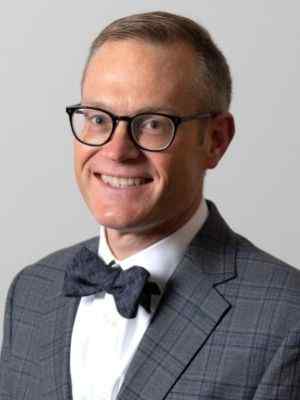
Jeff Jarman has always been interested in political science, but winning the national debate championship as a college senior sent him in a new direction.
“I loved debate and wanted to remain involved,” he said, adding that coaching became the next step. “Most debate coaches are in communication, so I went to grad school and studied communication with an emphasis on political communication.”
Jarman directs the debate program at WSU, but since becoming the interim director of the Elliott School, he has turned over a lot of the day to-day coaching and travel to Sam Maurer, assistant director of debate.
In his role as KSN’s political commentator, Jarman regularly provides political analysis on local, state and national political issues. He observed a lot of gaffes from the recent presidential candidates and would remind them that it’s on them to shape the message they want told.
“The media cover the story you give them,” Jarman said. “Politicians through their deeds and through their words play an important role in what the news cycle is, but they don’t seem to appreciate that most reporters typically will include whatever answer you give.”
Jarman serves on the Maize School Board. He’s married to Jan, an attorney, and has
two daughters, Cady and Allison.
Jarman started working at WSU in 1996. He earned his bachelor’s degree in political
science from Southwest Missouri State University and his master’s and doctoral degrees
in communication studies from the University of Kansas.
Holmes Museum Educates and Serves Students and Community
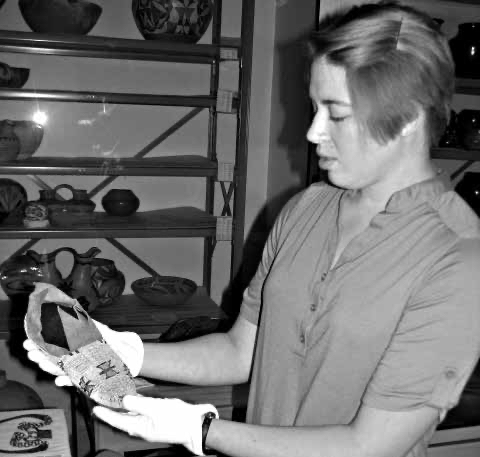
Jordan Adams holds a Moccasin in need of reshaping and some
light cleaning.
Jordan Adams held up her favorite item in the Lowell D. Holmes Museum of Anthropology collection: an embroidered red cotton and silk shoe that measures four inches from toe to heel. Known as a silver lotus shoe, it had been worn by a middleclass Chinese woman who had participated in the 1,000-year practice of foot binding
The process was begun on young girls at a time when their bones were still soft or would break easily, Adams explained, and their feet could be bent and shaped. The ultimate goal for women was to have Golden Lotus feet that would fit into a three-inch shoe.
Adams is nearing the end of her master’s program in anthropology and works as the museum’s registrar and collections manager. She benefits from the dual role Holmes envisioned for the facility when he opened it as the Museum of Man in 1966: to support the educational mission of the anthropology department and Wichita State, and to serve as a teaching museum operated by students enrolled in the museum studies program.
“I feel like I’m becoming fairly well-rounded,” Adams said. “Even though this isn’t some big, fancy museum with lots of different programs and equipment, it is still very good experience that I can take to wherever I choose to go next.”
The museum is widely regarded as a hands on teaching museum.
“There are really no others in Wichita, and very few in Kansas,” said Rachelle Meinecke, director of the Holmes Museum. “Holmes intended all along for it to be a teaching museum, and it has developed over time.”
Students in Meinecke’s museum studies class, ANTH 606, get an all-encompassing experience through their relationship with the museum.
“Students get to actually curate items,” she said. “They get to catalog items and write condition reports, photograph the items, label them and put them into storage. They get to see the whole process from the paperwork side of it to actually taking care of the items.”
According to an article in the Feb. 16, 1968 issue of the Sunflower, Holmes essentially built the museum space with his own hands. He used $2,000 in university funds to buy lumber, secondhand plate glass and hand tools. He also purchased a slide projector and a tape recorder. The museum opened in early 1966 and was located on the second floor of McKinley Hall, in one room on the south end.
Holmes was an expert on Samoa and loaned several pieces from his personal collection to the new museum. He exhibited pieces from the American Midwest and Southwest. He also hired Georgette Meredith, an assistant professor of anthropology, to serve as the first director of the museum.
From there, the Lowell D. Holmes Museum of Anthropology grew exponentially in the scope and breadth of its collections, which today include approximately 7,000 pieces. Now located in Neff Hall, the museum occupies approximately 3,000 square feet as a designated space, but pieces from the collections appear throughout the building.
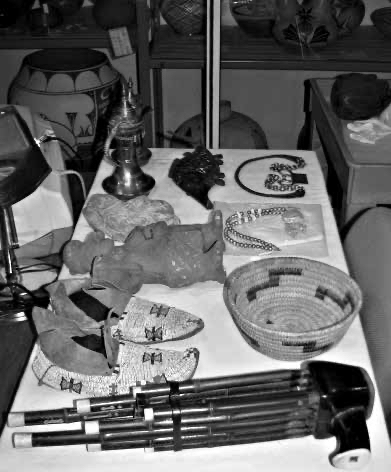
Several pieces to be used in Jordan' Adams' thesis
project wait to be cleaned or repaired.
“We don’t have enough space, so we use the entire building as the museum,” said Meinecke. “We just branch out everywhere. We have exhibits in the RSC and in the library.”
“There are really no others in Wichita, and very few in Kansas. Holmes intended all along for it to be a teaching museum, and it has developed over time.” -Rachelle Meinecke, director of the Holmes Museum
The peripheral exhibitions are often the work of anthropology students. In addition to learning about the acquisitions and curating processes, students also learn how to design, create and install exhibitions in ANTH 607, the museum exhibition course.
“I really had not planned to learn how to make exhibits,” said Adams. However, her graduate project will feature an exhibition of damaged or dirty items that she repaired or restored. One of these items is an Egyptian stone carving of a horse, covered in dirt.
“I want to clean off the dirt because it’s tough to see some of the details,” Adams said. “I am going to take it over to the geology department so they can take a sample and figure out what kind of stone it is. Because it’s carved, this is probably fairly soft stone, so I want to make sure I don’t use anything that will dissolve the rock away and make it worse.”
Adams believes her project will be of special benefit to other small museums, which often have limited funds to use for restoration of damaged pieces.
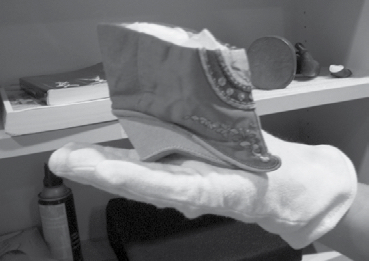
This Silver Lotus shoe features embroidery
most likely made by its wearer.
“I want to show small museums because they have all these items that they don’t do anything with,” said Adams. “Well, you can do something with them, and then you can put them on display and educate the public because that’s half of what a museum is.”
Another part of her exhibition will address preservation of items while on exhibit.
“Being on exhibit can be slightly stressful because items have to be in the light and in a less controlled environment,” Adams said, alluding to humidity, temperature and UV rays.
Adams hopes to open her exhibition on April 28, as part of the 50th anniversary celebration of the Holmes museum. Meinecke plans to host an anniversary party that may include cultural dancers, music and food.
For more information about the museum, visit holmes.anthropology.museum.
In Memorium
Maureen Hoag, 80, retired English instructor, died Aug. 25. She taught at WSU from 1967 to 2001.
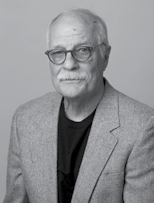
Jim Snyder, Katherine and Edith ErkerFaculty of Distinction Endowed Professor, died Sept. 11 at the age of 70. Snyder brought in more than $6 million in outside research funding and published 100 professional papers and chapters, most of them in his later years. He served as a member of the Psychosocial Development, Risk and Prevention Study Section of the National Institutes of Health. He also was active in the community with child-centered programs such as the Head Start and Early Head Start programs of Child Start.
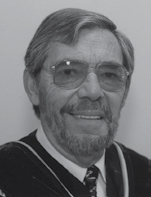
Bill Unrau, Emeritus Distinguished Professor of History, died Oct. 4. He was 87. Unrau taught courses in Western history, Kansas history and the Gilded Age from 1965 until his retirement in 1996. He continued to write during retirement, publishing “Indians, Alcohol, and the Roads to Taos and Santa Fe,” with the University Press of Kansas in 2013. Memorial contributions may be made to the Craig Miner-William Unrau Fund for Graduate Students at the WSU Foundation, 1845 Fairmount St., Wichita, KS 67260-0002.
Dean's Message
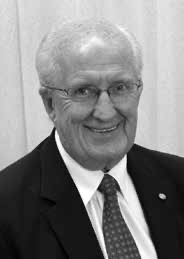
Ron Matson
Dear alumni, faculty, staff and friends:
So much is happening at WSU and within Fairmount College this fall. In this column, I want to talk about enrollment, WSU initiatives for this year and recent happenings that highlight our college and university.
WSU enrollment for fall 2016 is essentially flat. We are holding our own but have yet to turn the corner and move into growth mode. You can guess that growing is imperative if we are to achieve our aggressive goals of a “student centered, innovation driven” campus. LAS enrollments are down slightly, about 2 percent, while all the other academic colleges are up or flat. This is LAS’ second year of downturns.
This fall, chairpersons in each of our departments will conduct a comprehensive curriculum review. This will allow us to address our recruitment and retention concerns.
New for WSU is Strategic Enrollment Management. This initiative will move the university into an enrollment growth pattern tied to recruitment and retention. In the past year, the university is up about 10 percent in freshmen recruitment and up about 17 percent in non-resident students. However, those increases could not counter losses in numbers of graduate students. The numbers also could not counter losses of sophomores, juniors and seniors who did not return this fall.
A recent half-day event on WSU’s strategic planning activities allowed me to highlight several events for Fairmount College. Externally funded research and contracts in the college are up 81 percent the past two years and sit at $4.9 million for FY16. The college leads in online curriculum development, having posted a 45 percent increase in online credit hours between fall 2015 and fall 2016. One in seven credit hours offered in Fairmount College is delivered online.
Successes and challenges continue to define our collective enterprise. Know that you are a vibrant component of Fairmount College, and I appreciate your support.
Sincerely,
Ron Matson, Dean