


Wichita State University
Full-Time Faculty
Patrick Bondy
Associate Professor and Chair
Office: 110 Fiske Hall
Phone: (316) 978-7880
Ph.D. McMaster University (2012)
Areas of Interest: Epistemology, Ethics, Metaethics, Metaphysics, Formal and Informal Logic
Dr. Bondy joined the Department in 2018, having previously held limited term positions as Assistant Professor at Saint Mary's University, Brandon University, and Trent University, and a Postdoctoral Fellowship at Cornell University. His primary research interests are in contemporary epistemology, including especially the nature and normative force of epistemic reasons and rationality, the epistemic basing relation, epistemic luck, epistemic paternalism, epistemic injustice, and epistemological problems of peer disagreement and deep disagreement.
Susan Castro
Associate Professor
Director, The Academic Center for Biomedical and Health Humanities
Office: 310 Fiske Hall
Phone: (316) 978-7882
B.A. Mathematics--Applied Science, Specialization in Computing, UCLA
Ph.D. Philosophy, UCLA
APPA Certified Philosophical Counselor
Dr. Castro's research encompasses a wide range of interests that stem from graduate work in Kant scholarship, and early career work on the Human Genome Project at UCLA and support work for the Jefferson Institute of Molecular Medicine (no clinical or bench work). Her current focus is Philosophy of Biomedical Engineering, Philosophy of Medicine, and AI Ethics with a hefty dose of humanizing from World Philosophy and Philosophical Counseling.
Dr. Castro currently serves as the founding Director of The Academic Center for Biomedical and Health Humanities (HealthHum), which aims to center humanity and health and medicine through collaboration from campus to community in conjunction with the downtown Wichita Biomedical Campus and other health partners. She is also an Instigator for Responsible AI@ICT (rAI), a working group at Wichita State University that brings together researchers from all disciplines to collaborate in intelligently shaping our future in this new era of AI, through translational research that takes special care with respect to how artificial intelligence is developed and integrated into our world.
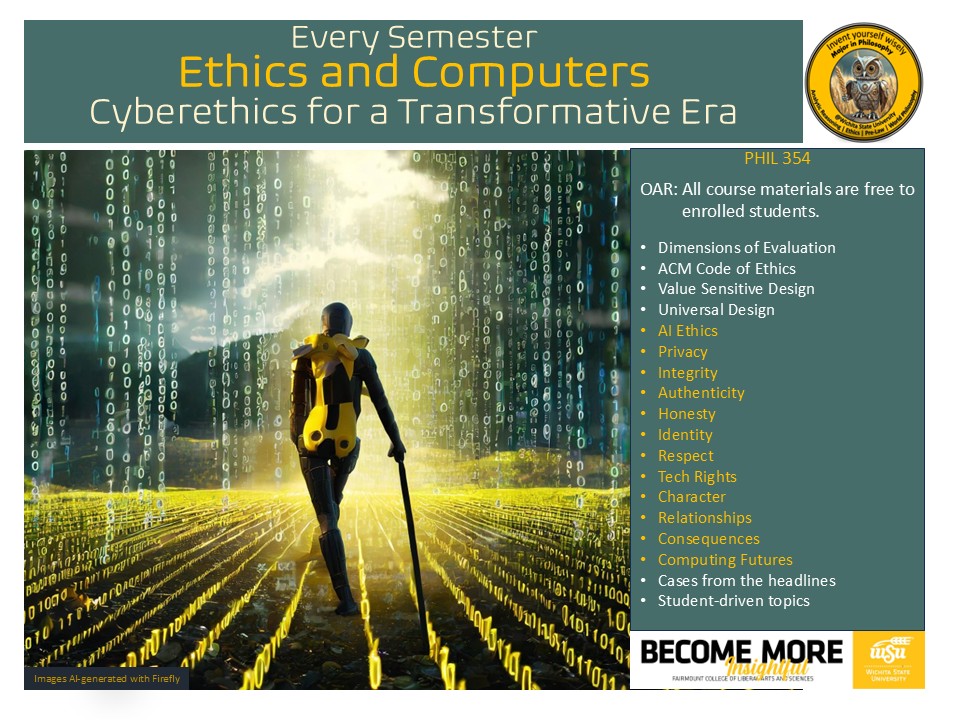
At WSU Professor Castro has taught History of Ethics, Metaethics, Ethical Theory, Philosophy of Law, Philosophy of Medicine, Philosophy of Feminism, Philosophy of the Arts, Business Ethics, Philosophy of Humor, Ethics and Computers, Biomedical Engineering Ethics, and Ethics of Big Data, among others. In Fall 2026 she will be the WSU Intercollegiate Ethics Bowl coach.


Scott Hill
Assistant Teaching Professor
Office: 008 Fiske Hall
Phone: (316) 978-3178
Dr. Hill received his PhD from the University of Massachusetts at Amherst and his BS from Kansas State University. His research is about ethics and religion. Before joining the Philosophy Department at WSU in Fall 2024, he worked at the University of Innsbruck, the University of Colorado Boulder, and Auburn University. He especially enjoys teaching ethics to engineering and computer science students.
Dr. Hill's Website: https://sites.google.com/view/hillscott/home.

Xiufen Lu
Associate Professor
Office: 311 Fiske Hall
Phone: (316) 978-7889
Ph.D. University of Kansas (2000)
Areas of Interest: Ancient Chinese Philosophy, Social/Political Philosophy, Feminism, and Ethics
Professor Lu earned a B.A. in English from the Beijing Second Institute of Foreign Languages, an M.A. in Philosophy and Women's Studies from Southern Illinois University at Edwardsville, and a Ph.D. in Philosophy from the University of Kansas. Her current research interests include Classical Chinese philosophy, Euro-American feminist theories and their relation to Third World women, and Marxism and its impact on Chinese society.
Angela Sager
Assistant Teaching Professor
Office: 016 Fiske Hall
Phone: (316) 978-7793
Ph.D. Philosophy, Fordham University (2021)
Areas of Interest: Philosophy of Religion, Continental Philosophy (emphasis in 19th-century European philosophy), Ethics, Ancient Philosophy (including ancient Chinese and Indian traditions), and Japanese Philosophy (particularly the Kyoto School)
Dr. Sager earned her B.A. in Philosophy, B.A. in History, and Minor in Religion at Wichita State University in 2012. She received her M.A. (2014), M.Phil. (2018), and Ph.D. (2021) in Philosophy from Fordham University. She regularly teaches Bioethics and Introduction to Japanese Philosophy as well as other courses like Introductory Logic and Critical Reasoning.
Research: Dr. Sager's research centers currently around the Existential Problem of Evil, or the fact that suffering can render a person's life meaningless. Specifically, this research includes:
- Outlining the therapeutic role of śūnyatā, or emptiness (particularly as the Buddhist concept is depicted by Keiji Nishitani), in overcoming the hopelessness of anomy.
- Illustrating a particular form of existential suffering dubbed as "onryoan corruption" where—like vengeful spirits found in Japanese folklore and horror cinema — a victim perpetuates evil by fixating on her suffering to the point that she lashes out at the world in nihilistic rage.
- Constructing an ameliorating, philosophical response to evil that stresses the importance of eschatology and theosis (or divinized transformation) in restoring the loss of the world's order and meaning.
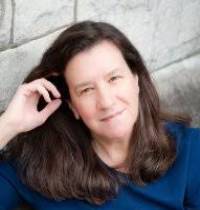
SUSAN G. STERRETT
Curtis D. Gridley Distinguished Professor of History and Philosophy of Science
Office: 307 Fiske Hall
Phone: (316) 978-7885
Areas of Interest: Philosophy of Science, History and Philosophy of Science, Philosophy of Mind, Analytic Philosophy.
Courses taught at WSU include: Women in Tech, Science and the Modern World, Minds and Machines (Honors), Engineering Ethics.
Susan G. Sterrett joined the department in the Fall of 2013, after having taught at Duke University, Carnegie-Mellon University, and the University of Pittsburgh. Professor Sterrett has a B. S. degree in engineering science from Cornell University, and an M.A. in Mathematics, M.A. Philosophy, and Ph.D. in Philosophy from the University of Pittsburgh.
Research:
"My area of specialization is philosophy of science, broadly construed. Much of my work concerns models and analogical reasoning in some way, whether in engineering, physics, geophysics, biology (Darwin), or artificial intelligence. One of my contributions has been to argue for the significance of the concepts of physical similarity and physically similar systems, already recognized as important in science and engineering, to philosophy of science. I use both historical and analytical approaches -- often together.
Besides the major works on analogical reasoning, models and modeling: I've published a group of papers on Alan Turing and natural and artificial intelligence. In an advanced undergraduate interdisciplinary textbook on logic, I presented and discussed alternatives to classical logic that are valuable in automated reasoning systems faced with inconsistent information. Overall, I have published widely on the history and philosophy of science, of technology, and of engineering methodologies."
Lecturers
Rebecca Fensholt

Chris Fox
Office: 001 Fiske Hall
Phone: (316) 978-7890
Chris Fox engages with issues in the History of Western Philosophy through the conceptual framework of post-Kantian European Philosophy. He earned his BA in Philosophy at Seattle University and his Masters and Doctorate at the University of Memphis. Dr. Fox’s dissertation, written under the direction of Robert Bernasconi, dealt with religion in the thought of G.W.F. Hegel and Emmanuel Levinas. Since then his published works have treated topics such as forgiveness in Hegel, comparative studies in political theory involving Rene Girard and Georgio Agamben, globalization, technology, ethics and eschatology in Christian and Jewish thought. Currently, Dr. Fox is working on a monograph that tracks the influence of Roman historian Tacitus on the depictions of Jews and German in the works of Spinoza, Hegel, Nietzsche and Heidegger. Dr. Fox has taught full time at the baccalaureate level in Kansas since 2003, is a father, grandfather and husband, and enjoys traveling with cats.
Jeremy Gallegos
Ph.D. Purdue (2002)
Areas of Interest: Ethics; Social and Political Philosophy; Philosophy of Law; Eastern thought; and Existentialism and Phenomenology.
Professor Gallegos earned his B.A. in Philosophy at Wichita State University in 1995. He received his M.A. (1998) and Ph.D. (2002) in Philosophy at Purdue University. He has delivered papers at the Hume Society, the Merleau-Ponty Circle, and the World Congress of Philosophy, the last of which was included in the online published proceedings. Outside of the academic arena, he has delivered "Ethical Issues for Bankers" seminars in Austin, Texas and conducted presentations at the Wesley Medical Center's Ethics Committee where he is also community member. Currently, he also teaches organizational behavior, leadership, and corporate governance at another university full time.
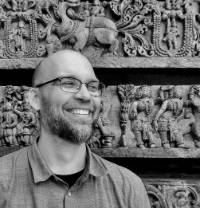
Jason Matteson
Ph.D. University of Arizona (2011)
My main teaching and research interests focus on understanding what it takes to live well and ethically, together, within complex modern societies. More narrowly, I work primarily within environmental ethics, disability ethics, and the ethics of cities. I have taught courses on normative ethics, meta-ethics, economic markets, philosophy of law, and personal identity. I enjoy living all over the world. I grew up in Kansas, but have spent significant time in South Africa (in high-school), in Senegal (as a Peace Corps Volunteer), in Tucson (for graduate school), in Flagstaff (as a university instructor), and in India (as a university instructor). I currently divide my time between family, teaching, and a textbook project on engineering ethics.
Anastasia Pine
BA in Philosophy, Wichita State University
BA in English Literature, Wichita State University
MA in Philosophy, University of Kansas
I have a BA in Philosophy and a BA in English Literature from Wichita State. I also have an MA in Philosophy from the University of Kansas. I teach Business Ethics online and am interested in applied ethics and philosophy of language.
Other Associated Faculty
Robert Feleppa
Professor Emeritus
Office: 116 Fiske Hall
Phone: (316) 978-7881
Ph.D. Washington University (1978)
Areas of Interest: Philosophy of Social Science, Metaethics, and Comparative Philosophy, with current emphasis on the comparison of Asian and Western thought and culture.
Professor Feleppa has been at WSU since 1980. In 2001 he received the college's John R. Barrier Distinguished Teaching Award; in 2004 he was promoted to full Professor. Dr. Feleppa is working on a series of papers in Philosophy of Social Science. Click here for Dr. Feleppa's cv.

Brian Hepburn
Associate Professor
Retired Spring 2025
BASc, Physics and Philosophy, 1999, University of Lethbridge. PhD, History and Philosophy of Science, 2007, University of Pittsburgh. Postdoctoral Fellow: University of British Columbia 2007-2011; Aarhus University (Denmark) 2011-2014.
Professor Hepburn's current research interests are scientific explanation, problem solving and innovation, particularly all three in interdisciplinary contexts. His dissertation was on how the concept of equilibrium was used in explanations in 18th century physics, and how this usage was connected to mathematical changes. He continues to work on an historical and philosophical picture of how the descriptive and explanatory resources we have available contribute to the problems we can solve. Especially interesting is when resources from different domains (whether scientific or not) can be integrated in some way. He hopes to use these insights to inform education in Science Literacy and Science Proficiency.
Jeffrey Hershfield
Retired 2024
Associate Professor, Director of the Legal Education Accelerated Degree program (LEAD), Director of Masters of Liberal Studies Program
jeffrey.hershfield@wichita.edu
Ph.D. University of Arizona (1992)
Areas of Interest: Philosophy of Mind, Philosophy of Language, Philosophy of Religion, Philosophy of Sex and Love.
Professor Hershfield was faculty advisor to the Pre-law Student Association and pre-law coordinator for WSU.

Day Radebaugh
Retired 2023
Office: 001 Fiske Hall
Phone: (316) 978-7890
M.S., Computer Science, George Washington University (1990); Ph.D. Philosophy, The Johns Hopkins University (1983)
Areas of Interest: Philosophy and History of Technology, Philosophy of Mind
Professor Radebaugh received a Ph.D. in Philosophy from the Johns Hopkins University in 1983 and an M.S. in Computer Science from the George Washington University in 1991. He served as Assistant Director of the Information Resources Division at the Federal Reserve Board in Washington, DC until 2001. Areas of specialization include ethical issues in computing and engineering, philosophy and history of technology, and information-processing theories of cognitive behavior.
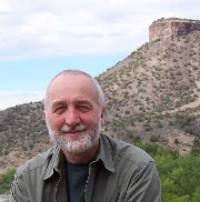
David Soles
Professor Emeritus
Office: 300 Fiske Hall
Phone: (316) 978-7886
Ph.D. The Johns Hopkins University (1977)
Areas of Interest: History of Philosophy, with emphasis in Epistemology
Professor David Soles received a BA in Philosophy from the University of Pittsburgh and a Ph.D. in Philosophy from the Johns Hopkins University. His primary areas of research and teaching are in the History of Philosophy, especially Modern European and Classical Chinese Philosophy. He has published numerous articles in the areas of Early Modern Philosophy and Classical Chinese Philosophy, and is currently working on a book project on Locke. He has received the Mortar Board Educator Appreciation Award, the George A. Lewis Teaching Award, the John R. Barrier Distinguished Teaching Award, The Wichita State University Leadership in the Advancement of Teaching Award, the Wichita State University Excellence in Teaching Award, and The Presidents Distinguished Service Award. He also has been selected as an Emory Lindquist Honors Society Mentor several times. Dr. Soles served as President of the SOUTHWESTERN PHILOSOPHICAL SOCIETY from 2003-05. When not studying or teaching philosophy he enjoys gardening, hiking, fly fishing in the Rockies and riding his horse named Jilly. Click here for Dr. Soles's cv.
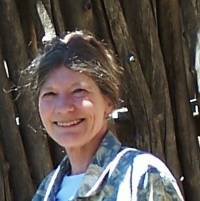
Deborah Hansen Soles
Professor Emeritus
Office: 300 Fiske Hall
Phone: (316) 978-7886
Ph.D. The Johns Hopkins University (1975)
Areas of Interest: Philosophy of Language, Epistemology, Philosophy of Logic; currently working on Donald Davidson on objectivity and belief.
Professor Deborah Soles routinely teaches Introductory Logic, and is responsible for Philosophy of Language, Philosophy of Logic, Theory of Knowledge, Analytic Philosophy, and offers special courses such as seminars on Davidson and Wittgenstein. Professor Soles received her B.A. from George Washington University and her Ph.D. from the Johns Hopkins University. She has been teaching continuously at WSU since 1975. Her major research area is the philosophy of language and adjacent topics in epistemology and logic, and she has published work on both historical and contemporary treatments of these topics. Currently she working on a book on Donald Davidson's epistemology. [click here for Dr. Soles's cv.] Since coming to WSU she has taught some dozen and a half different courses. She has served several times as an Emory Lindquist Honors program mentor, as a McNair program mentor, in 1999 was awarded the college's John R. Barrier Distinguished Teaching Award, and in 2008 was awarded the University Excellence in Teaching Award. In 1998 she received the President's Award for Distinguished Service to WSU. Dr. Soles is a Past President of the Southwestern Philosophical Society, and served as President of the Faculty Senate in 2009-2010.