


Wichita State University
Graduate Programs
The WSU graduate programs in chemistry prepare students for careers ranging from teaching at postsecondary institutions to conducting research in universities, industrial settings and government laboratories. Two graduate degrees are offered at WSU, the Master of Science and the Doctorate of Chemistry. Enrollment in either program requires a bachelor’s degree, however a master’s degree is not required for enrollment in the doctoral program.
Both degrees offer a wide range of up-to-date and rigorous courses encompassing six areas of chemistry along with a thesis based on original research for the M.S. and a dissertation based on original research for the Ph.D. degree.
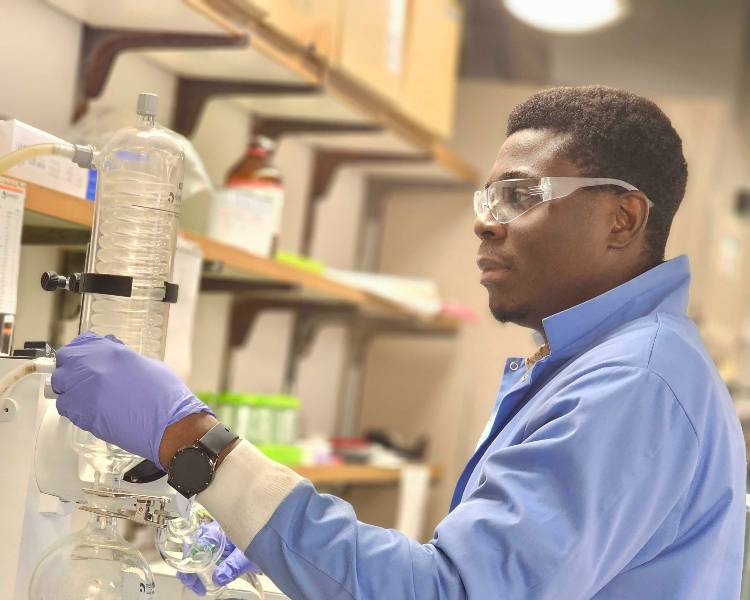
Master of Science in chemistry
A strong, research-oriented degree, the Master of Science in Chemistry involves the training of students in the art and logic of research and imparting an advanced understanding of the discipline of chemistry. Grounded in tradition and looking to the future, the Master of Science degree has been offered at WSU since 1930.
The Master of Science degree in chemistry prepares students for leadership and management roles in the chemical industry. Attainment of a master’s degree designates an individual as having achieved a higher understanding of the theoretical and practical aspects of chemistry and research. This degree improves career opportunities for students by providing advanced knowledge and training. Attainment of a master’s degree typically requires 2-3 years of advanced study and laboratory research.
Program requirements
The Master’s in Chemistry requires the completion of 30 credit hours, including the presentation of a thesis based on original research. For a complete list of courses and detailed descriptions, visit the university catalog.
Assessment Examinations
Examinations in the areas of analytical, inorganic, organic, physical chemistry and biochemistry determine a student’s mastery of undergraduate material. Students must pass four of these exams upon entering the program. Otherwise, they’ll enroll in appropriate advanced undergraduate courses within their first year to make up the deficiency.
Thesis
Students must select a research adviser before the end of their first semester in the program. The student incorporates the results of the original research project into a thesis. This thesis demonstrates that the student has become a trained research scientist prepared to embark on an advanced career in chemistry.
Financial Support
Graduate teaching assistantships are available to qualified students. Faculty members may also support students in their research groups from research grants. The department is committed to supporting M.S. students for up to two years as they pursue completion of degree requirements. Satisfactory performance ensures continuing annual financial support.
Graduate application forms and links
Ph.D. in chemistry
The doctoral degree in chemistry allows students to develop their full potential as independent research scientists. This degree involves an intensive training of students in which they complete original, independent research.
Ph.D. candidates complete an original body of research to support a scientific thesis, which they must defend before obtaining their degree. The Ph.D. degree offers the recipient unlimited career options including leadership positions in academia, industry or government.
The Ph.D. is the highest degree awarded in chemistry and recognizes those who have made notable, independent and original contributions to the field of chemistry. Attainment of a Ph.D. normally requires 3-5 years of advanced studies in which the major focus is on research. Students who have earned a bachelor’s degree may enroll directly into the Ph.D. program.
Program Requirements
All Ph.D. students are required to satisfactorily complete the “Professional and Scholarly Integrity Training” by the end of their first year in the program. Ph.D. students are also required to take 24 credit hours of graduate chemistry courses comprising core courses and focused courses. For a complete list of courses and detailed descriptions, visit the university catalog.
Assessment Examinations
Examinations in the areas of analytical, inorganic, organic, physical chemistry and biochemistry determine a student’s mastery of undergraduate material. Students must pass four of these exams upon entering the program. Otherwise, they must enroll in appropriate advanced undergraduate courses within their first year to make up the deficiency.
Cumulative Examinations
The cumulative examination program, which offers eight examinations per year, helps students keep well-informed of scientific literature and develop up-to-date methods of solving problems encountered in their chosen field of research. Successful completion of six cumulative examinations out of the maximum of 16 is deemed sufficient evidence of a student’s development in this area.
Research Proposal
During their fifth semester in the program, students prepare a proposal embodying a new and independent research problem and methods of achieving a solution to that problem. Students then defend their proposal before a dissertation committee.
Dissertation
Students must select a research adviser before the end of their first semester in the program. The student incorporates the results of the original research project into a dissertation. This dissertation demonstrates that the student has become a trained research scientist prepared to embark on a creative independent career in chemistry.
Financial Support
Doctoral students in chemistry are eligible to receive Fellowships in Chemistry. The department is committed to supporting Ph.D. students for up to five years as they pursue completion of degree requirements. Satisfactory performance ensures continuing annual financial support.
Graduate application forms and links