


Wichita State University
Undergraduate Program | Biomedical Engineering, College of Engineering, WSU
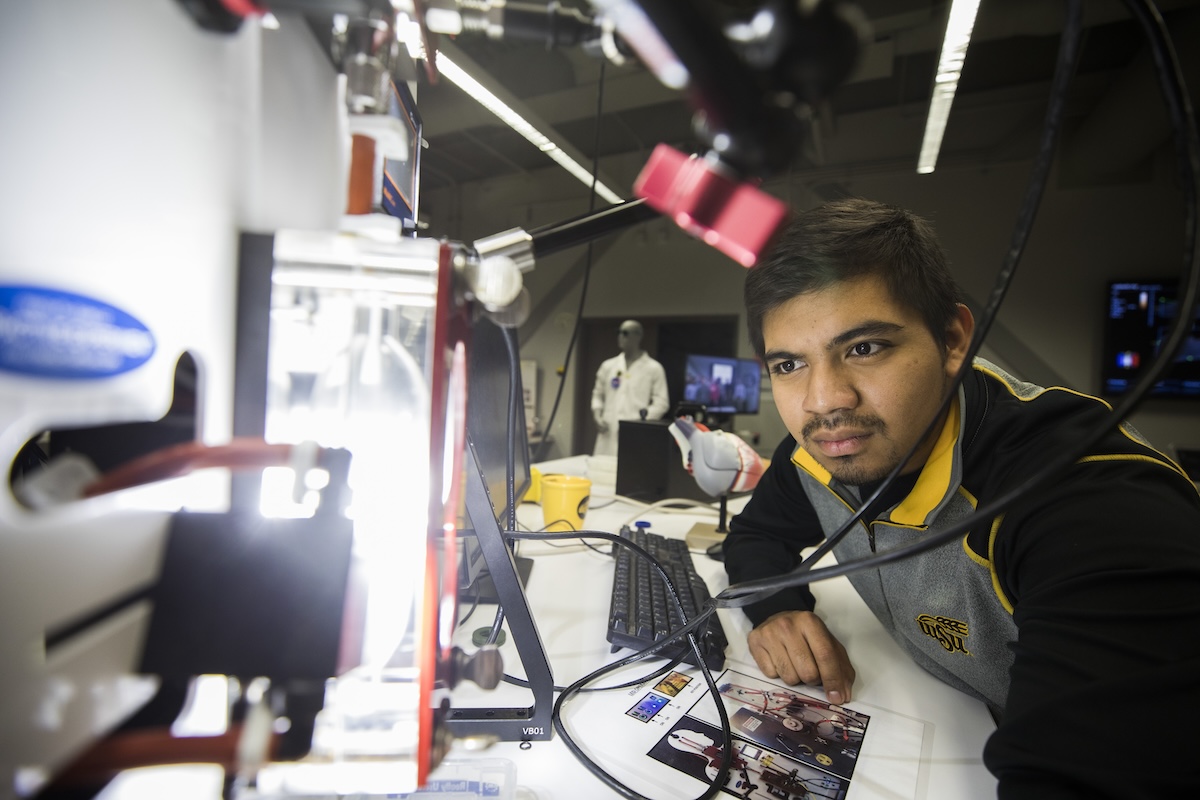
Biomedical Engineering Undergraduate Program
The undergraduate program in Biomedical Engineering is a 128/129 credit hour ABET accredited Bachelor of Science degree program that is based upon engineering fundamentals, mathematics, physics, anatomy and physiology, chemistry, organic and biochemistry, biology, biomechanics and biomaterials. Students in the biomedical engineering program acquire the capability to make measurements on and interpret data from living systems, addressing problems associated with the interaction between living and non-living materials and systems.
Mission
The mission of Wichita State University's Biomedical Engineering program is to provide students a comprehensive education, including integration of life sciences and engineering principles, to prepare students to address health needs at the local, national and global levels.
Program Educational Objectives
The educational objectives of the Biomedical Engineering program are driven by Wichita State University's mission to be an essential educational, cultural, and economic driver for Kansas and the greater public good, as well as the Biomedical Engineering program mission to prepare students to address health needs. Specifically, Biomedical Engineering program alumni, within a few years of receiving their baccalaureate degree, will be successful professionals as evidenced by having:
- Secure employment in engineering, biomedical, life-science, and/or health-related professions.
- Continue their professional development by pursuing advanced education, including graduate or professional degrees, certificate programs, and other formal training opportunities.
- Demonstrate a willingness to serve in leadership or supporting roles that contribute to addressing societal needs—such as improving health, safety, equity, sustainability, and community well-being—at local, national, or global levels.
Student Outcomes
Graduates of the Biomedical Engineering program will have:
- An ability to identify, formulate, and solve complex engineering problems by applying principles of engineering, science, and mathematics
- An ability to apply engineering design to produce solutions that meet specified needs with consideration of public health, safety, and welfare, as well as global, cultural, social, environmental, and economic factors
- An ability to communicate effectively with a range of audiences
- An ability to recognize ethical and professional responsibilities in engineering situations and make informed judgments, which must consider the impact of engineering solutions in global, economic, environmental, and societal contexts
- An ability to function effectively on a team whose members together provide leadership, create a collaborative environment, establish goals, plan tasks, and meet objectives
- An ability to develop and conduct appropriate experimentation, analyze and interpret data, and use engineering judgment to draw conclusions
- An ability to acquire and apply new knowledge as needed, using appropriate learning strategies
Accreditation
The Bachelor of Science program in Biomedical Engineering is accredited by the Engineering Accreditation Commission of ABET, https://www.abet.org, under the General Criteria and the Program Criteria for Bioengineering, Biomedical and Similarly Named Engineering Programs.
Sequence of Courses
| Sequence of Courses (Effective Fall 2024) | Hours |
|---|---|
| BME 115 (Biomedical Engineering Seminar) | 0 |
| ENGL 101 and 102 (College English I and II) | 6 |
| CHEM 211 and 212 (General Chemistry I and II) | 10 |
| MATH 242 and 243 (Calculus I and II) | 10 |
| Physics 313 (Physics for Scientists I) | 4 |
| First Year Seminar* | 3 |
| Sequence of Courses (Effective Fall 2024) | Hours |
|---|---|
| COMM 111 (Public Speaking) | 3 |
| BIOL 223 (Human Anatomy and Physiology) | 5 |
| BIOL 210 (General Biology I) | 4 |
| AE 223 (Statics) | 3 |
| MATH 555 (Differential Equations) | 3 |
| BME 335 (Biomedical Computer Applications) | 3 |
| CHEM 533 (Elementary Organic Chemistry) | 3 |
| BME 477 (Introduction to Biomaterials) | 3 |
| IME 254 (Engineering Probability & Statistics I) | 3 |
| BME 482 (Design of Biodevices) | 3 |
| Sequence of Courses (Effective Fall 2024) | Hours |
|---|---|
| PHIL 385 or 386 (Engineering Ethics) | 3 |
| EE 282 (Engineering Circuits I) | 4 |
| ME 398 (Thermodynamics) | 3 |
| BME 452 (Biomechanics) | 3 |
| BME 462 (Intro to Biofluids) | 3 |
| CHEM 661 (Intro to Biochemistry) or BIOL 420 (Molecular Cell Biology) | 3 or 4 |
| Physics 314 (Physics for Scientists II) | 4 |
| BME 480 (Bioinstrumentation) | 3 |
| Fine Arts and Humanities Elective* | 3 |
| Engineering Technical Elective** | 3 |
| Sequence of Courses (Effective Fall 2024) | Hours |
|---|---|
| IME 255 (Engineering Economy) | 3 |
| BME 585 (Capstone Design I) | 3 |
| BME 595 (Capstone Design II) | 3 |
| Social and Behavioral Sciences Electives* | 6 |
| Engineering Technical Electives** | 12 |
| General Education (Bucket 7)*** | 3 |
- *Refer to graduation requirements of the university undergraduate catalog for details.
- **15 hours of Engineering Technical Electives are required. Click here to see the list of eligible Engineering Technical Elective courses.
- ***3 hours of Open Electives can be considered. Click here to see the list of eligible Open Elective courses.
Learn More
To learn more about the Bachelor of Science in Biomedical Engineering, visit the Undergraduate Catolog.