


Wichita State University
John Bardo Center | College of Engineering, Wichita State University
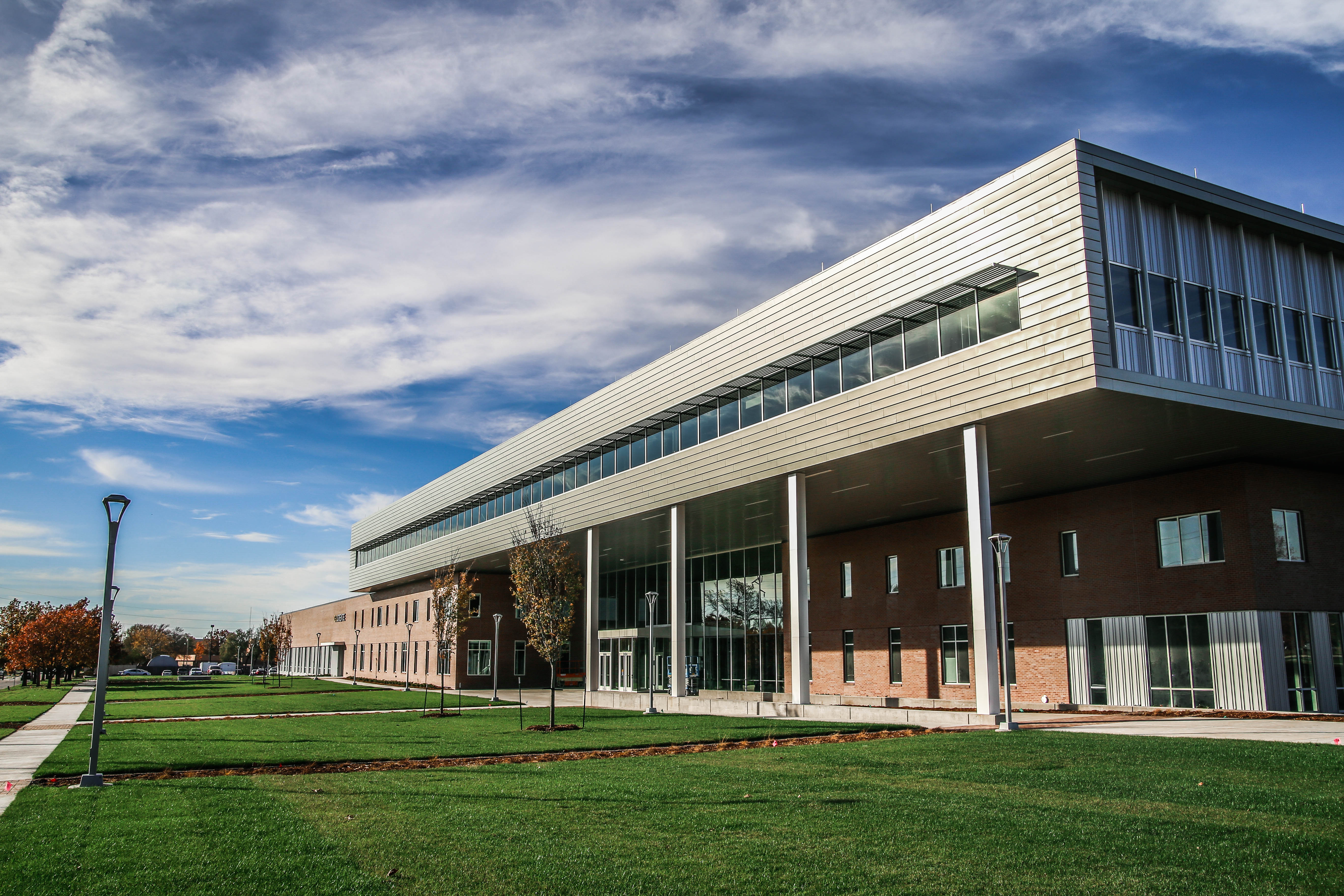
Explore the John Bardo Center
The $32 million, 143,000 sq. ft. John Bardo Center opened in January 2017 as the first phase in the development of WSU's Innovation Campus. Each College of Engineering department and program contributed to the design through a task-force of faculty members and department chairs. The result is a project-based experiential learning environment for bringing engineering fundamentals to life. Students benefit from ideas inspired by multi-disciplinary collaboration with faculty, students from across campus, industry, and the Wichita community. The building houses all the necessary tools for innovators to develop ideas into new products and bring them to market, including a 3D print center, business incubator and accelerator spaces, and a technology transfer office to offer advice on patents and marketing. (The building was originally called the Experiential Engineering Building but renamed for the former university president John Bardo, following his death in 2019.)
First Floor
Automation and Controls Lab
A multidisciplinary simulation lab that brings electrical, industrial, and mechanical engineers together in a setting that mimics a mini-factory layout with manufacturing, assembly, and packaging operations.
Aerospace Structures Lab
This lab provides for advanced structural testing of components and prototypes. Students get hands-on experience conducting tests using top-notch equipment, instruments, and methods.
Project & Prototyping Lab
This lab supports project and prototyping activities. Unique wind tunnel models, small aircraft, and interesting concepts are fabricated here.
Materials and Metallurgy Lab
An experimental workspace where students learn about materials testing and metallurgy, including metal fatigue test equipment.
Power and Engines Lab
A workspace for students to experiment with hydrogen fuel cells.
Vehicle Design Lab
Home to WSU's two SAE design and build race teams: SAE Baja and SAE Formula. This lab will house the team's race cars, a fully equipped machine shop, and a state-of-the-art engine test stand.
Metrology Lab
A lab to provide students hands-on experience in metrology and measurement. This lab contains several pieces of advanced measurement equipment such as the coordinate measuring machine and optical comparator.
Manufacturing Processes Lab
A lab for developing and testing functional prototypes that also provides students hands-on experience in measurement and inspection, materials testing, heat treatment, lathe and mill operations, plastics forming, casting, and assembly.
Controls Lab
Here, students take control theory out of the classroom in order to make motors spin, robots navigate, and drones fly at our command.
Project Innovation Hub
A central space where students will use state-of-the-art tools to turn ideas into prototypes and some, eventually, into products that will transform tomorrow.
Maker Space Hub
The space where students from across campus may use a variety of crafting, do-it-yourself, and basic manufacturing and prototyping tools to quickly build cost-effective and short-run prototypes and new products.
GoCreate, A Koch Collaborative
GoCreate is a creative community workspace open to creators of all ages and experiences. The 18,000-square-foot space offers sophisticated tools and equipment, as well as expert training and a supportive community that can help make your prototypes, projects and dreams come true.
3DEXPERIENCE Center
The 3DEXPERIENCE® Center, a partnership with Dassault Systèmes, involves an interconnected community of top researchers, corporations and laboratories to accelerate innovation. The 22,000 sq. ft. facility offers the expertise and technology for companies to accelerate their innovation.
Hexagon Manufacturing Intelligence
Hexagon Manufacturing Intelligence and the Wichita State’s National Institute for Aviation Research (NIAR) have an extended partnership agreement for cooperative research projects. For example, the automated scanning solution for customer applications. Hexagon also hosts technology workshops and training events in its space at WSU.
WSU Strategic Initiatives
WSU Strategic Initiatives empowers market-driven technology development, demonstration, and deployment by providing unparalleled access to WSU facilities, faculty, and students as problem solvers for business/industry, innovators, and students to explore, evaluate, customize, and implement new technology.
Applied & Experiential Learning
At Wichita State, applied learning is a big part of what we do. In fact, every degree we offer has opportunities for an applied learning or research experience. As a Shocker, you'll get the chance to work side by side with established professionals, building contacts, confidence and a strong resume before graduation.
Second Floor
Aerospace Propulsion Lab
This lab supports the interactive and detailed study of various aerospace propulsion systems, such as a small turbine engine and rocket motor test cell.
Astronautics Lab
A lab where students explore their interests in space systems, mission planning, and small-satellite design with significant computational and prototyping capabilities.
Virtual Instrumentation Studio
Hands-on education requires students to experience modern engineering tools such as software and virtual instrumentation. Students will learn how to apply these tools to analog and digital electronics, microcontrollers, communications, data acquisition, and instrumentation.
Electronics Hub
This hub simplifies the assembly and testing of unique power, wiring, and micro-controller components needed to complete project and prototyping activities in other labs.
Fluids Lab
An experimental workspace for students to study thermal and fluid science phenomena.
Third Floor
Computational Hub
No technology has impacted people in the 21st century more than computers and the networks that bring them together. In this hub, students will build the software that runs computers and the wired and wireless networks that connects them and us. This hub will also allow students to model, simulate, and visualize many complex aerospace related problems.
Flight Simulation Lab
Flight simulators allow students to demonstrate, evaluate, and refine vehicle behavior or control system designs.
Collaborative Software Studio
Because engineers and computer scientists rarely work on engineering projects or write software as individuals, this lab is designed to facilitate the writing of software and the use of software in teams.
Renewable Energy Lab
A space for undergraduate learning and outreach activities related to renewable energy technologies, namely wind and photovoltaic and thermal solar power.
Biomedical and Biosensor Development Lab
A space where students create innovative miniature and wearable biosensors to monitor vital signs for the purpose of enhancing human health.
Innovative BioImaging and BioComputational Modeling Lab
A space for students to develop quantitative approaches to improve medical diagnosis and treatment through application of mathematics, computational medicine, and bioinstrumentation design.
Multidisciplinary Human Biomechanics and Design Lab
A space for students from multiple disciplines — engineering, exercise science, health professions, human factors — to investigate the neuro-musculo-skeletal mechanics of activities of daily living and develop technologies to improve the quality of life for people with general and age-related disabilities.
Entrepreneurship Engineering Studio
A gathering place for students to apply entrepreneurial principles to engineering problems.
Computer Studio
Where students may access computers to design and simulate their projects
Martin Defense Group
Martin Defense Group is a provider of research and development services for the Department of Defense, NASA, and other government agencies. Historically a provider of naval architecture and modeling and simulation services, its portfolio has diversified to encompass digital twins, power and energy systems, unmanned vehicles, robotics, autonomy, AI/ML, data science, inflatables, composites, and additive manufacturing.