


Wichita State University
SEM Check-In Goal 3: Increase retention rates of degree-seeking underserved student populations
In conjunction with the University’s Strategic Planning process, WSU has developed a Strategic Enrollment Management (SEM) plan for future growth. To stay informed on the progress toward our goals, each month we will provide the status of one of the goals and provide information for you to assist us in moving forward together.
As announced on Oct. 1, WSU saw an increase of 1.58 percent, or 176 full-time equivalency (FTE), over last fall, and welcomed our highest new first-time-in-college (FTIC) class for the 3rd consecutive year*. While the increase in freshmen is great news with regard to recruitment, it is equally important to retain these students as they pursue their degrees.
Many on campus actively participate in retention initiatives, and we are grateful
for everyone’s efforts. We continue to enhance our outreach initiatives and will soon
have success coaches placed in each college to assist faculty in identifying and supporting
students who may not be on track toward graduation. 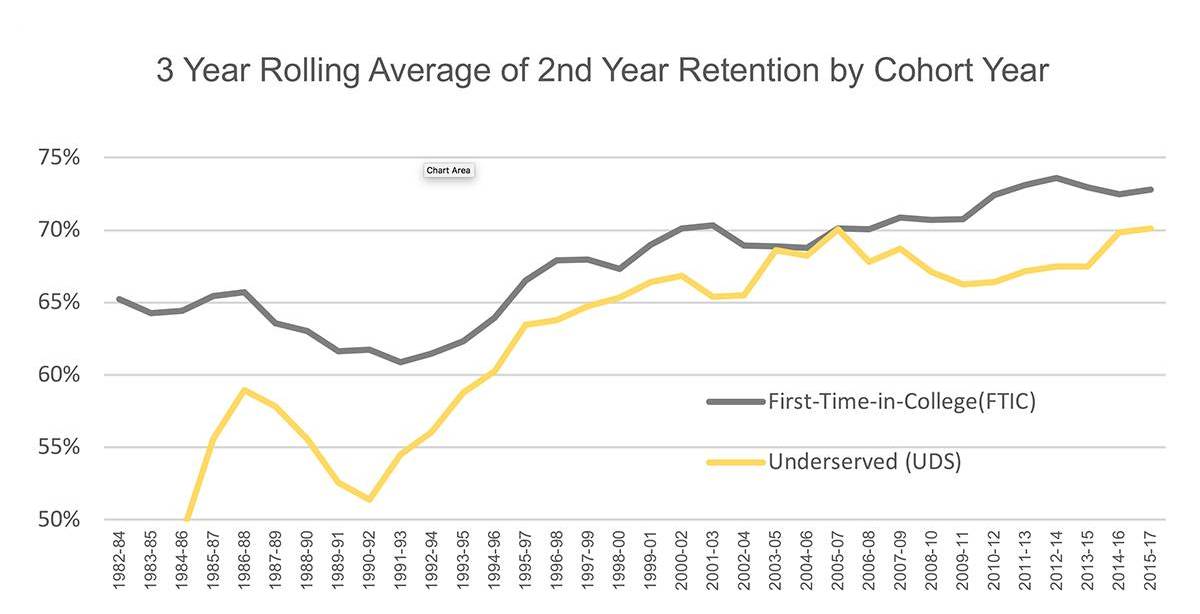
Our three-year rolling average retention rate is 72.8 percent for our most recent cohorts (FTIC), with underserved students within that cohort (UDS) being retained at 70.1 percent. There has been a gradual increase in the three-year rolling average retention for underserved student cohorts in the past five years, with the 2013-15 average retention at 67.5 percent. As a campus community, we still have work to do to reach our goal of retaining 78 percent of our underserved students by 2020**.
What can you do?
- Share the “Provost Tip of the Week” with your students as an announcement in Blackboard or through a course email message. These are also provided as a PowerPoint slide in the faculty toolbox.
- Encourage students to make advising appointments in preparation for spring enrollment to make sure they are on track with their degree and aware of scholarship deadlines.
- Use the Student Early Alert System (SEAS) on the myWSU Teach/Advise tab to flag students who may be having problems. The message generated by this alert directs students to change behaviors to improve their performance. It’s a proven tool in getting students back on track.
- Encourage students to download the Guide app (search “guide-college simplified”) that will provide reminders of important deadlines, academic planning reminders, information on paying for college, and other tips.
*KBOR’s full-time-equivalency (FTE) is based on a 15-hour load for undergraduates and 12-hour load for graduates. First-time-in-college (FTIC) are matriculating high school seniors who have no earned post-secondary coursework post their high school graduation; while most will start as freshmen, some may carry enough AP credit to start as sophomores or juniors.
** Underserved students include American Indian/Alaskan Native, Black non-Hispanic, Hawaiian, Hispanic; first generation; and low-income students with families at or below 125 percent of the poverty line.