


Wichita State University
An organization's control environment is the component most influencing the control consciousness of its people. The control environment is the basis for internal control and sets the tone for an organization. This episode examines how you contribute to the university's control environment.
Five Interrelated Components

Internal Control Pyramid
Every employee will have some internal control responsibility built into their job. We use a pyramid to illustrate how the five internal control components link and work together. Using this structure highlights how internal controls are "built-in" and not "bolted on" as an afterthought.
Consider how a plumbing or ventilation system works throughout a facility. When the systems work well, they work routinely and efficiently in the background, relatively unnoticed, resulting in positive outcomes.
But when the systems break down, they are very noticeable. And the failure can have consequences for many, especially those closest to the problem.
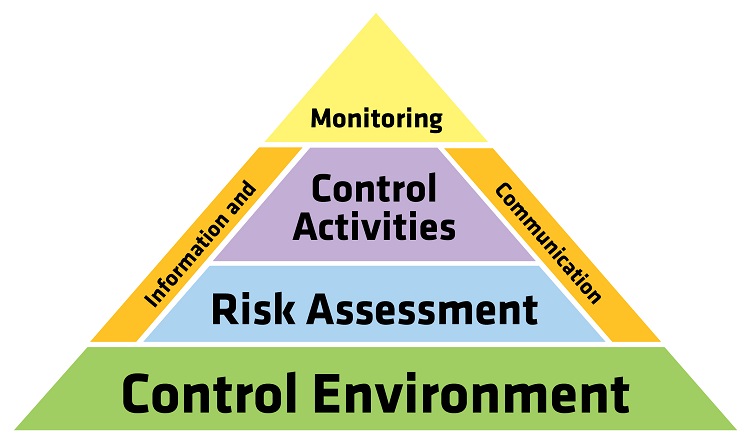
At the same time, the pyramid's broad base drives home the importance of having a sturdy foundation.
An organization's control environment sets the tone of an organization. It's the factor that most influences the control consciousness of its people and provides the foundation for all other components of internal control.
The control environment is the basis for internal control and sets the tone of an organization. Ultimately, it influences the control consciousness of its people. It's the foundation for all other components of internal control, providing discipline and structure.
Control environment factors include:
- The integrity, ethical values, and competence of the organization's people
- The administration's philosophy and operating style
- The assignment of authority and responsibility
- Processes for organizing and developing its people
- The attention and direction provided by the governing board
These factors illustrate how an organization's control environment depends on its people.
Criteria for Accreditation

(iStock/GOCMEN)
The Higher Learning Commission used five criteria for accreditation when it conducted its most recent evaluation of WSU.
- Mission
- Integrity: Ethical and Responsible Conduct
- Teaching and Learning: Quality, Resources, and Support
- Teaching and Learning: Evaluation and Improvement
- Resources, Planning, and Institutional Effectiveness
The commission's placement of "Integrity: Ethical and Responsible Conduct" as Criterion Two (second only to the university's mission) underscores the importance of an institution's control environment.