


Wichita State University
Multiple articles about the college admissions scandal cited it as a "textbook example" of the fraud triangle. Here's one that uses the triangle to look inside the minds of those involved.
Health writer Cory Stieg explains in Inside the Minds of Fraudsters Like the Parents in the College Admissions Scandal how the circumstances of this fraud differ from what is typically described as occupational fraud (where a longtime trusted employee violates that trust to commit fraud).
It's also important to remember that pressure needs only to be perceived. It will vary considerably between individuals depending on their social, economic, or celebrity status or other factors unique to the individual.
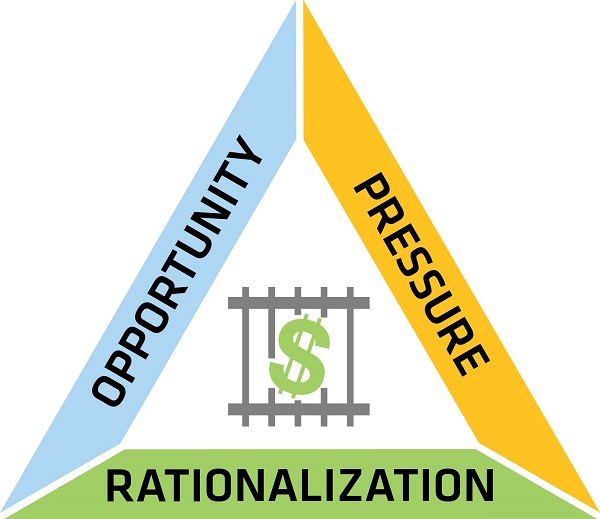
Here's a key passage where Stieg aligns the circumstances to each side of the triangle:
"The top of the triangle signifies the person's motivation for fraud which is pressure. Usually, people have a problem they need to solve (in this case, the problem is getting into a competitive college), but they can't through legitimate means, so they look to illegal stuff.
"Then, in one corner of the pyramid is opportunity, or a solution that's illegal, but is secretive enough that it won't get them caught. (Singer's business, The Key, would count as the parents' opportunity.)
"And then, there's rationalization, or a way that people can justify the crime to themselves and others. Here, the parents had seemingly the ultimate rationalization: wanting to provide their kids with what they consider a good education to better their futures."
Rick Singer, the principal orchestrator of the admissions scheme, created a "side door" euphemism to further help parents rationalize their participation. Characterizing his illegal activities as a side door suggested it was simply an alternate avenue to admission and gave it an air of legitimacy.
Jennifer Baker, PhD, associate professor of philosophy at the College of Charleston who specializes in ethics, explains how the scammers' rationalized their actions as simply a way to help their kids:
This particular type of scammer often believes that they're a morally good person who's in a sticky situation -- in other words, they believe the end justifies their means.
Jennifer Baker, PhD, College of Charleston
For a practical understanding of the fraud triangle and additional context to pressure, rationalization and opportunity, refer also to Getting Ahead of the Risk and Fraud Triangle Primer.