Hugo Wall School of Public Affairs

Mapping value in Sedgwick County

Linking Fiscal Information with Land Use Policy

  • An alternative way to prioritize land use
  • Consider fiscal impacts of the land use pattern
  • Collaboration between county and municipalities
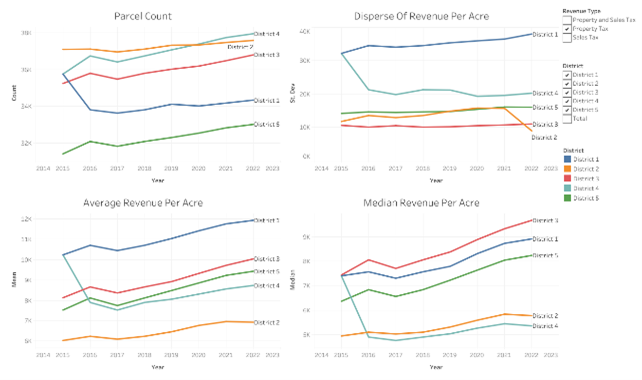
line graph

Think of It as an Opportunity

  • Use underutilized parcels within existing urban areas
  • Maximizes the utility of the land and improves revenue per acre

Balance of Development Choices

  • Low-density development (larger lots or more spacious layouts)
  • Cross-subsidization
  • Balance budgets and supplement services to less dense areas
  • Raises issues of fairness and long-term fiscal sustainability

About Hugo Wall School

The Hugo Wall School of Public Affairs reflects the vision of its namesake, Dr. Hugo Wall, a professor who served the University for forty-two years, from 1929 to 1971. In the mid-1940s, Professor Wall began envisioning an academic unit that would link the University and the community. The mission of the Hugo Wall School of Public Affairs is to engage a diverse faculty, staff, and graduate students in applied learning and applied research that benefits the community.

Through rigorous quantitative and qualitative analysis, the school's research addresses critical public sector issues, informs public policy decisions, and contributes to the advancement of effective governance and public service delivery. Whether examining public finance, urban development, environmental sustainability, or social equity, the school's research endeavors strive to enhance our understanding of complex challenges faced by government and non-profit organizations.

The Hugo Wall School also houses two applied research centers: the Environmental Finance Center (EFC) and the Kansas Public Finance Center (KPFC). In 2023, the EFC was selected by EPA to establish the Heartland Environmental Justice Center.

Deeply integrated into the local community, the Hugo Wall School is involved in numerous projects with nonprofit and public partners that provide applied learning opportunities for students and build community capacity.


Ongoing Grants and Sponsored Research

  • “ECO-CBET: Convergent Electrolysis-Electrodialysis System (CEES) to Curb Urban Chloride Pollution by Eco-friendly Road Deicing and Upcycling Waste Salt.” National Science Foundation.
  • “Indoor Air Quality at Schools and Daycares in Low-income Communities through the Decision Support Tool.” Funded by Environmental Protection Agency.
  • NSF EPSCoR RII Track-1: Adaptive and Resilient Infrastructures driven by Social Equity (ARISE), National Science Foundation
  • Research and Education Innovation (REI): Integrating Social Equity into Infrastructure Maintenance Planning Towards Resiliency, Kansas NSF EPSCoR
  • Sedgwick County Revenue Analysis Project Phase II
  • WSU Convergent Sciences - Smart Fusion Material Research Cluster


Environmental Finance Center

Our Mission is to build capacity for addressing environmental challenges.

We Serve communities, municipalities, utilities, nonprofits, businesses, state and local agencies, and more.

Grant and Contract Highlights

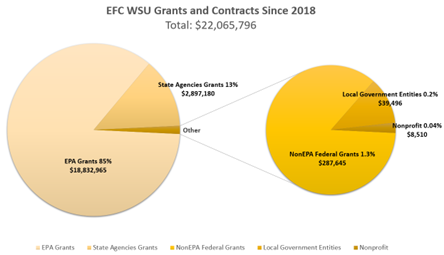
    • EPA Region 7 Environmental Justice Thriving Communities Technical Assistance Center (Heartland Environmental Justice Center) $10M
    • EPA Region 7 Reginal Water Infrastructure Environmental Finance Center $3.4M
    • EPA Region 7 Multi-Environmental Media Environmental Finance Center $4.08M
    • EPA Region 7 Training and Technical Assistance to Rural, Small & Tribal Wastewater Treatment $980K
    • KDHE Technical Assistance for Nutrient Discharge Reductions $980K
    • KDHE Capacity Development for Drinking Water Systems $693K
    • EPA Children’s Healthy Learning Environments in Low-Income and/or Minority Communities, Indoor Air Quality in Schools and Daycares
    • EPA Innovative Water Infrastructure Workforce Development Program, Future Water Leaders. $305K
round graphs

Heartland Environmental Finance Center

The Heartland Environmental Justice Center supports
communities that are experiencing environmental injustice
across Iowa, Kansas, Missouri, Nebraska, and adjoining Indigenous Nations.
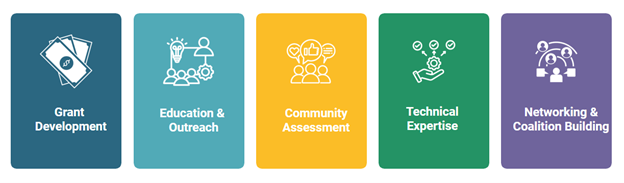
Project Work Examples

  • Assistance applying for nonprofit status and other required designations for federal grant applications.
  • Aligning like-minded community stakeholders from academic, public, and nonprofit sectors to drive change collectively.
  • Helping CBOs & rural local governments apply for programs to assess and determine environmental contamination levels and remediation needs on abandoned properties for acceptable future use.
  • Working with communities on issues like illegal dumping, industrial air pollution, inequitable access to public green spaces, transportation infrastructure, community gardens, food deserts, cultural heritage preservation, lead removal, and green energy
EFC


©