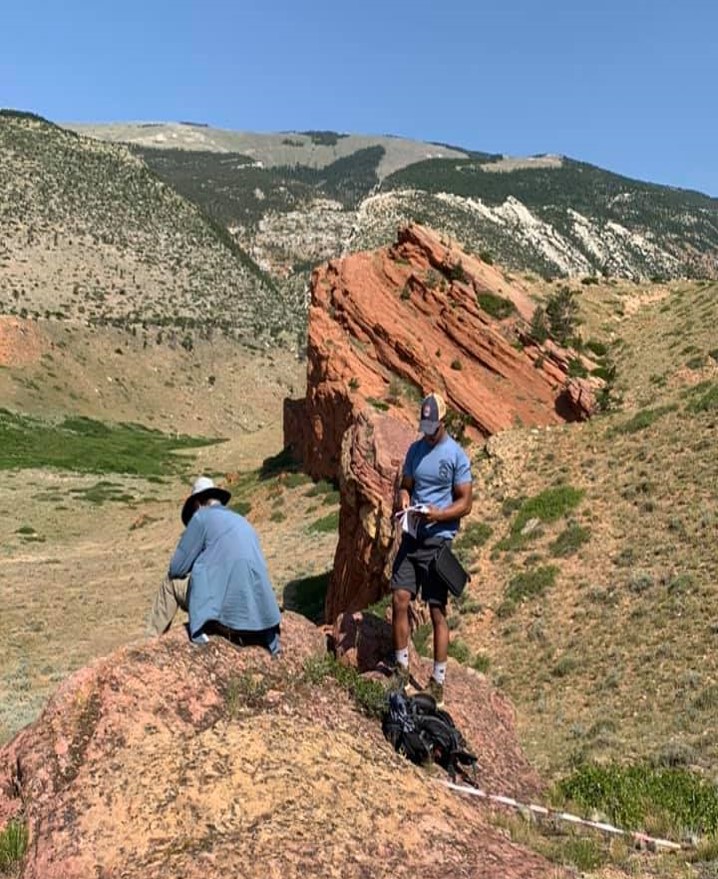
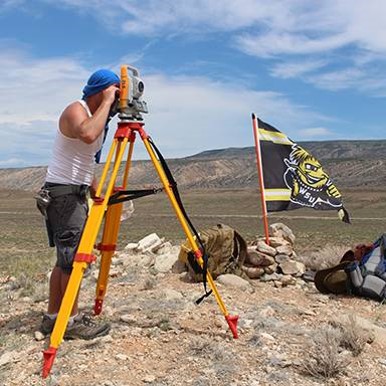
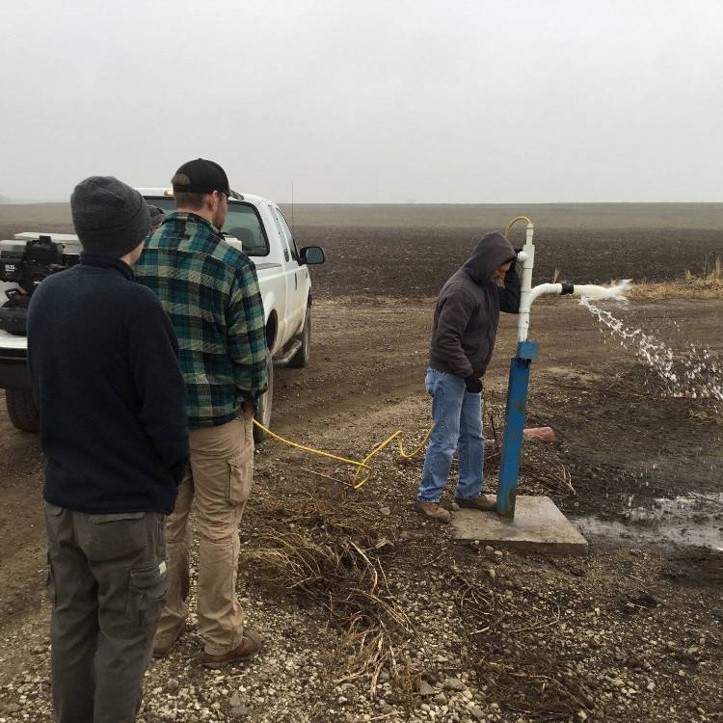
Geology is the study of the Earth, its materials, and its processes. Geology is essential for finding solutions to climate change, natural hazard mitigation, pollution and waste disposal, resource exploration and sustainability, and civil engineering projects. The Geology Department offers applied degrees and certificates to prepare students for careers in industry, government, and education.
Areas for Industry Support and Collaboration
Faculty-led department research groups include:
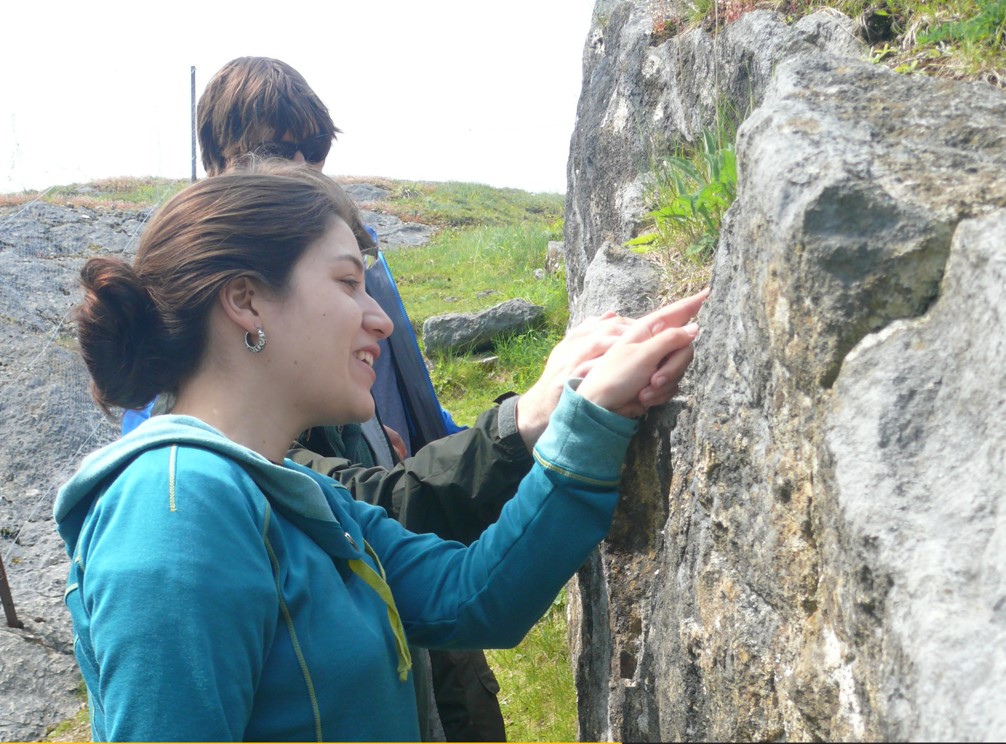
This research group studies contaminants in the environmental media – soil, groundwater, sediment and surface water. Recent students involved in faculty research are employed in environmental remediation companies, government agencies and nonprofit groups.
This group studies mineral and energy exploration for efficient use and extraction, emphasizing the Earth processes that concentrate economically valuable resources. Recent students involved in faculty research are employed in petroleum companies and mining industry.
This group applies geographic information systems and mapping techniques in environmental sciences, natural resource exploration, social sciences and life science applications. Recent graduates work with government agencies, environmental industries, and natural resource exploration companies.
This group focuses on the study of Earth’s history including climate change, plate tectonics, physical geography and paleontology. Recent graduates are employed in environmental companies, natural resources industry, education, and government agencies.


Geology is fundamentally an applied and practical discipline that supports industry
and societal interests. Research in the department addresses fundamental questions
about the physical processes and history of the Earth and applies this knowledge to
benefit society. The research programs of many faculty are broadly interdisciplinary,
blurring the boundaries between geological and other disciplines and between fundamental
and applied research. Geology’s three faculty and an Executive in Residence are involved
with four research clusters. They also participate in specific centers and groups
that further faculty research and involve student participants. Geology Faculty: Dr. Zelalem Demissie (Asst Professor) Kevin Doyle (Executive in Residence) Dr. Will Parcell (Assoc Professor and Chair) Dr. Andrew Swindle (Assoc Professor)Applied Research and Scholarship
Demissie: 3D Displacement Maps using remote sensing technologies DInSAR and MAI Demissie, Parcell, Swindle: Assessing strain localization and distribution in the
southcentral Kansas using geodetic and seismic observations Parcell: Gamifying Geology - Digital transformation of field experiences through Minecraft,
Unreal, and Unity3D game engines Parcell: Elemental and mineral stratigraphy of mixed carbonate-clastic system: Middle
Jurassic Gypsum Spring Formation, Bighorn Basin, Wyoming Parcell: Microbial carbonate textural controls on porosity and permeability; application
to geothermal, petroleum, and groundwater aquifers. Parcell: Philosophy of Geology. Translation and analysis of Athanasius Kircher’s Mundus Subterraneus (1665), Itinerarium Exstaticum (1656) and Iter Exstaticum II (1657) Swindle: Clay minerals in surface soils of Kansas prairies (w/ G. Houseman, Dept.
of Biology) Swindle: Using sandstone to increase the effectiveness of passive and semi-passive
AMD remediationResearch Topic Highlights
An Integrated TIME-SERIES Surface Deformation Analysis Using INSAR, GNSS, and NLDAS
Data, Wichita earthquake. Demissie, Z., 2022, Journal of Remote Sensing (MDPI) 3D Displacement Maps of the 2019–2020 Puerto Rico Earthquake Sequence from DInSAR
and MAI and Comparison with Mapped on Land Faults. Demissie, Z., 2020, Seismological
Research Letters Holocene to Recent Sedimentology & Stratigraphy of Dickmans Island, a Mangrove Island
in the Northern Portion of the Ten Thousand Islands Estuary of SW Florida, Doyle,
K. 2021, Geological Society of America Annual Meeting A Field Camp experience with Minecraft: Gamifying field mapping, exploration, and
discovery in the Bighorn Basin, Wyoming. Parcell, W.C., 2020, Geological Society of
America Synthesis, Crystal Structure, and Thermoelectric Properties of Ternary Phosphides
BaCu5P3. Cicirello G, Swindle A, Wang J, 2021, Journal of Solid State Chemistry Synthesis, Crystal Growth, Electronic Properties and Optical Properties of Y6IV2.5S14
(IV=Si, Ge). Ye Z, Bardelli S, Wu K, Sakar A, Swindle A, Wang J, 2020, Journal of
Inorganic and General ChemistryPublication and Presentation Highlights
Our faculty consistently excel in attaining industry awards and gifts. Between 2017
and 2022 the Geology Department was awarded over $5.5 million. Acquisition of a Bench Top SEM and Field Equipment for Research and Teaching. National
Science Foundation. Andrew Swindle, 2021 ($275K) Nanoparticle sorption behavior in chemically complex environments: bridging the gap
between lab and field investigations. National Science Foundation. Andrew Swindle,
in review 2022 Woolsey Family Field Camp Fund (1 million endowment) and Woolsey Family Petroleum
Fund (1 million endowment) 2018. Gifts to support energy and mineral resource development
and student field trainingGrants and Industry Donation Highlights