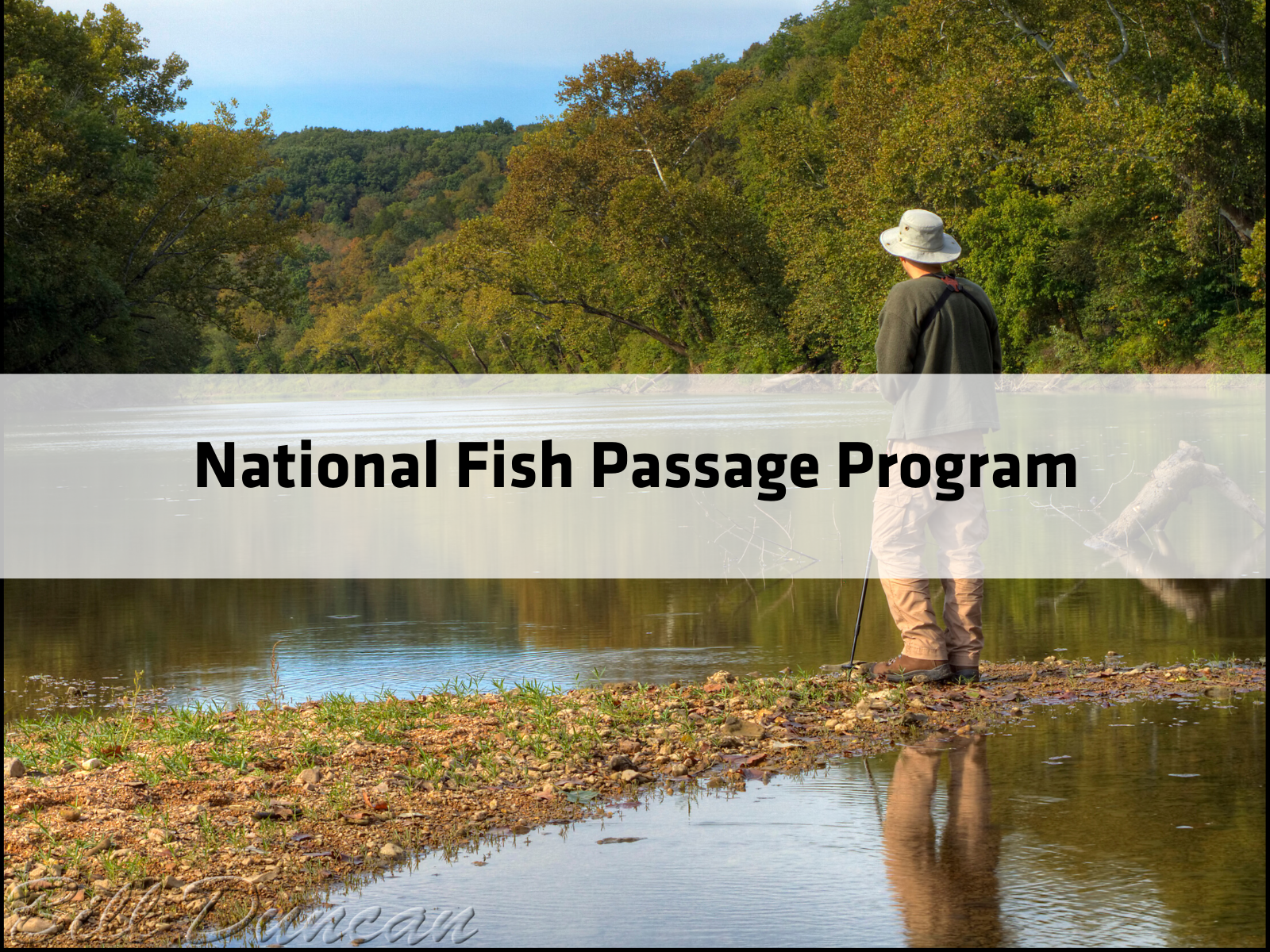
Through the National Fish Passage Program, the USFWS provides financial and technical
assistance to reconnect aquatic habitats through the removal of barriers.
Quick Facts
USFWS Mission To conserve, protect and enhance fish, wildlife, plants and their habitats
Program Mission Improve and remove barrier to fish movement and reconnect aquatic habitats
Eligibility State governments, Local governments, Tribes, Universities, Nonprofits, Businesses,
Individual landowners, Ranchers
What do they fund? Inventories, Assessments, Research, Levee breaches, Engineering, Fishways, Fish passage
training, Low water crossings, By-pass channels, Culvert replacement, Dam removal,
Water diversion, Natural rock ramps
What don’t they fund Mitigation, projects required by regulation
Length of funding Variable
Amount of funding Average funding is $70,000. Could be a few thousand dollars. There is no upper limit.
TheNational Fish Passage Program focuses on restoration of waterway connectivity by providing funding and technical
assistance to a wide variety of partners.
USFWS funds could be used to enhance a floodplain restoration project or other healthy
watershed project when reconnecting waterways is involved.
USFWS can be engaged after a disaster to provide technical assistance, and possible
funding, for culverts, fish passage, etc. so that flooding and wildlife benefits can
be achieved. See this video about how NFWS helped Vermont in 2011 after a flood disaster.
Contact your Regional Fish Passage Coordinator or Local Fish and Wildlife Conservation
Office to initiate a project proposal. It is recommended that you engage the regional
coordinator early in the project planning process.
Proposals are reviewed on the following criteria:
Show the greatest ecological benefits for trust species
Exhibit permanence of fish passage benefits
Make use of the most current scientific knowledge and proven technology
Evidence of the greatest public support
and generate the maximum in matching contributions
Project Examples
Lower Mississippi River Levee Breach Project
The USFWS worked with the Lower Mississippi River Conservation Committee, the Army
Corps of Engineers and Wildlife Mississippi to restore access to wetlands along the
Mississippi River. The river was reconnected to a 3.5-mile-long channel with vital
fish spawning and rearing habitat by notching a hole in Dike 2 on Island 70.
Region 3 – Midwest (Illinois, Indiana, Iowa, Ohio, Michigan, Minnesota, Missouri,
and Wisconsin)
Jessica Hogrefe Fish Passage Coordinator 5600 American Blvd. West, Suite 990 Bloomington, MN 55437-1458 jessica_hogrefe@fws.gov
General Questions: Eric MacMillan, National Fish Passage and Aquatic Habitat Coordinator Eric_MacMillan@fws.gov, 703-358-2435
Consult your community’s attorney and financial advisors prior to moving forward with
any of these funding options. Any reference in this website to any person, or organization,
or activities, products, or services related to such person or organization, or any
linkages from this website to the website of another party, do not constitute or imply
the endorsement, recommendation, or favoring of companies or organizations.