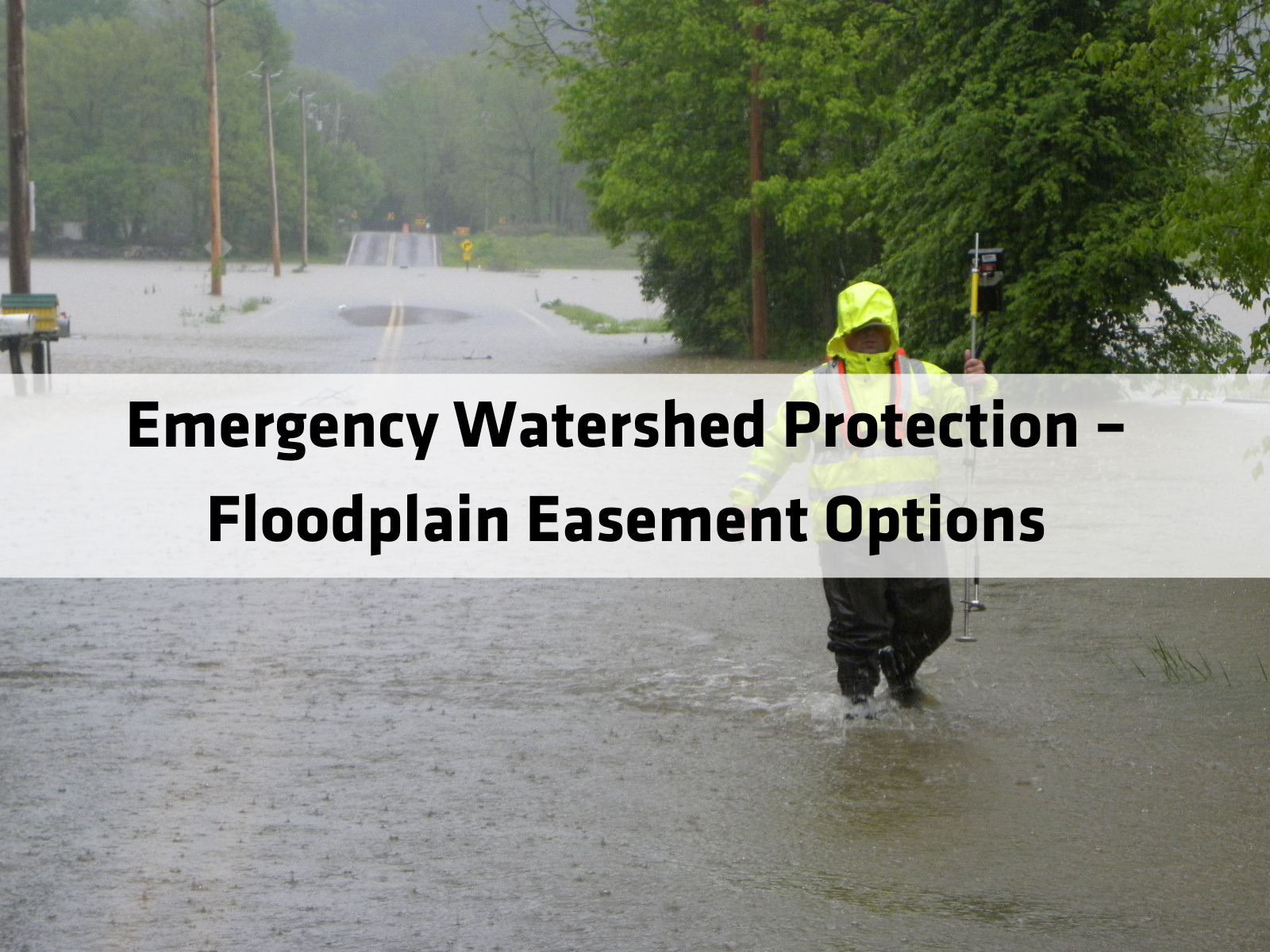
The Emergency Watershed Protection (EWP) program takes emergency measures to safeguard
lives and property from floods, drought and erosion. Measures can include purchase
of floodplain easements to reduce runoff and soil erosion.
Quick Facts
USDA Mission Provide leadership in food, agriculture, natural resources, rural development, nutrition
and related issues based on public policy, the best available science and effective
management
Program Goal Restore land, to maximum extent possible, to its natural condition
Eligibility Landowners
What do they fund? Floodplain restoration, Demolition, Debris removal
Amount of funding NRCS may pay up to the entire restoration costs.
The landowner has the opportunity to participate in restoration efforts.
The Emergency Watershed Protection Program – Floodplain Easements can be used when acquiring an easement in lieu of recovery measures, and is the most
economical and prudent approach to reduce flood risk.
Easements are restored to its natural condition to the extent possible. So, this is
a great option for accomplishing floodplain restoration projects. Floodplain restoration
goals can be accomplished by working strategically with NRCS and landowners.
Only acquisition of permanent floodplain easements is authorized.
Land Types Eligible:
Ag land or open land.
Lands primarily used for residential housing
Land must have been damaged by flooding at least once during the previous calendar
year or subject to flood damage at least twice within the previous 10 years.
Other lands within the floodplain may be eligible if they contribute to the restoration
of the floodwater storage and flow, offer erosion control or improve practical management.
Lands that would be inundated or adversely impacted as a result of a dam breach are
also eligible.
Structures within the floodplain easement must be demolished and removed, or relocated
outside the affected floodplain area.
NRCS then has authority to restore floodplain functions and values. Ownership of the
land is retained by original landowner. Compensation for rights purchased by the NRCS
are the lowest of three values:
Fair market value of the land
The geographic area rate cap
A voluntary written offer by the landowner
After the sale, landowners retain the right to ownership and conveyance, to quiet
enjoyment, to control access, to undeveloped recreational use (hunting, fishing, etc.),
and to mineral rights as long as the surface is not disturbed.
Contact Info
National Wetland Reserve Program and Wetlands Reserve Easement Program Manager, Easement Programs Division 202-720-9474 andrew.james@wdc.usda.gov
Franklin, Jefferson and St. Louis County NRCS Renee L. Cook, District Conservationist Renee.cook@mo.usda.gov 686-583-2303 EXT 3
Consult your community’s attorney and financial advisors prior to moving forward
with any of these funding options. Any reference in this website to any person, or
organization, or activities, products, or services related to such person or organization,
or any linkages from this website to the website of another party, do not constitute
or imply the endorsement, recommendation, or favoring of companies or organizations.