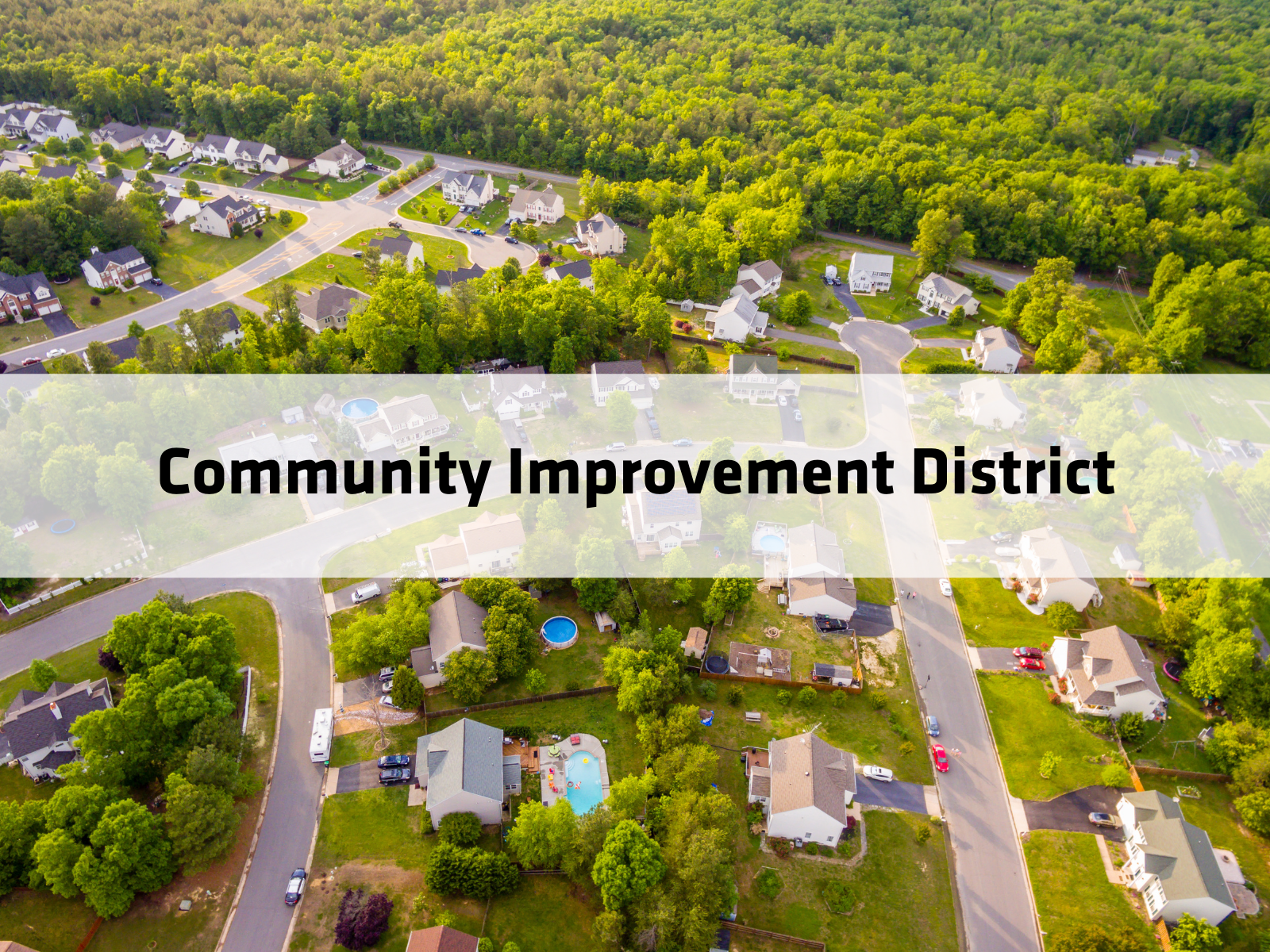
A Community Improvement District is a special purpose district whose property owners
voluntarily tax themselves to fund public improvements or services to support the
community and promote economic development
Quick Facts
Benefits of a Community Improvement District Proceeds collected can be used for a broad range of public purposes – including stormwater
infrastructure
Focus costs only on those benefiting from the services
Allows local residents to obtain expanded services they want at a price they are willing
to pay
Drawbacks of a Community Improvement District Adds another layer of government
Adds another layer of taxes and taxing districts
May deter businesses or customers
Can seem redundant to business and property owners
A Community Improvement District (CID) is a non-profit corporation or separate political subdivision that delivers specific
public services within a defined boundary. A community improvement district can levy
taxes, issue bonds, charge fees, and apply for grants.
The purpose of establishing a CID is to improve the community through infrastructure
investment and creating conditions that attract new growth. Community improvement
projects supported by the CID may include capital improvements, beautification, community
safety, business retention and economic development. Each CID has its own goal and
focus.
Public improvement, public services and blight removal within the boundaries of the
district can be financed by the CID. Stormwater, flood-reduction and other healthy
watershed projects can be financed through CID funds.
A CID is created by ordinance of the local municipal governing body. To get a CID
approved the must be a petition signed by property owners owning 50% of the assessed
value of the real property and more than 50% per capita of all owners of real property
in the district. State law (Sections 67.1401-67.1571 RSMo) provides detailed directions for establishing CIDs.
The petition must include a detailed 5-year plan (CID purpose, services, proposed
improvements, costs), description of the governance structure, maximum rates of property
taxes of special assessments, a statement about whether or not sales tax will be sought,
a statement about the borrowing capacity and revenues, and the length of time that
the CID will exist.
In Missouri, a CID can be one of two types:
Political subdivision – funded by public money via sales tax
Nonprofit – funded by property tax or special assessment
Consult your municipal attorney prior to moving forward with CID opportunities.
Project Examples
City of Pacific, MO
Pacific, MO has three Community Improvement Districts, that each impose a 1-cent sales
tax on retail sales at businesses in the districts. They were developed to generate
revenue for road improvements in each district. More Info
Consult your community’s attorney and financial advisors prior to moving forward with
any of these funding options. Any reference in this website to any person, or organization,
or activities, products, or services related to such person or organization, or any
linkages from this website to the website of another party, do not constitute or imply
the endorsement, recommendation, or favoring of companies or organizations.