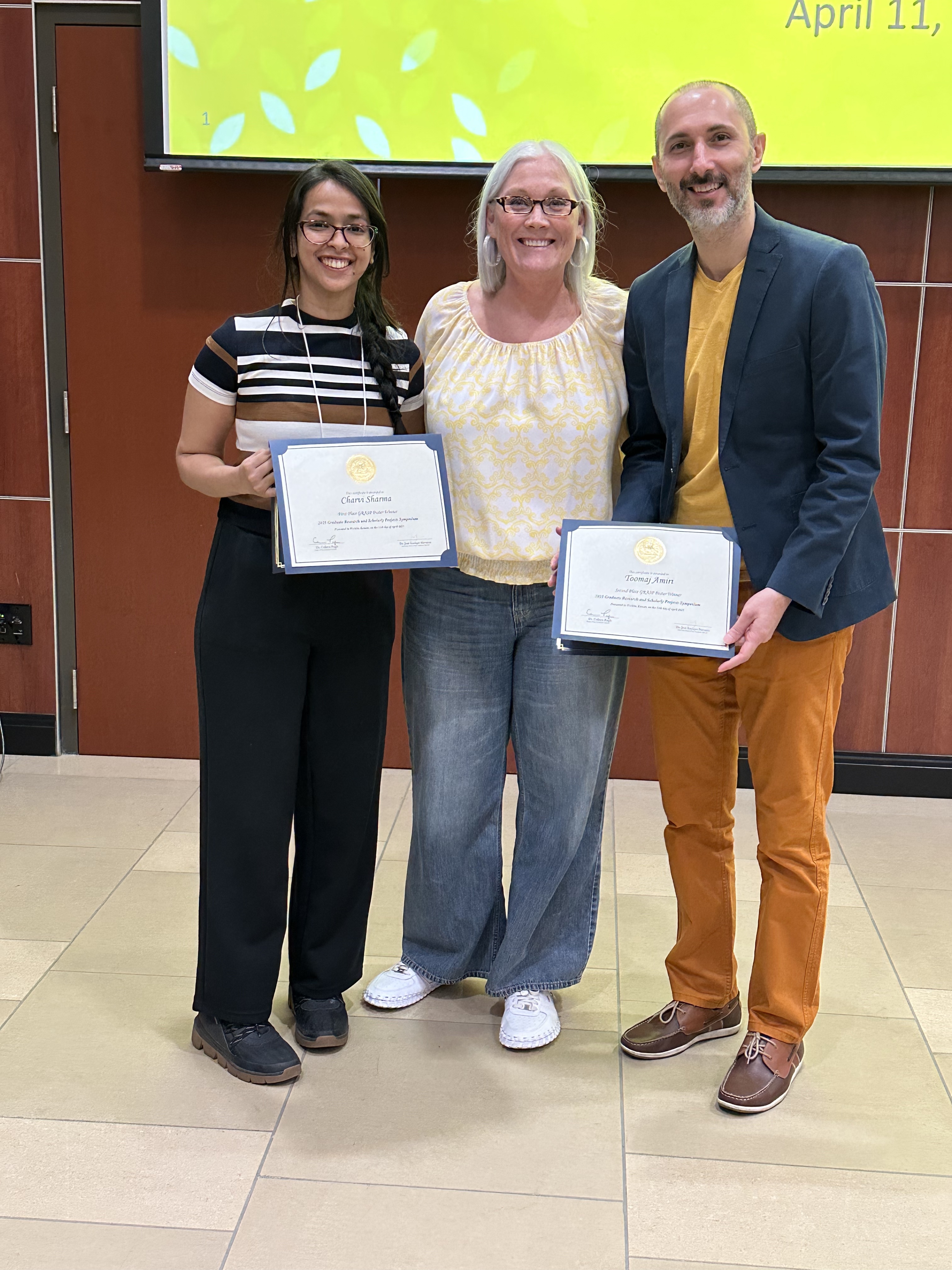
Charvi Sharma (Master's Student in Exercise Science, 1st place), Dr. Heidi Bell (HPS
Department Chair, PI and Advisor) and Toomaj Amiri (Master's student in Innovation
and Design, 2nd place).
Two graduate students from Wichita State University’s Department of Human Performance
Studies earned 1st and 2nd place at the 2025 GRASP (Graduate Research and Scholarly
Projects) symposium, a university-wide poster presentation competition.
Charvi Sharma, a master’s student in the Exercise Science program, earned 1st place
for her research project titled “Three Neurocognitive Mobile Applications: Perception of Usability in Adults with
and Without Parkinson’s Disease.” Conducted in the Human Performance Laboratory, the study assessed how adults with
and without Parkinson’s disease perceived the usability of three neurocognitive mobile
applications—on smartphone, tablet and touchscreen monitor platforms. Participants
found smartphones and tablets significantly easier to use and more preferred than
the larger touchscreen monitor, regardless of Parkinson’s status.
Toomaj Amiri, a master’s student in the Innovation and Design program, received 2nd
place for his interdisciplinary project titled “PARROT: A Wearable Device for Assessing and Improving Tongue Function.” The project introduces a wireless, AI-integrated mouthpiece designed to assess tongue
function through lingual pressure mapping and provide real-time feedback for improving
mobility. The device would aim to have potential applications for individuals with
speech and swallowing disorders or conditions like obstructive sleep apnea.
Both projects were developed in the Human Performance Laboratory and supported by
faculty mentorship through the Department of Human Performance Studies.
The GRASP symposium, held annually by the WSU Graduate School, showcases graduate
student research from across campus. Its purpose is to promote awareness of innovative
work being conducted at Wichita State, provide a forum for students to practice professional
presentation skills and recognize the contributions of both students and their faculty
mentors.