
Clinton Hall, current home of the Department of Economics in the W. Frank Barton School of Business.

Achieve your goals and earn your master's degree faster.

Streamline your path from bachelor's to master's with our accelerated 4+1 economics program. By combining your undergraduate and graduate coursework, you can earn two degrees in as few as five years and save up to an entire year of schooling. That means a savings not only in time, but a real reduction in costs for your education. Keep in mind, while your learning journey may be on the fast track, we don't take any shortcuts. You'll still develop and sharpen all the skills you need while we provide you with the support and knowledge to be successful.
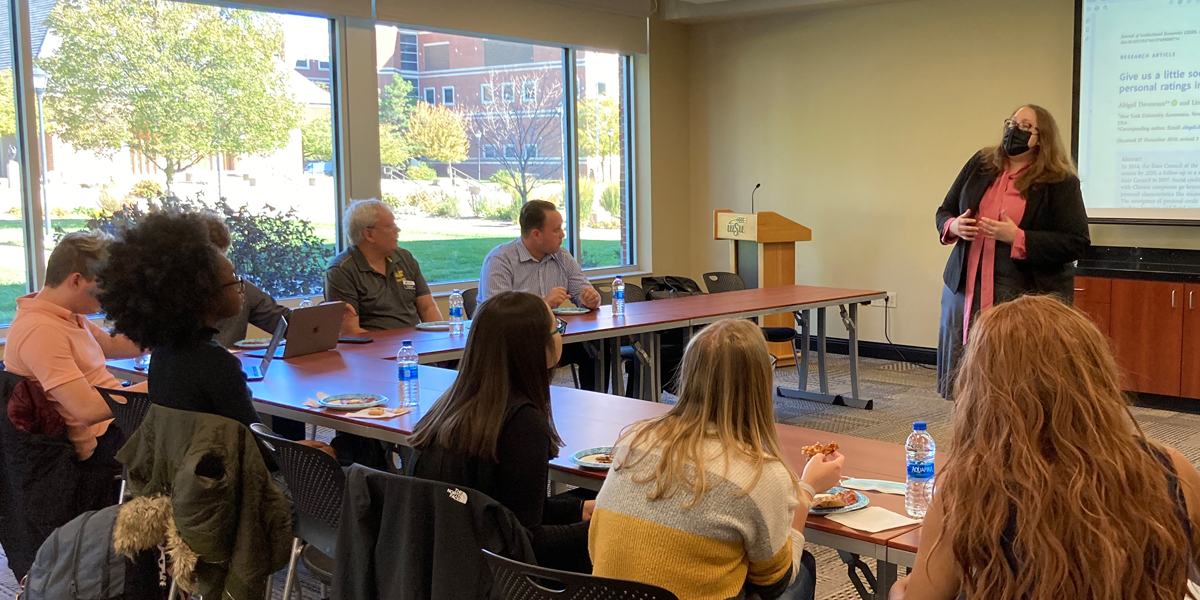
Abigail Devereaux presents a paper during an ISEG mentoring group meeting.

How it works

In dual/accelerated bachelor’s to master’s degree programs students can pursue two degrees at the same time. Up to 9 credit hours completed in the accelerated program count towards both the bachelor's and master's simultaneously. Economics students in the dual/accelerated program can take courses at the 700- and 800- level towards both degrees. Our economics advisors can help students select courses in a sequence to help them save time and tuition dollars. Talk with our advisors to make sure you fill out necessary paperwork prior to taking these courses to ensure they are counted toward both degrees. 

With senior rule students can take classes starting their senior year that will count towards a graduate degree. These classes count only towards the graduate degree, not for undergraduate credit. Regardless of undergraduate major,  students who want to pursue a Masters in Applied Economics can finish up their last few undergraduate courses while beginning their master's program. We want to help you get started on your advanced degree as soon as possible. 

Graduation
  • To Use Dual/Accelerated

    1. Apply to the master’s program of interest by the deadline at wichita.edu/apply.
    2. Complete the Dual Accelerated Form with your advisor and send it to the graduate program director. 
    3. Enroll in up to 9 total credit hours of graduate classes.
    4. Confirm with the Financial Aid Office if there will be any impact to your award package.
    5. Maintain a 3.0 semester and cumulative GPA to remain in good standing as a graduate student.
  • To Use Senior Rule

    1. Be classified as a senior in college, having completed 90 credit hours or more.
    2. Complete the Senior Rule Form with your advisor and send it to the graduate program director.
    3. Enroll in up to 9 total credit hours of graduate classes.
    4. Confirm with the Financial Aid Office if there will be any impact to your award package.
    5. Maintain a 3.0 semester and cumulative GPA to remain in good standing as a graduate student.

Note: Students can participate in one or both programs to complete a maximum of 18 graduate credit hours while an undergraduate student.

Explore your opportunities.

Economists are problem solvers. Economists collect and analyze data, research trends, and evaluate economic issues for resources, goods, and services. Economists have all kinds of jobs, such as researchers, government advisors, consultants, analysts, data scientists. You can check out the field’s classification system (called JEL codes) for more topics that economists study.

When you study economics, you will develop a wide range of analytical and critical thinking skills. As a result, economic majors are well positioned for a wide variety of careers. Our alumni have success after graduation include areas as diverse as:

  • Technology
  • Business
  • Government
  • Public Policy/Public Administration
  • Law
  • Journalism and Media
  • Education

Testimonials:

A history of excellence.

Wichita State's master of arts in applied economics program has a rich history of attracting outstanding domestic and international students. This program plays a critical role in AACSB-accredited Barton School of Business and offers you a general economics track and three specialized tracks to choose from— data analytics, financial economics, or international economics. All tracks will equip you with a broad understanding of the overall economic environment, which will help you as you advance your career or pursue your Ph.D. in economics.

Students

Concentrations

  • Data Analytics

    The data analysis option is ideal for students who wish to become a data scientist or an analyst in the industry or public sectors.

  • Financial Economics

    The financial economics option is ideal for careers in the financial institutions, including banks, investment companies, insurance companies, and real estate firms.

  • International Economics

    The international economics option is ideal for students with an interest in the international economy.

  • General

    A general, no-concentration option is available for students who want to to customize their program of study and take courses from Economics, and any other concentrations. 

Master's Degree in Applied Economics - Curriculum 

The program consists of 30 credit hours. The graduate coordinator or the department chairperson must approve the candidate’s plan of study.

Core Courses (18 credit Hours in Total)

  • ECON 722. Topics in Microeconomics (3 credits)
  • ECON 731. Applied Econometrics (3 credits)
  • ECON 801. Macroeconomic Analysis (3 credits)
  • ECON 803. Analysis of Business Conditions and Forecasting (3 credits)
  • ECON 804. Managerial Economics (3 credits)
  • ECON 893. Research Project (3 credits)

Elective Courses (12 credit Hours in Total)

The Department of Economics offers a variety of traditional and contemporary courses for electives. Students can also take courses from Finance, Data Analytics, MIS, Marketing and Management as electives with the Graduate Coordinator's approval. More details can be found here. 

Graduate Assistantship

Graduate Assistantships are awarded on a competitive basis. Criteria for receiving one are primarily a student’s performance in economics and math/statistics classes. A full (100%) assistantship currently provide a stipend of $6000 per academic year and a reduction in the tuition paid by international students of about 50 percent. All students who have been accepted into the program can be considered for an assistantship at their request. The deadline to apply for graduate assistantship is March 30th for Fall semester and Oct 30th for Spring semester. The decisions will be made after the deadline. We courage early applications. To apply, fill out the application form for GA assistantship online. Note that this form doesn't need to be filled until you are admitted to the program (see how to apply for admission in the section above). There is no need to contact professors for graduate assistantship as the decisions are made jointly by the department. 

Scholarships

Global Select Scholarship: If your GPA is above 3.3 (out of 4.0) or its international equivalent, you are eligible for Global Select Scholarship. In order to apply, you only need to answer one scholarship question on the application for admission.The Graduate School will determine the student's eligibility for a scholarship.

Other Scholarships: There are also various other opportunities of scholarships for Economics students at Wichita State University. Pleaes check the information here. 

Cost Estimate

Visit the link below for an estimate of specific tuition and fee costs.

Basic Costs for Graduate Studies

Career Outlook

The following national information is from U.S. Bureau of Labor Statistics. The numbers may vary with the region you live. 

Economists Career Outlook

What Economists Do?

Economists collect and analyze data, research trends, and evaluate economic issues for resources, goods, and services.

How to Become an Economist?

Most economists need a master’s degree or Ph.D. However, some entry-level jobs—primarily in the federal government—are available for workers with a bachelor’s degree.

Job Outlook

Employment of economists is projected to grow 13 percent from 2020 to 2030, faster than the average for all occupations.

Questions? Contact us

Jodi Pelkowski

Economics Undergraduate Director

Jodi.Pelkowski@wichita.edu

Siyu Wang

Economics Graduate Director

Siyu.Wang@wichita.edu


©
