


Wichita State University
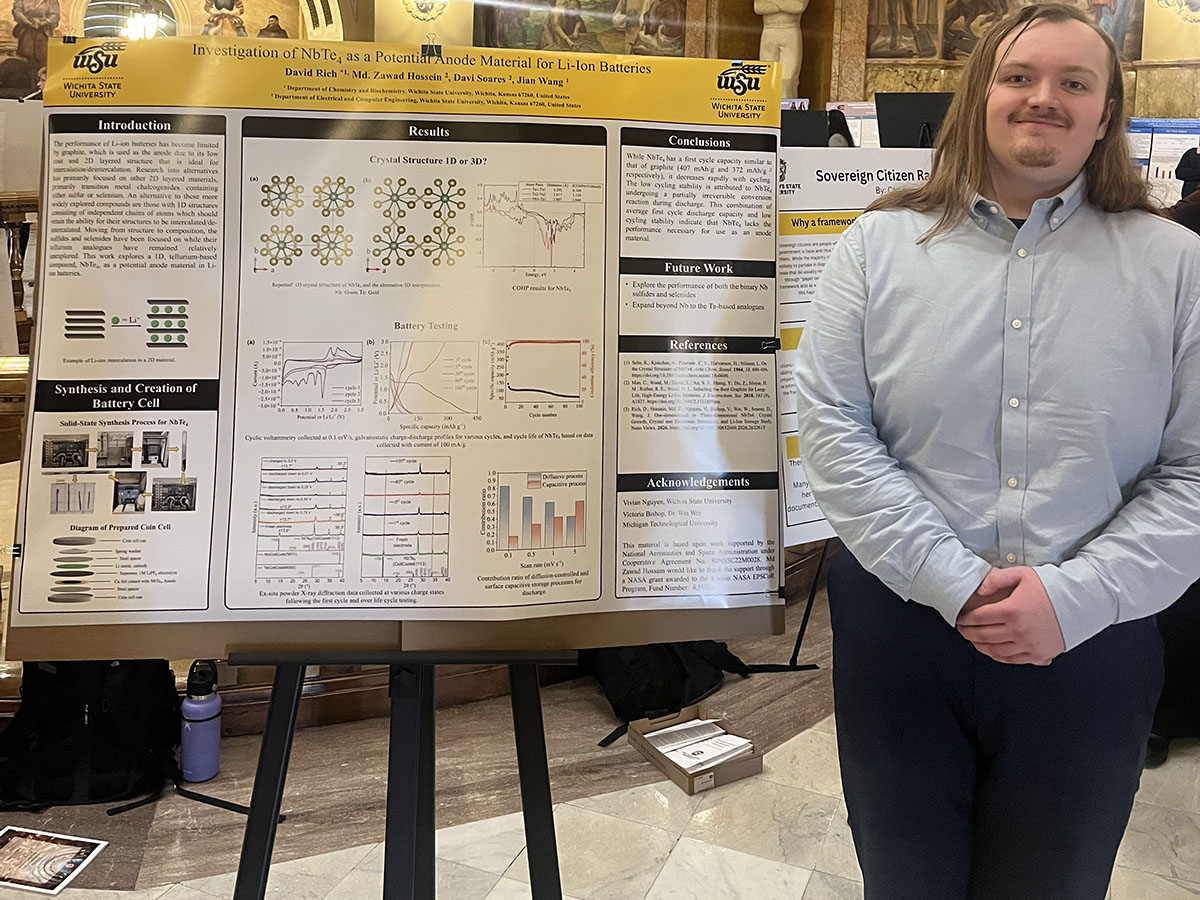
Wichita State chemistry student David Rich has fully embraced research throughout
his time at Wichita State. With several published papers under his belt already, Rich
plans to pursue grad school and a career in academia.
Wichita State chemistry student explores new battery materials
March 27, 2026
Wichita State chemistry senior David Rich is exploring alternative anode materials for lithium‑ion batteries through undergraduate research. His work, conducted in collaboration with faculty mentors, has resulted in multiple peer‑reviewed publications and national research presentations.
Wichita State University's research emphasis includes opportunities for undergraduate and graduate students, as well as faculty and staff, and extends across campus from aerospace to ancient civilizations and business administration to biochemistry.
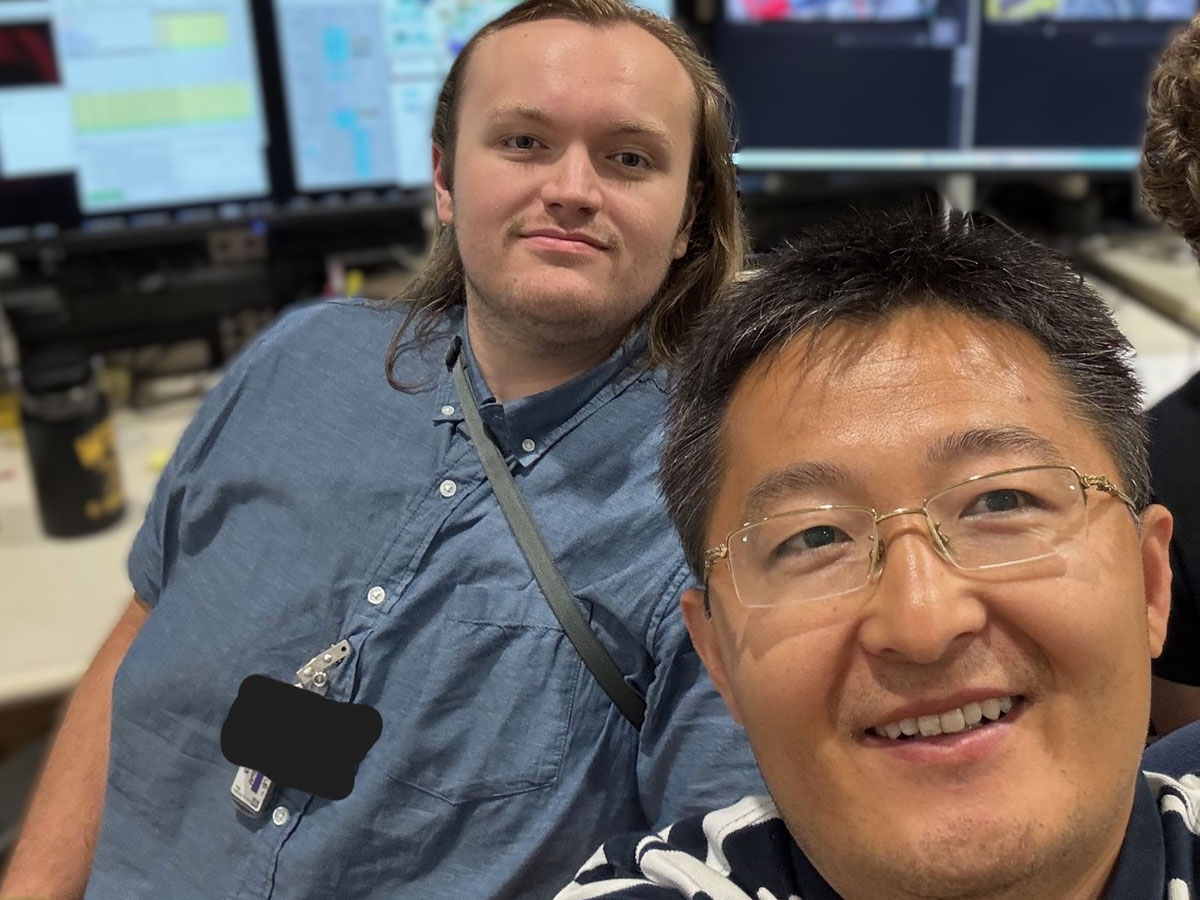
David rich (left) with his faculty research mentor, Dr. Jian Wang.
Researcher
David Rich, senior in chemistry
Hometown
Wichita
Research topic
Investigation of NbTe4 as a Potential Anode Material for Li-Ion Batteries
Faculty mentors
Dr. Jian Wang, associate professor of chemistry and biochemistry
How did you get involved in undergraduate research?
I already had an interest in materials chemistry research before joining Dr. Wang's lab, so I got in contact with him and asked if I could join his lab doing research. He agreed to it. For my first semester in the lab back in fall 2024, I was completing my required independent research credit; and after the semester, I was able to join the lab as an undergraduate research assistant.
How would you summarize your research to a layperson?
This collaborative project between the labs of Dr. Jian Wang and Dr. Davi Soares (assistant professor of electrical and computer engineering) focused on the synthesis and testing of a potential alternative anode material for lithium-ion batteries. The reason for doing research into alternative anode materials is that battery performance has become limited by the use of graphite as the anode material. Graphite has a specific capacity of 372 mAh per gram, which is acceptable for most everyday electronics but is lacking for use in applications that require high energy densities such as EV batteries. The potential anode material we were investigating was niobium tetra telluride (NbTe4), which was chosen due to its reported 1D crystal structure. To understand why the crystal structure is important, a brief discussion of battery mechanism is necessary. As a battery discharges lithium moves from the cathode to the anode, in the case of graphite, which has a 2D layered structure, the lithium will go between the layers which results in volume expansion of the graphite as the battery discharges. When the battery is then charged, the lithium is removed from between the layers and flows back to the cathode material, which also has a similar 2D layered structure. The reported 1D structure of NbTe4 consists of independent chains of atoms, which should function in a similar manner with less volume expansion as the chains have more empty space between them compared to the space between graphite layers. While attempting to confirm that the desired NbTe4 structure was made, we discovered that the structure was better represented with the chains connecting to form a 3D structure as opposed to the reported 1D structure. This 3D structure would likely be worse for batteries as it lacks the ability to reversibly add and remove lithium without breakdown of the overall structure. The battery testing results were consistent with this as while the specific capacity after the first cycle was 407 mAh per gram, this dropped to below 150 mAh per gram by the fifth cycle. While our results show that NbTe4 is a poor anode material, we are interested in further work investigating other potential anode materials.
What do you think the average person would think is interesting about your research?
I think that this research is interesting as it relates to society and people's everyday lives. Improvements in battery technology have the potential to drastically alter not only our personal electronic devices but also the viability of electric vehicles and other applications needing higher energy density batteries.
How would you describe your experience doing research and working with your faculty mentor?
My time in Jian's lab has been nothing short of amazing. Jian lets undergraduates perform truly independent research where we are able to develop our own ideas and test them and get feedback on our work. He also provides opportunities for undergraduates that I would say you can really get in other labs. Throughout my nearly two years in the lab, I have been able to present a poster at a national conference and travel to a national lab to conduct research while also authoring three publications. Beyond this, Jian has also been integral to my process of getting into graduate programs. I can honestly say that without him, I would be in a much worse position than I am now, and I can never thank him enough for what he has done for me.
What kinds of skills have you learned in the process?
In my time doing research I have gained a number of lab-related skills, including X-ray crystallography, techniques for working with air sensitive materials and crystal-growth techniques. For non-lab skills, I have gained significant improvement in my ability to present a project to others, and my writing has had significant improvement compared to when I started.
How will this research help you in your career aspirations?
This research has already directly impacted my career aspirations, as having the work done on this project published helped with getting accepted into graduate programs. My experiences during my research have also strengthened my desire to go into academia after graduate school, so that I can give others the opportunities that I have had as an undergraduate.
What would you say to prospective students who might be interested in doing research at the undergraduate level?
My advice would be to find something that you are truly interested in, find a professor with related research, and contact them. Most professors are willing to at least talk with you about their research. Even if they aren't taking undergraduates, they can get you in contact with someone who is.
About Wichita State University
Wichita State University is Kansas' only urban public research university, enrolling more than 23,000 students between its main campus and WSU Tech, including students from every state in the U.S. and more than 100 countries. Wichita State and WSU Tech are recognized for being student centered and innovation driven.
Located in the largest city in the state with one of the highest concentrations in the United States of jobs involving science, technology, engineering and math (STEM), Wichita State University provides uniquely distinctive and innovative pathways of applied learning, applied research and career opportunities for all of our students. The National Science Foundation ranked WSU No. 1 in the nation for aerospace engineering R&D, No. 2 for industry-funded engineering R&D and No. 8 overall for engineering R&D.
The Innovation Campus, which is a physical extension of the Wichita State University main campus, is one of the nation’s largest and fastest-growing research/innovation parks, encompassing over 120 acres and is home to a number of global companies and organizations.
Follow Wichita State on social media: