
The Undergraduate Research and Creative Activity Hub supports and promotes an undergraduate research community across academic disciplines. We aim to facilitate a student research pipeline so that existing programs work together to create an arc of development for students, while developing innovative programs to increase student access and success.
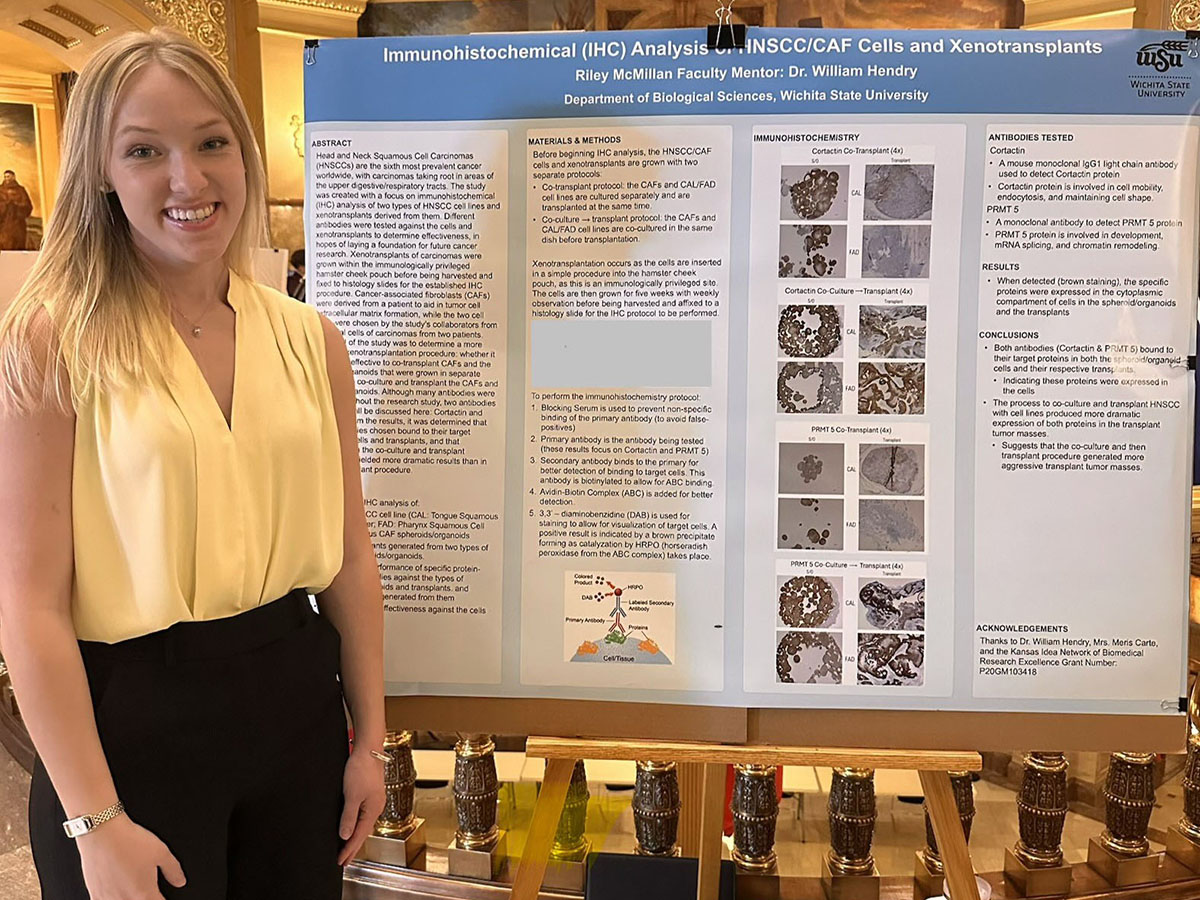
Riley McMillan, a senior in biological sciences and health science, analyzed head and neck squamous cell carcinoma tissues at the cellular level. Working with faculty mentors, she studied how specific proteins contribute to cancer progression and presented her findings during Undergraduate Research Day at the Kansas State Capitol in Topeka.
Wichita State University's research emphasis includes opportunities for undergraduate and graduate students, as well as faculty and staff, and extends across campus from aerospace to ancient civilizations and business administration to biochemistry.
Riley McMillan, senior in biological sciences and public health science with minors in chemistry and university honors
Concordia, Kansas
Immunohistochemical (IHC) Analysis of HNSCC/CAF Cells and Xenotransplants
Dr. Bill Hendry, professor and chair of the Department of Biological Sciences
I got involved with undergraduate research by introducing myself to our amazing biology advisor, Emmy Engasser. I told her about my goals within biology and my future career and expressed my interest in research. She connected me with Dr. Hendry’s lab, and I then spent two semesters conducting research under Dr. Hendry. It is amazing how putting yourself out there can open you up to so many possibilities.
My research focuses on a microscopic analysis of HNSCC/CAF cells and xenotransplants. HNSCC stands for head and neck squamous cell carcinomas, or cancers of the head and neck region, as well as the upper digestive and respiratory tracts. This form of cancer is the sixth most prevalent in the world. Our microscopic analysis technique demonstrates the involvement of specific proteins in the cancer progression process and does so at the individual cell level.
I recruited Riley to conduct undergraduate research in my lab because of her prior stellar A+ performance in my upper-level Human Physiology lecture and lab courses. Her excellent analytic technique defined the involvement of specific proteins in the cancer progression process and did that at the individual cell level.
I loved it. When I started college, I was not sure whether I wanted to pursue research, but I wanted to give it a try. I believe researching is one of the most rewarding experiences from my college career. As I gained wonderful mentors in Dr. Hendry and Meris Carte, I was able to pursue an applied learning experience and had the opportunity to present my research at the annual Kansas Idea Network of Biomedical Research Excellence (K-INBRE) symposium and the Undergraduate Research Day at the Capitol. These were wonderful professional experiences, and I am thankful for choosing to pursue research.
In traditional lab settings, we receive quite a bit of supervision and follow strict procedures to complete the assignment. In research, we are given greater independence, and we may work on problems not encountered in traditional lab settings. As a K-INBRE scholar, I presented my research at their symposium and at the Undergraduate Research Day at the Capitol event, where I had to have a thorough understanding of my research to explain it to individuals at all levels of education and biological knowledge. Through research, I have deepened my lab, research and presentation skills.
I am graduating from Wichita State University in May and will continue my education with the University of Iowa College of Dentistry and Dental Clinics to obtain my Doctor of Dental Surgery (DDS). Through dental school, I wish to continue researching, as I enjoyed my experience here at WSU. Research forces you to gain a deeper understanding of a topic, and it is how we continue to innovate. Continuing research will allow me to be the best dentist for my patients.
Give it a shot! If you are interested in research, reach out to professors with projects that interest you or a professor you enjoyed taking a class with. If you find it is not for you, that is OK, but it could also turn into your favorite experience in college.
Wichita State University is Kansas' only urban public research university, enrolling more than 23,000 students between its main campus and WSU Tech, including students from every state in the U.S. and more than 100 countries. Wichita State and WSU Tech are recognized for being student centered and innovation driven.
Located in the largest city in the state with one of the highest concentrations in the United States of jobs involving science, technology, engineering and math (STEM), Wichita State University provides uniquely distinctive and innovative pathways of applied learning, applied research and career opportunities for all of our students. The National Science Foundation ranked WSU No. 1 in the nation for aerospace engineering R&D, No. 2 for industry-funded engineering R&D and No. 8 overall for engineering R&D.
The Innovation Campus, which is a physical extension of the Wichita State University main campus, is one of the nation’s largest and fastest-growing research/innovation parks, encompassing over 120 acres and is home to a number of global companies and organizations.
Follow Wichita State on social media: