


Wichita State University
WSU News
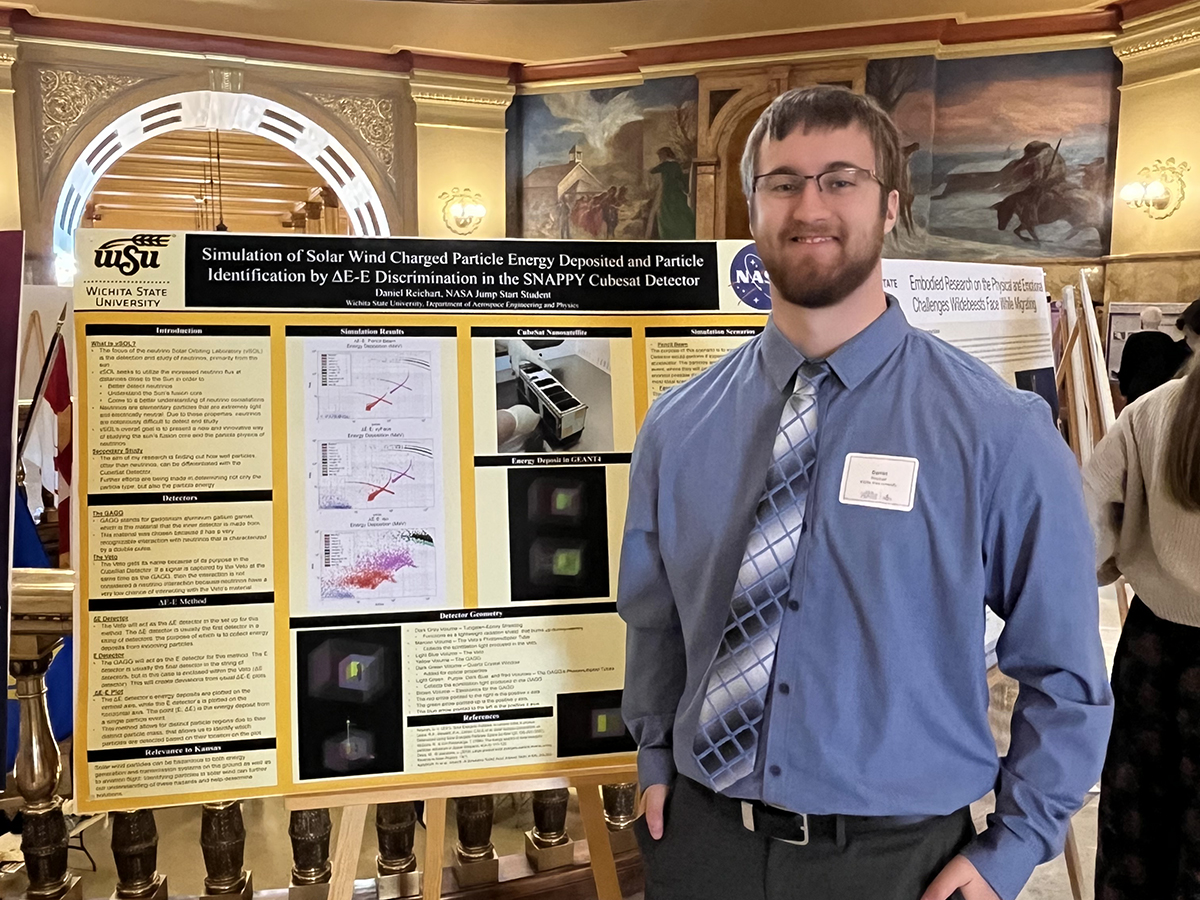
Wichita State senior Daniel Reichart presents his research at the Kansas Capitol building
in Topeka for Undergraduate Research Day in February. Reichart is researching how
to improve particle identification in space using the SNAPPY CubeSat detector.
Exploring the cosmos: WSU student’s research aims to improve particle identification in space
April 9, 2025
Undergraduate Research and Creative Activity Hub
The Undergraduate Research and Creative Activity Hub supports and promotes an undergraduate research community across academic disciplines. We aim to facilitate a student research pipeline so that existing programs work together to create an arc of development for students, while developing innovative programs to increase student access and success.
College of Engineering
Since 1928, Wichita State's College of Engineering has built a reputation for equipping engineering and computing students with the most complete education possible. From hands-on research using the latest technologies to our location in Kansas' center of industry — with virtually unlimited jobs, applied learning and professional connections — Shocker engineering students have everything they need to make their dream careers a reality.
WSU's Cohen Honors College
The Cohen Honors College at Wichita State challenges ambitious students in any major to build a better future through rigorous classes, problem solving across disciplines, independent and collaborative research, and community service.
Daniel Reichart uses advanced simulations to study how a CubeSat detector can identify space particles like electrons, protons and alpha particles. His work, guided by physics professor Dr. Nick Solomey and supported by NASA’s Jumpstart Program, contributes to understanding radiation hazards in space and showcases how undergraduates can play a vital role in space research.
Wichita State University's research emphasis includes opportunities for undergraduate and graduate students, as well as faculty and staff, and extends across campus from aerospace to ancient civilizations and business administration to biochemistry.
Researcher
Daniel Reichart, senior in aerospace engineering and physics
Hometown
Andale, Kansas
Research topic
Simulation of Solar Wind Charged Particle Energy Deposited and Particle Identification by ΔE-E Discrimination in the SNAPPY Cubesat Detector
Faculty mentor
Dr. Nick Solomey, professor of physics
How did you get involved in undergraduate research?
I got involved in undergraduate research through the NASA Jumpstart Program, which in turn got me set up with the nuSOL project. I decided to go with this particular study because it was an area of nuSOL that no one else was working on and was at the skill level of an undergraduate student.
How would you summarize your research to a layperson?
My research essentially deals with using the CubeSat Detector to identify different particles via an easy and effective method: ΔE-E. This method separates particles by their masses. Identifying particles, especially in space, is a good way to begin the process of understanding radiation hazards. I created simulation scenarios with the Monte Carlo software GEANT4 and shot particles at different faces of the CubeSat detector. The results of these simulations show that electrons, protons and alpha particles can be identified via ΔE-E.
What do you think the average person would think is interesting about your research?
I think that the average person would enjoy how the CubeSat Detector will operate. The CubeSat Detector will be placed into a 3U CubeSat Nanosatellite and then launched into orbit over Earth's poles, which is where we will see the most particle interactions.
Daniel learned quickly how to do science analysis and simulations for the SNAPPY CubeSat detector to be used in a unplanned way to study the solar wind particles.
Wichita State professor of physics
How would you describe your experience doing research and working with your faculty mentor?
I very much enjoy working with Dr. Solomey. He gives me the freedom to manage my tasks in a way that I understand and provides great advice when I hit road bumps.
What kinds of skills have you learned in the process?
I have learned a lot about programming and simulation work during my time at nuSOL. I have learned how to use the following software and programming languages: C++, GEANT4, ROOT and LaTeX. All of which are essential to nuSOL and particle physics as a whole.
How will this research help you in your career aspirations?
This research will help me in my career aspirations by equipping me with valuable tools. My research deals heavily with programming, which will be of great importance to any physics or engineering career path.
What would you say to prospective students who might be interested in doing research at the undergraduate level?
Take pride in your work. Whether that means spending an extra hour or two compiling your information or writing a project report, make the effort to do your best work. Good work is passable, great work is noticed.
About Wichita State University
Wichita State University is Kansas' only urban public research university, enrolling more than 23,000 students between its main campus and WSU Tech, including students from every state in the U.S. and more than 100 countries. Wichita State and WSU Tech are recognized for being student centered and innovation driven.
Located in the largest city in the state with one of the highest concentrations in the United States of jobs involving science, technology, engineering and math (STEM), Wichita State University provides uniquely distinctive and innovative pathways of applied learning, applied research and career opportunities for all of our students. The National Science Foundation ranked WSU No. 1 in the nation for aerospace engineering R&D, No. 2 for industry-funded engineering R&D and No. 8 overall for engineering R&D.
The Innovation Campus, which is a physical extension of the Wichita State University main campus, is one of the nation’s largest and fastest-growing research/innovation parks, encompassing over 120 acres and is home to a number of global companies and organizations.
Follow Wichita State on social media: