


Wichita State University
Exploring Mars, shaping the future: Sejun Moon’s journey in multi-agent robotics
April 10, 2025
Wichita State junior Sejun Moon is exploring how teams of autonomous robots work together in extreme environments like Mars using a multi-agent reinforcement learning approach. Under the guidance of Dr. Fujian Yan, Moon is developing a scalable, hierarchical system that enables robot collaboration with minimal human input — a concept with promising applications for both space exploration and disaster response here on Earth.
Wichita State University's research emphasis includes opportunities for undergraduate and graduate students, as well as faculty and staff, and extends across campus from aerospace to ancient civilizations and business administration to biochemistry.
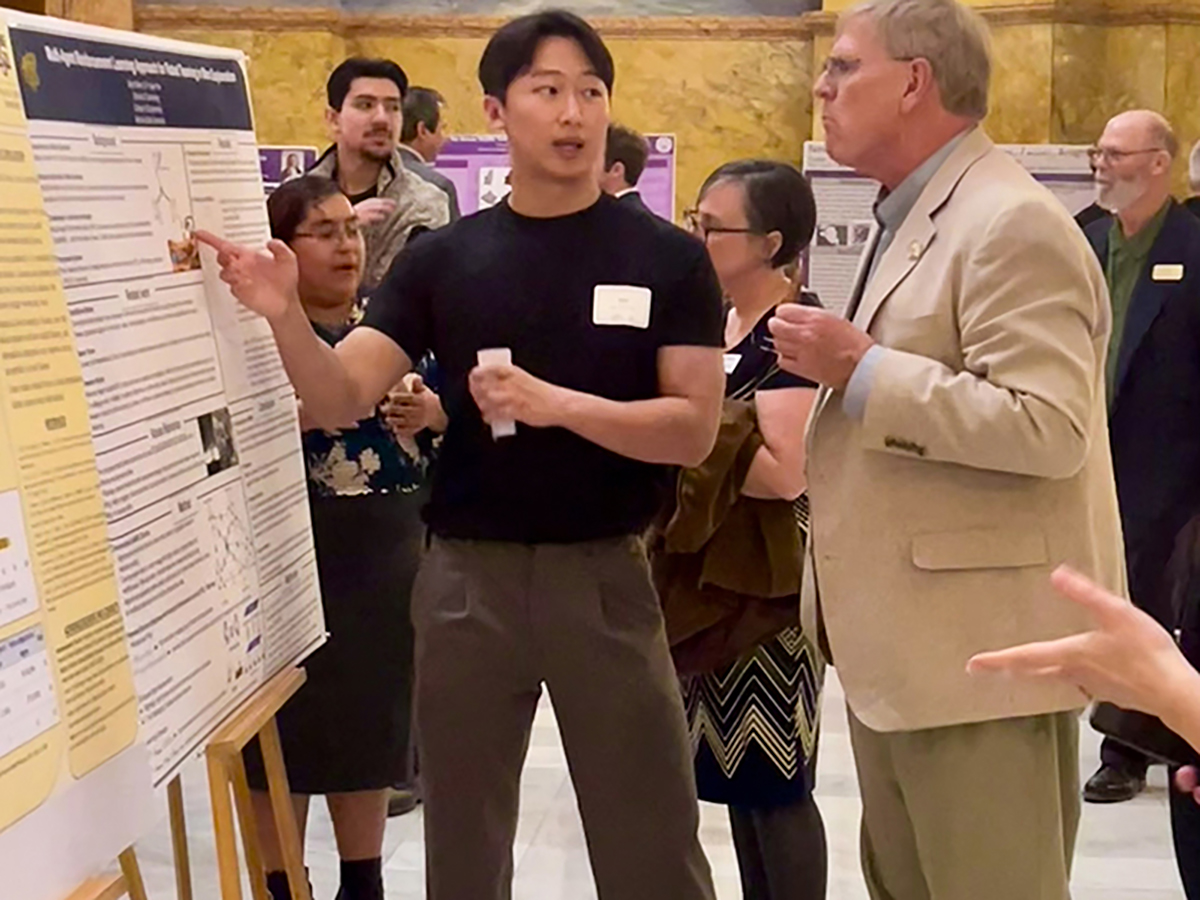
Sejun Moon, a junior in computer science, presents his work at the Kansas Capitol in Topeka in February. Moon is researching multi-agent reinforcement learning to improve robot teamwork in Mars exploration. His work focuses on creating a hierarchical system that enhances coordination and scalability, with potential applications in disaster response, such as tornado recovery.
Researcher
Sejun Moon, junior in computer science
Hometown
Gyeryong-si, South Korea
Research topic
Multi-Agent Reinforcement Learning Approach for Robot Teaming in Mars Exploration
Faculty mentor
Dr. Fujian Yan, assistant teaching professor in Wichita State's School of Computing
How did you get involved in undergraduate research?
At first, I just wanted to get hands-on experience with hardware and coding — maybe build IoT (Internet of Things) systems or work on simple robotics projects. Then, last semester, I found out about a robotics seminar by Dr. Fujian Yan and decided to check it out. After the seminar, I reached out to him, and that’s how I ended up joining his lab as an undergraduate researcher. Honestly, I didn’t have a clear plan — it just kind of happened.
As for why I chose multi-agent reinforcement learning for Mars exploration, I was drawn to multiple robots working together automatically in extreme environments. The thought of robots figuring things out on their own, without human intervention, sounded both challenging and exciting. And the more I learned, the more I realized this research isn’t just about space: It could also help in real-world situations, like disaster response, which made it feel even more meaningful.
How would you summarize your research to a layperson?
My research improves teamwork among robots in extreme environments like Mars, where communication is often unreliable. Using reinforcement learning, robots self-learn through trial and error. To enhance coordination and scalability, the team follows a military-like hierarchy, with higher-level agents handling strategy and lower-level agents executing tasks. Robots also leave markers in the environment so others can make informed decisions even when they lose the communication signal due to sensor noise. Beyond Mars, this approach can support disaster response, like tornadoes, where a large team of robots needs fast, organized, and autonomous decision-making.
What do you think the average person would think is interesting about your research?
I think the most interesting part of my research is how multiple robots can learn and cooperate without constant human control. People are often surprised that robots can teach themselves through trial and error, just like how we learn from mistakes. Plus, the fact that this technology isn’t just for Mars but can also help in real-world disasters, like tornado response, makes it even more exciting.
How would you describe your experience doing research and working with your faculty mentor?
Researching under Dr. Yan has been a really great experience. He’s really kind, patient and always makes sure I have the support I need. Since I’m the only undergraduate researcher in the robotics lab, I mostly work alone. Since everything new to me, it feels like I’m exploring uncharted territory by myself. There have been moments when I felt completely lost, not knowing if I was heading in the right direction. But Dr. Yan has always been there to guide me. He takes the time to explain difficult concepts multiple times in different ways until I truly understand. At the same time, he encourages independent thinking and gives me the space to figure things out on my own. He also gives detailed feedback on presentations, poster design and even small things like how to structure my ideas clearly. He also makes sure to recognize my progress, which keeps me motivated.
What kinds of skills have you learned in the process?
Through my research, I’ve gained a mix of technical and soft skills that go beyond just coding. Technically, I’ve improved my understanding of reinforcement learning, multi-agent systems and robotics. Beyond technical knowledge, I’ve also developed critical thinking and communication skills. Dr. Yan often asks me to present what I’ve learned, which has helped me break down complex ideas and explain them clearly. Also, working independently as the only undergraduate researcher has taught me self-motivation, adaptability and perseverance. Research is full of challenges, and I’ve learned how to push through uncertainty, seek solutions proactively and manage my time effectively. These skills will be valuable no matter where my career takes me.
How will this research help you in your career aspirations?
Honestly, I haven’t had much time to think about my long-term career plans since I’ve been so busy juggling coursework, research and conference preparations. Right now, I stop thinking and just live with the flow.
What would you say to prospective students who might be interested in doing research at the undergraduate level?
If I can do it, so can you. All you need is interest and persistence.
About Wichita State University
Wichita State University is Kansas' only urban public research university, enrolling more than 23,000 students between its main campus and WSU Tech, including students from every state in the U.S. and more than 100 countries. Wichita State and WSU Tech are recognized for being student centered and innovation driven.
Located in the largest city in the state with one of the highest concentrations in the United States of jobs involving science, technology, engineering and math (STEM), Wichita State University provides uniquely distinctive and innovative pathways of applied learning, applied research and career opportunities for all of our students. The National Science Foundation ranked WSU No. 1 in the nation for aerospace engineering R&D, No. 2 for industry-funded engineering R&D and No. 8 overall for engineering R&D.
The Innovation Campus, which is a physical extension of the Wichita State University main campus, is one of the nation’s largest and fastest-growing research/innovation parks, encompassing over 120 acres and is home to a number of global companies and organizations.
Follow Wichita State on social media: