


Wichita State University
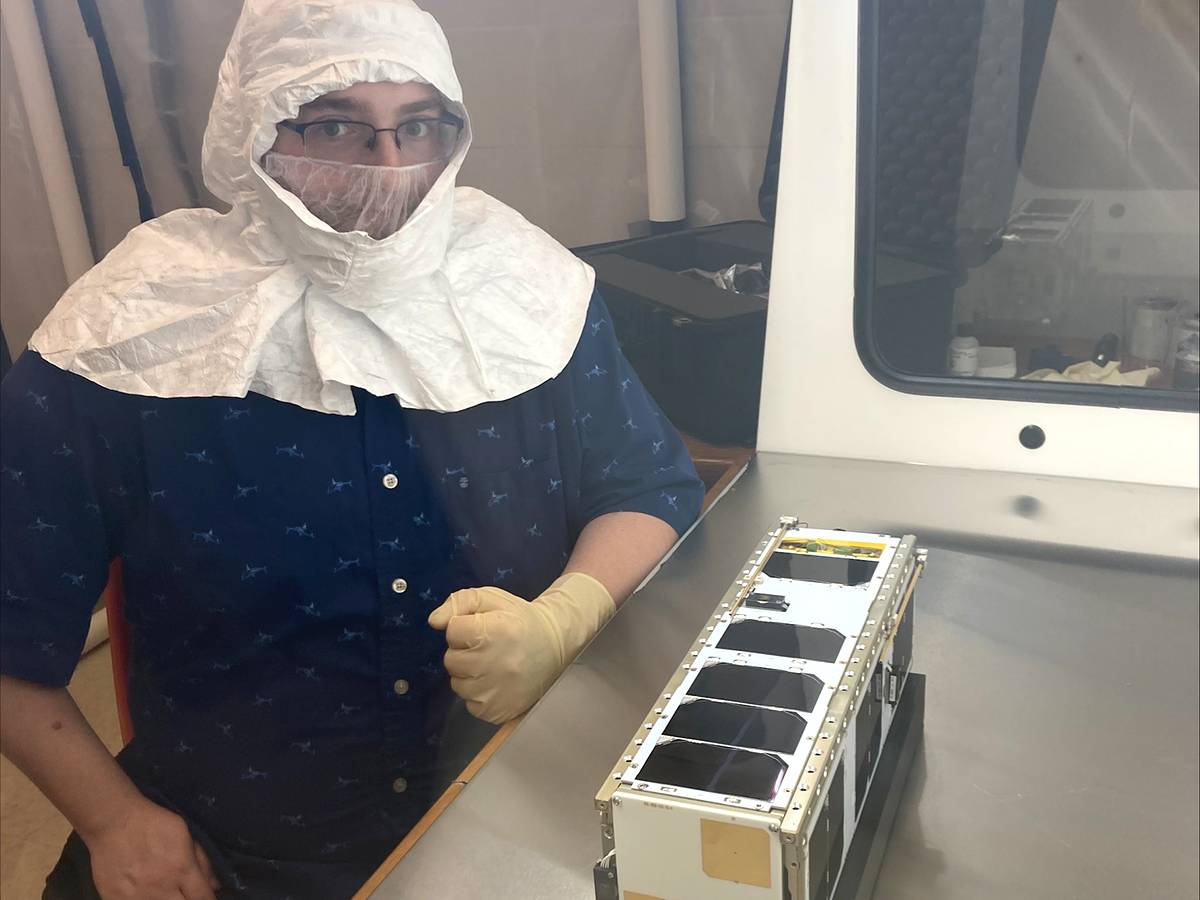
The arrival of a nanosatellite — called a CubeSat — at Wichita State University is
another sign of progress as researchers work with NASA to flight test a neutrino detector
in space.
Wichita State is now home to a nanosatellite, taking research on NASA project to a new level
July 11, 2024

This CubeSat nanosatellite will carry and test a WSU-designed prototype neutrino detector
in low Earth orbit to prove the detector can operate in space and measure the rate
of cosmic and gamma rays.
Dr. Nickolas Solomey
The arrival of a nanosatellite – referred to as a CubeSat – on campus signals significant progress in Wichita State University’s NASA project to design a solar probe to investigate neutrinos.
“This is the first major spacecraft to be at Wichita State,” said Dr. Nickolas Solomey, a professor of mathematics, statistics and physics. “That’s a great step.”
A team of researchers, led by Solomey, has worked on the development of a CubeSat, a kind of nanosatellite, since 2021. The CubeSat, built by NanoAvionics of Lithuania, will carry and test a WSU-designed prototype neutrino detector in low Earth orbit to prove the detector can operate in space and measure the rate of cosmic and gamma rays.
The project began in 2016 and received its first funding in 2017. In 2021, NASA gave WSU a $2 million grant for the project to flight test a neutrino detector with a CubeSat. The CubeSat is a box 10 by 10 by 30 centimeters made of aluminum. The prototype detector weighs 250 grams and will be housed with computer cards and solar panels in the CubeSat.
Five Wichita State doctoral/master's students are working with Solomey on the project: Kyle Messick (doctoral degree in aerospace), Brian Doty (doctoral degree in physics and applied math), Johnathan Folkerts (doctoral degree in physics and applied math), Brooks Hartsock (doctoral degree in physics and applied math) and Tyler Nolan (master’s degree in physics).
Neutrinos are miniscule subatomic particles that are similar to electrons but have no charge and almost negligible mass. Understanding neutrinos holds the keys to understanding the structure of the universe and the origin of mass. According to neutrinos.fnal.gov, neutrinos are the second most abundant fundamental particle in the universe, and the sun is the source of most of these neutrinos.
Neutrino detectors currently in use are positioned deep below the Earth’s surface.
“No one has ever operated a neutrino detector in space,” Solomey said. “This will allow us to look at the sun in a very new way. We can do experiments we can’t do here on Earth with solar neutrinos.”
WSU’s CubeSat arrived in late June and is housed in a sterile room in Jabara Hall. The schedule calls for launch in June 2025 from Kennedy Space Center in Florida.
“My hope is that this will add ways in which we can study the core of the sun,” Solomey said.