


Wichita State University
Wichita State team one of 10 remaining in NASA SUITS design challenge
May 20, 2024
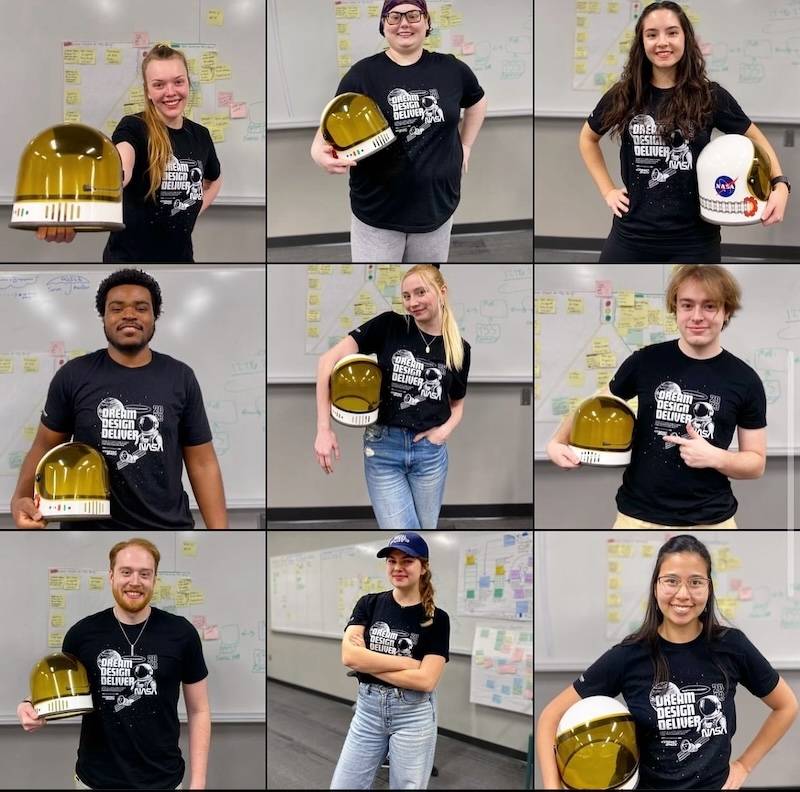
Wichita State University's NASA SUITS team (from top left): Samantha Hein, Elaine
Duff, Marianna Fronciana Farina, Desmond Cockrell, Savannah Denny, Elliott Chambon, Nathan Lewis, Denae Sawyer and Yumi Kikuchi.Courtesy photo
Yumi Kikuchi attended an information session in Devlin Hall for the NASA SUITS design challenge last fall. She considered passing on the opportunity.
“I was like, ‘Wow, this sounds like a lot of work,’” she said. “I’m glad that didn’t discourage me.”
Kikuchi, a graduate student in Wichita State University’s Master of Innovation Design (MID) program, is now co-leader of the nine-student group. She considers the experience an essential part of her time in the MID program.
“It’s a great way for applied learning,” she said. “Everything I’m learning in the MID program I’m constantly applying into this challenge. It’s a very big technical challenge, but it’s also a people challenge, learning how to work together. It takes a team.”
Wichita State is one of 10 teams that advanced to the spring semester competition in the NASA SUITS (Spacesuit User Interface Technologies for Students) challenge. Teams are tasked to design and build an augmented reality heads-up display for astronauts on missions to Mars, as well as a web browser user interface for local mission control.
The competition, which is open to all United States universities, started in the fall with a mission description from NASA. The team travels to Test Week this week in Houston at the Johnson Space Center.
Their goal is to mitigate risk and reduce cognitive load for astronauts on future space missions to Mars. The heads-up display can help them navigate by dropping a pin or guide them through a complicated repair process. It also displays heart rate, oxygen levels and other biometric data.
“One of the biggest challenges is for us to figure out a way to display all the data in a way that is not overwhelming and for it to still makes sense,” Kikuchi said.
The display serves as a second set of eyes for tasks such as entering and leaving the home base by listing procedures to help astronauts work through the steps.
“It’s a huge laundry list of pressurizing stuff, making sure all the correct tanks are full,” said Nathan Lewis, a student in the Master of Innovation Design program. “It’s usually about an hour process. They’re having us simulate about a 15-minute condensed version of ingress and egress.”
The local mission control allows astronauts in the habitat to communicate with those on EVA missions on the Mars surface.
“We have applied four years and gotten accepted to the top 10 three times,” said Kristyn Waits, assistant director of the Open XR Lab. “It is a full-year commitment if you get accepted. The top teams are invited to continue to the second half, and now they’re building what they proposed.”
The list of finalists includes the University of California Berkeley, University of Colorado, Baylor University, University of Michigan, Rice University, Georgia Tech, Purdue University, University of Texas at Austin and others.
Waits and Maggie Schoonover, director of the Open XR Lab, are faculty mentors. Denae Sawyer (master of innovation design), Desmond Cockrell (graphic design), Savannah Denny (graphic design), Elaine Duff (master of geology and planetary sciences), Marianna Fronciana Farina (mechanical engineering), Elliott Chambon (aerospace engineering), Samantha Hein (game design), Lewis and Kikuchi comprise the team.
“We pride ourselves on having interdisciplinary teams, so most of these students have never met before,” Waits said. “We do an open call for students to build the team in fall. It is a lot of it is ideation, brainstorming and a lot of it is just getting to know your teammates.”
That collaboration is important to the team’s success as the students develop and test the software.
“You are building trust in the team,” Kikuchi said. “We can be candid and give critical feedback without another taking offense because we took to the time to build a psychologically safe environment.”
Both Lewis and Kikuchi see the SUITS competition as an important part of building a resume and work experience.
Lewis is interested in developing software and game design. The project’s use of Unreal Engine 3D creation tool is valuable. He grew up fascinated by Neil Armstrong and the July 1969 moon landing.
“It’s cool to have an opportunity to develop something for NASA,” he said. “I felt this real connection with Apollo 11. I became really enamored with first steps on the moon.”
Kikuchi sees a future in business using augmented reality.
“I want to work in technology that will help people overcome challenges,” she said.