At Wichita State, every degree we offer has opportunities for an applied learning or research experience. As a Shocker, you'll get the chance to work side by side with established professionals, building contacts, confidence and a strong resume before graduation.
Human Factors psychologists conduct research to broaden the base of knowledge about human capabilities and limitations. They apply that knowledge to the design, operation and maintenance of machines, systems and environments so that optimum performance can be achieved. Among the goals of the human factors psychologist are to make it easier for people to use machines such as computers, airplanes, and automobiles and to improve work and leisure environments.
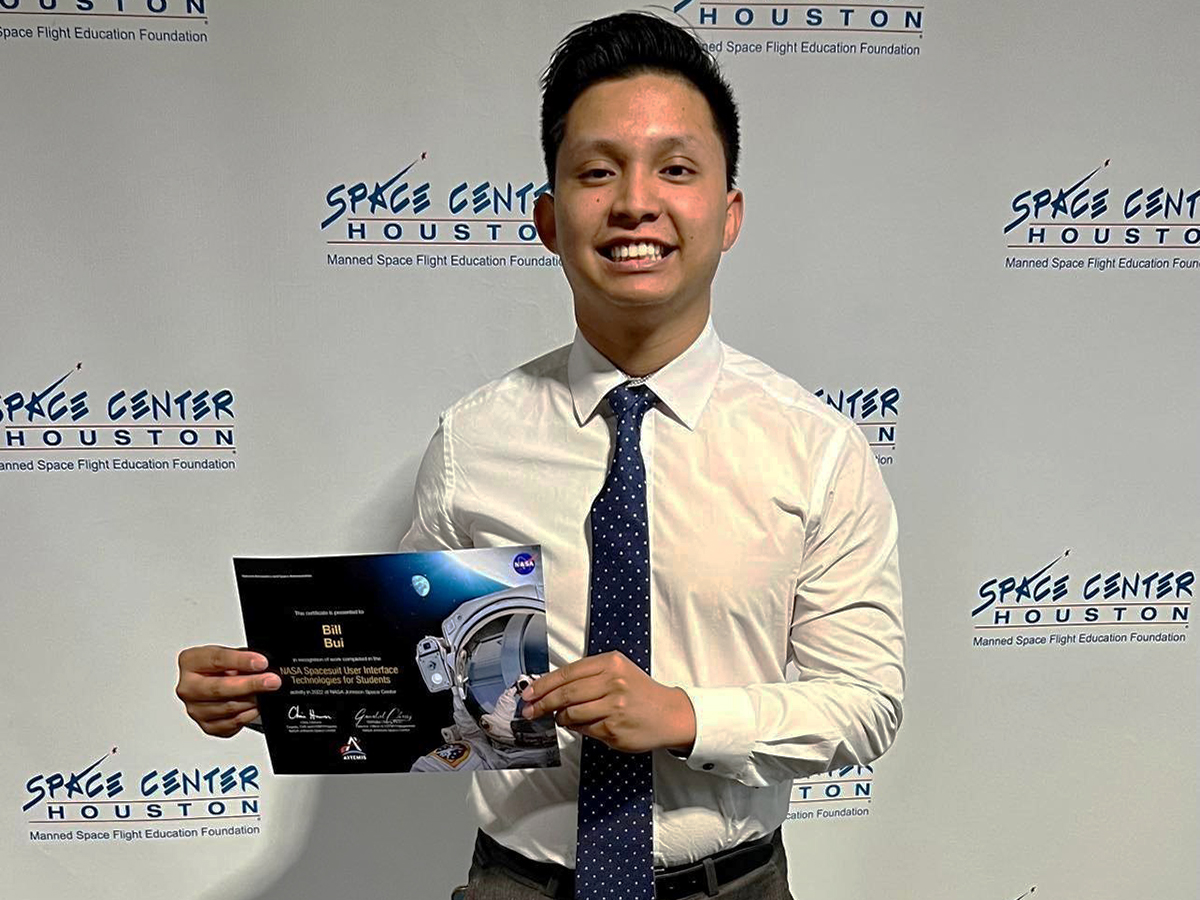
Bill Bui, a fifth-year human factors psychology student, is broadening his studies by working as a human factors engineer at NASA during fall 2022.
More than 5,000 Shockers each year take what they’ve learned in the classroom and transfer that knowledge into real-world environments. Applied learning — which is required for every Wichita State student — happens in offices, factories, laboratories, nonprofits, industries and companies across the globe. Students work side-by-side with seasoned professionals to ensure that they’re fully prepared to make meaningful contributions to their employers and their communities when they graduate
Santa Ana, California
Fifth-year Ph.D. student
I am currently interning as a human factors engineer at NASA. I will be conducting human-in-the-loop (HITL) testing on the Joint Augmented Reality Visual Informatics team. My duties will be defining use cases, creating HITL-test designs and analyzing results.
From Aug. 22 to Dec. 12.
I was in the NASA SUITS (Spacesuit User Interface Technologies for Students) design challenge last year. My NASA mentor, Amanda Smith, team mentor and WSU alumna, from the challenge reached out to the team with the opportunity.
This experience will give me more exposure to augmented reality and human factors. I will be able to use what I learn during this internship to support my academic research. Additionally, this internship will provide me an opportunity to apply theory to practice. This kind of experiential learning will also give insight into my skills, passions and interests.
The NASA SUITS challenge at Wichita State was an incredible opportunity to work on real-world problems. We worked on a similar project during my internship — an augmented reality heads-up display for astronauts. The challenge taught me how to work with a multidisciplinary team on computer science, innovation, design and aerospace engineering. I am also grateful to my NASA SUITS WSU advisors Maggie Schoonover and Kristyn Smith, and Amanda Smith, for teaching us how to innovate and collaborate as a team. My graduate school program in human factors psychology has also provided me with a strong foundation in experimental design, statistical analysis and human factor methods.
My advice would be to grab any opportunity that arises even if you are scared. Although I had little experience in aerospace, I decided to apply for the NASA SUITS challenge. This experience ultimately helped me get my internship. Experiences, even small ones, will help you grow and build confidence.