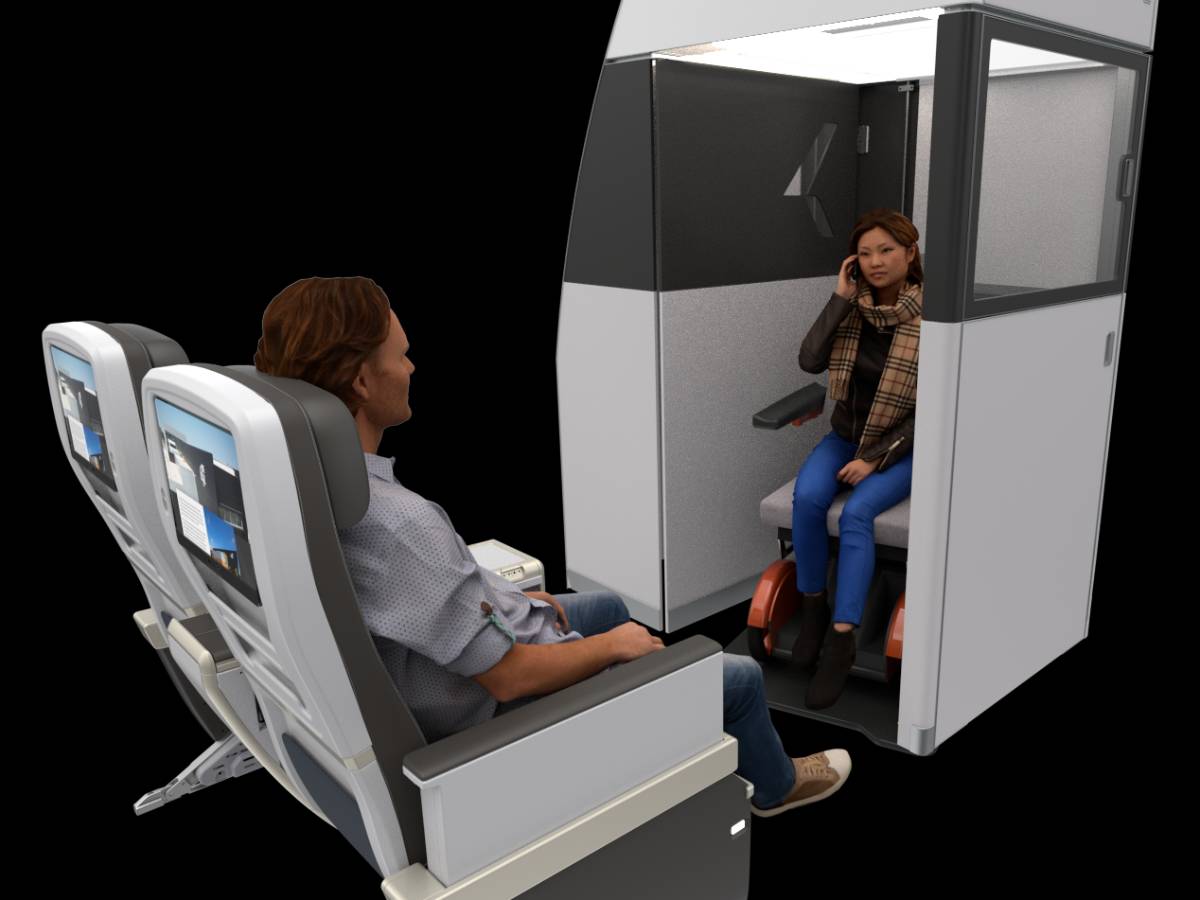
The Fly Your Own Wheels Suite concept would allow individuals to ride their own wheelchair
on a commercial flight.Courtesy of NIAR
WSU design to modify planes for wheelchair access gets international recognition
April 7, 2022
By WSU Strategic Communications
Advanced Virtual Engineering and Test Labs
The Advanced Virtual Engineering and Testing Lab (AVET) is home to NIAR’s Virtual
Engineering, Flight Simulation, Building Block and Crash Dynamics Labs.
A team from Wichita State University’s National Institute for Aviation Research has
received international recognition for a design that would allow WC19 certified manual
and power wheelchairs to be used as a seat on board commercial airlines.
The Fly Your Wheels Suite — designed by NIAR researchers and students in the Advanced
Virtual Engineering and Test Labs (AVET), in collaboration with Collins Aerospace
and Q’Straint — can be implemented near the first-class cabin of a single-aisle aircraft,
such as a Boeing 737.
The design concept centers on modifying an airplane’s cabin closet to be re-engineered
for a safe, interactive and spacious suite for passengers using a wheelchair.
For this concept, Fly Your Own Wheels Suite was shortlisted for the Crystal Cabin Award, the only international award for excellence in aircraft interior innovation. The
Crystal Cabin Award's main intention is to initiate a significant improvement in passenger
comfort.
Market needs
Research shows that people with disabilities prefer to be in their own wheelchairs
when on airplanes in order to maintain independence, comfort, safety and dignity.
Currently, people with disabilities are required to fly on standard aircraft seats,
while relying on auxiliary personnel to board and deplane the aircraft. This can result
in uncomfortable situations for the passengers, as well as damage to the wheelchairs
that are stored in the aircraft cargo compartment.
Airlines looking to expand options for passengers with disabilities could see multiple
benefits:
The concept is safe and reliable, meeting FAA and other federal guidelines while provided
a more preferred seating option for passengers.
The design requires no/minimal loss of revenue from empty seats because in the absence
of a wheelchair passenger, the space can be turned into a closet.
There would be no loss of cargo space.
With this solution, passengers with disabilities have the opportunity to travel comfortably
and safely in their own wheelchair while allowing them to board and deplane the aircraft
independently as in other public transits systems.
“These type of applied research programs are what makes NIAR ideal for applied learning
opportunities with students and researchers collaborating to provide an efficient
and simple solution to a well-known problem,” said Gerardo Olivares, senior research
scientist and director of AVET.