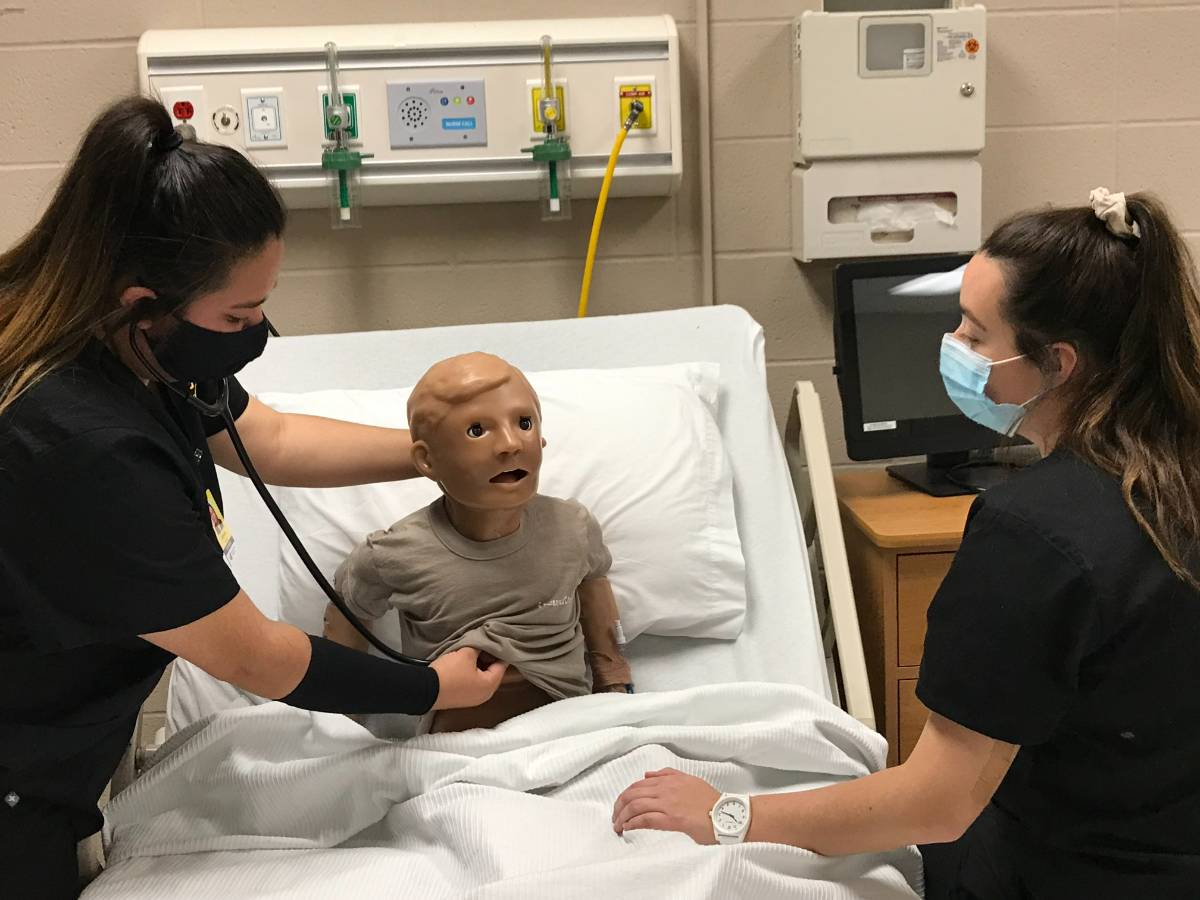
The expanded simulation capabilities in the College of Health Professions will allow
students to prepare for real life clinical situations through a range of simulated
scenarios that mimic real events.College of Health Professions
College of Health Professions begins expansion of robotic-based clinical simulation
technology
Dec. 7, 2021
By WSU College of Health Professions
College of Health Professions at Wichita State
Jeff Tuttle
Wichita State's College of Health Professions offers a full range of nationally accredited
degrees, exclusive programs and state-of-the-art technology.
The College of Health Professions (CHP) has initiated a major expansion to its clinical
simulation capabilities. Students across the CHP’s clinical degree programs will have
increased exposure to high-tech robotic simulated patients in preparation for treating
humans.
CHP students will continue to attend clinical rotations at local hospitals, outpatient
clinics, and rehabilitation centers. However, the expanded simulation capabilities
will allow students to prepare for real life clinical situations – some life threatening
– through a range of simulated scenarios that mimic real events. The controlled environment
of a simulation clinical setting allows the students to not only evaluate their own
performance, but also provides the opportunity to approach unexpected situations through
teamwork.
“Robotic simulation is as close as you get to working with real patients.” said Dr.
Gregory Hand, dean of the College of Health Professions. “This is very high-tech equipment
and a major financial investment by the college, but there is simply no substitute
when preparing health professionals for real-life, sometimes critical situations.”
The high-fidelity robotic manikins are sex specific and can be infant, child or adult.
Not only can the manikins talk, frown, cry, bleed, go into labor and give birth, but
they can also be programmed to simulate disease signs and symptoms. Cameras in the
simulation clinics are used for recording activities so that students can review their
performances and the cameras can be used in real time for feedback from faculty instructors
with microphones watching in an adjacent monitoring room.
“This is a great opportunity to increase the technology that is available to help
educate students,” said Dr. Debra Pile, chair and associate dean for nursing practice.
“Simulation scenarios provide a safe learning space for students and increases their
confidence when they provide care to live patients.”
Purchasing and programming simulation mannequins, as well as refurbishing simulation
rooms and other facilities and equipment, has already begun and should continue through
the spring semester as class schedules allow.