WSU Tech is the state’s leader in modern technical education offering over 100 degree
and certificate options in aviation, health care, manufacturing, design, information
technology, police science and business.
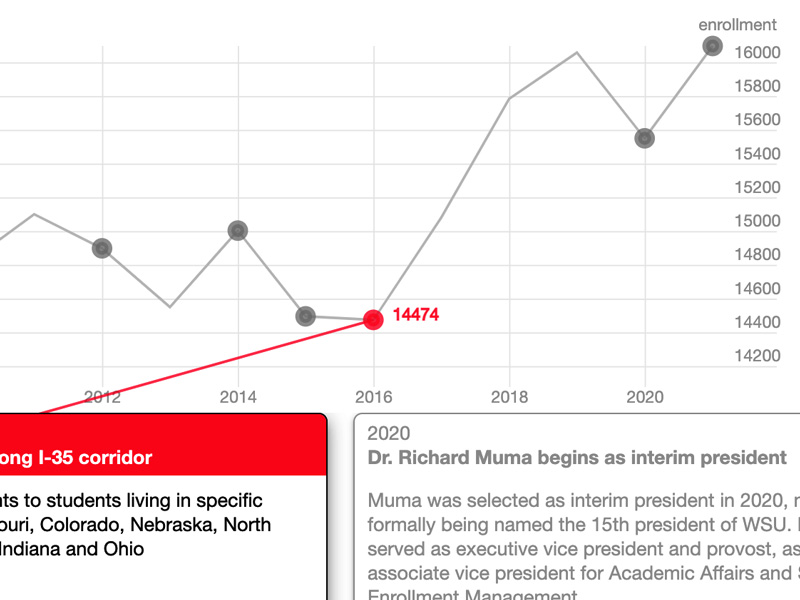
Enrollment for fall 2021 at Wichita State University and WSU Tech is showing strong
growth despite a decline in 2020 caused by the COVID-19 pandemic and the loss of thousands
of local jobs.
Returning to its pre-pandemic enrollment numbers, WSU enrolled 16,097 students this
fall. That’s an increase of 3.5% over last year and the largest enrollment Wichita
State has seen since 1990. Wichita State also has the largest first-time-in-college
class in history at 1,735 students, an increase of 14.5%.
The Kansas Board of Regents reports Wichita State full time equivalency (FTE) as 11,289,
up 2.2% over last year. The Regents system as a whole is down 1.1% in FTE from last
year.
“The overall enrollment numbers reflect Wichita State’s commitment to the people and
communities we serve,” says WSU President Dr. Rick Muma. “This is due, in no small
part, to Shocker Nation’s concentrated and determined efforts to raise need-based
aid, which makes higher education affordable and accessible to those who might not
have considered the possibilities. Removing the financial barriers to a WSU education
helps our Shockers achieve their goals and eventually become the leaders of tomorrow.
It should also be noted that the record number of out-of-state students coming to
Wichita State brings talent and potential to our city and our state.”
WSU Tech saw 4,834 students enroll in classes this fall, a 4.9% increase from last
year. Although the college saw a slight decline in FTE as stated in the KBOR report,
overall headcount is up with the largest growth being in the high school student population,
at an increase of 23.2% over last year.
“WSU Tech continues to focus on delivering a solution to Wichita’s workforce needs,”
said Dr. Sheree Utash, president of WSU Tech. “We are being more innovative in our
approach to recruiting students and helping them to access financial assistance to
help pay for college, as well as providing relevant education, training and credentials
in order to meet our industry partner needs and creating pathways of employment for
our graduates.”
Additional WSU highlights
16.9% growth in undergraduate and graduate students from the I-35 corridor.
24.9% growth in Hispanic first-time-in-college students.
38.7% growth in Black non-Hispanic first-time-in-college students.
Growth of 84% in international students enrolled in graduate programs.
Continued strong enrollment of first-generation students, consisting of 44% of the
undergraduate student population.
26.9% increase in the number of first-generation students in graduate programs.
Enrolled 3,375 graduate students this fall, a 7.3% increase and the highest graduate
enrollment in 20 years.
An increase of 1.7% in student course credit hours, for a total of 162,955.
Wichita State students have also greatly benefited from new programming, expanding
career path opportunities
The School of Computing in the College of Engineering saw a 50.6% increase in enrollment
over last year.
The School of Digital Arts in the College of Fine Arts — which offers degrees and
certificates in animation, audio production, collaborative design, filmmaking, and
game design — saw an increase in enrollment of 7.8%.
The Master in Human Resource Management, offered in the W. Frank Barton School of
Business and started just 2 years ago, now has 73 students enrolled.
The 2-year-old Army ROTC program, associated with the School of Criminal Justice in
the Fairmount College of Liberal Arts and Sciences, increased its cadets by 11.9%
this fall.
WSU Tech success highlights
2021 is WSU Tech’s second largest fall semester headcount in the history of the college,
trailing only fall 2019.
The Applied Technologies division increased the number of students taking classes
by 26.6%. This includes programs such as Construction Science, Automotive and Information
Technology.
WSU Tech also saw a 37.9% increase in headcount in business classes. The college attributes
this growth to the positive response from the community following the announcement
of the pathway program and scholarship opportunities with the WSU W. Frank Barton
School of Business.
WSU Tech saw success with the launch of its new Culinary Arts, Professional Pilot,
Unmanned Aircraft Systems (Drones) and Logistics and Supply Chain programs.
With second eight-week classes beginning in October and the offer of the tuition-free
Metallica Scholars scholarship for aviation sheet metal and process mechanic (paint),
WSU Tech continues to see more enrollment in the fall 2021 semester.