
Health Management capstone members: (Left to right) Jazmyn Burks, Latisha Davis, Ya-Aida
Sillah, and Kelsi Keath. Members not pictured are Sydney Ward and Thanh Pham.Courtesy photo
Wichita State students helps Shockers learn COVID-19 health precautions
There is no shortage of information about the COVID-19 pandemic. The way that information
is delivered can make a big difference.
“I had to be careful in the way I approached a person, being the person who would
direct them in the right way,” said Ya-Aida Sillah, a Wichita State University senior.
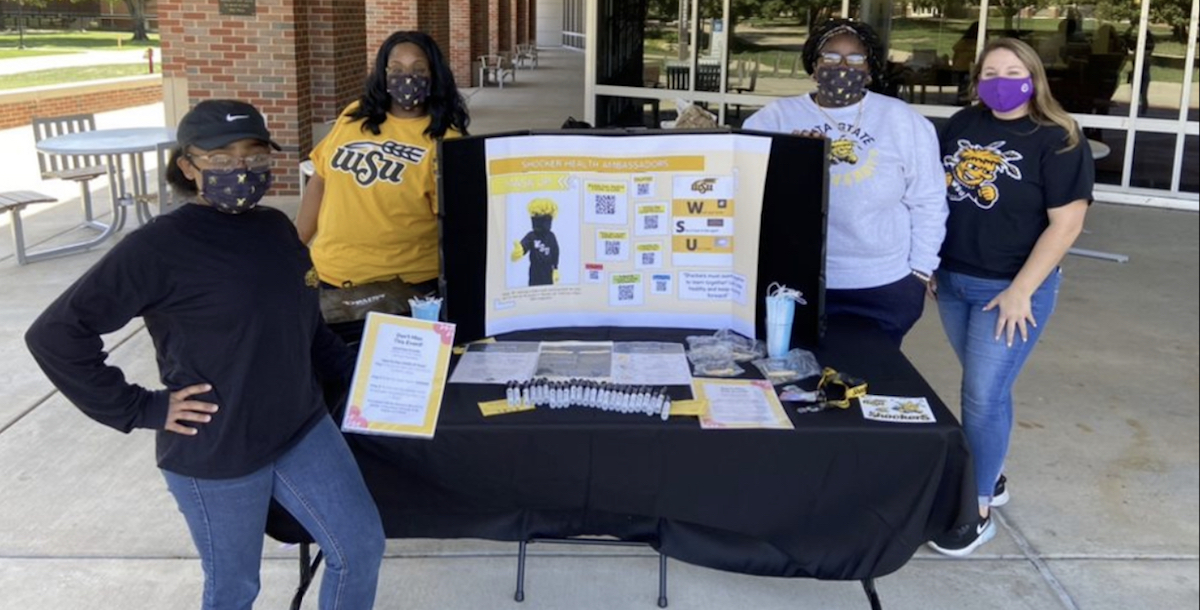
Sillah, a health management major from Wichita, took a lead role in “Mask Up!” The
Department of Public Health Sciences capstone group project is designed to help students
understand COVID-19 and health protection.
Sillah wanted to reach students in peer-to-peer health engagement and created an online
quiz about COVID-19 precautions that served as the event’s centerpiece. Students administered
the quiz outside the Rhatigan Student Center earlier this fall. They monitored the
quiz while a participant answered questions and offered correct information when needed.
“Students chose to do a peer-to-peer engagement about reducing risk for exposure and
spread (of COVID-19),” said Dr. Amy Drassen Ham, clinical professor in Public Health
Sciences. “It became a point of intervention for the students to talk to that peer
right there at that point. We know that peer-to-peer engagement is pretty good for
this kind of information.”
Answers revealed four areas commonly misunderstood, Drassen Ham said.
Some students did not know that fleece and gaiter-style masks are not recommended
for preventing the spread of COVID-19.
Some students assumed a person’s vulnerability to COVID-19 would be visible. In many
cases, a person’s vulnerability to the virus may be hidden.
Some students were unaware that nausea and vomiting are potential symptoms.
Some students did not know that monitoring for fever and other symptoms daily is recommended.
The group’s social media team created graphics and social media messages as part of
the larger project. The graphics used the acronym WSU:
Wash your hands
Stay at least 6 feet apart
Use a mask.
“The most helpful thing was being able to see students know what they misunderstood,”
Sillah said. “Some people who took the survey would not really get the whole thing
about the fleece-style mask. They would think that would be a safe style to wear.
But it’s not really recommended.”
Drassen Ham said teaching students that vulnerabilities are not always visible is
one of the most challenging aspects of education.
“There’s all of this talk about vulnerability and underlying conditions,” she said.
“Students thought that they could see another person’s vulnerability. We don’t know,
as a generalization, who is at risk for really poor outcomes related to COVID, or
even dying from COVID, just by looking at them. It’s hard to teach our Shocker community
that vulnerability is not always visible, which is why it’s so important to consistently
follow social distancing standards, mask-wearing standards and good hand hygiene standards.”
Participants generally understood many prevention strategies, such as avoiding large
gatherings, asymptomatic transmission, mask wearing, social distancing and COVID-19’s
increased transmission indoors and in crowds.
Sillah wants to work in human resources, a field in which she knows the ability to
communicate and educate is vital.
“I learned how to be a pro-active person when it comes to giving someone else the
correct information,” she said. “It was different for me. If they missed it, you don’t
want to say, ‘You didn’t get it right.’ I wanted to educate them.”