


Wichita State University
NIAR receives $13.7 million from Air Force for advanced composites research
Nov. 12, 2020
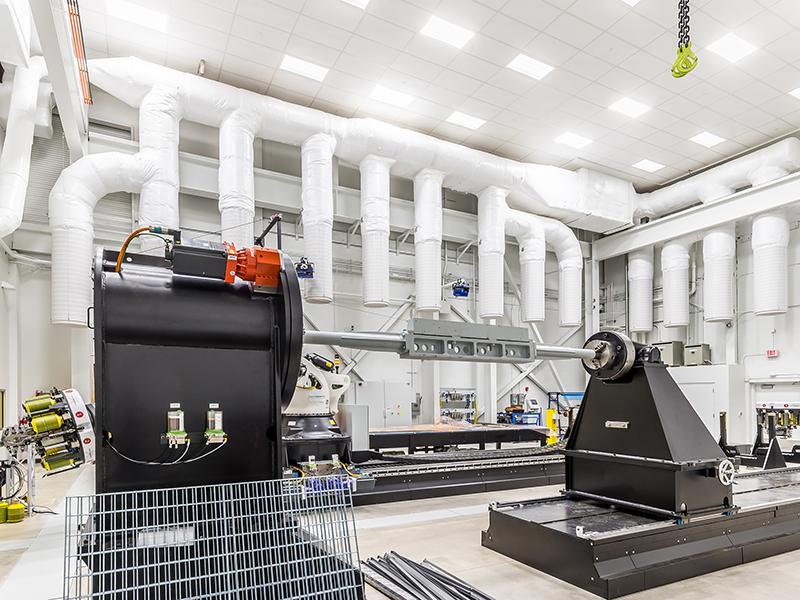

The National Institute for Aviation Research (NIAR) has received another $13.7 million contract from the United States Air Force Research Laboratory (AFRL) to extend the Modeling for Affordable, Sustainable Composites (MASC) research program.
The first phase of the program was a $23.5 million contract awarded in May 2019 to develop a certification framework to pave the way for advanced materials and structural concepts for automated manufacturing. The additional funding will allow researchers to further investigate damage growth behavior and characterize material systems that have strategic importance to the U.S. defense industry, including ceramic matrix composites manufactured using automated processes and press-foamed thermoplastic and injection-molded composites.
NIAR’s Advanced Technologies Lab for Aerospace Systems (ATLAS) is leading the MASC program through partnerships with AFRL researchers, defense contractors, and university partners. The program will enhance tools for manufacturing next-generation advanced integrated composite airframe structures using automated technology, machine-learning and artificial intelligence algorithms.
ATLAS director Waruna Seneviratne said the MASC program goals fit well with the mission of ATLAS: to create a multi-disciplinary manufacturing environment and an engineering education program to prepare engineers and educators for the Factory of the Future.
“We are on track to achieve this while developing technologies that have strategic importance to the U.S. Department of Defense and the aerospace industry,” he said.
In its first year of operation, ATLAS already employs more than 50 engineering students including Matthew Lucas, a senior in mechanical engineering.
“Working at NIAR ATLAS has taught me valuable lessons that prepare me to work in an engineering environment,” he said. “This opportunity allows me to apply the knowledge learned in class towards hands-on experience creating and designing composites. Many new experiences are still opening up for us, giving us a foot in the door for a fast-approaching future in engineering innovation.”
The new funding will allow NIAR researchers to develop technologies to optimize digital twin data, which can be used to analyze damage and defects and automate the repair analysis process using high-fidelity analyses techniques. Researchers will develop machine-learning algorithms that fit into the digital twin concept in order to cross-examine the defect map of every part and recognize various patterns and process optimization. This information can be used to improve part quality, tool designs, and manufacturing rate.
Through the program, researchers will also fabricate full-scale manufacturing technology prototypes incorporating the advanced technologies developed under MASC in order to assess the affordability, producibility, and maintainability in comparison to traditional manufacturing concepts.