Since 1928, Wichita State's College of Engineering has built a reputation for equipping
engineering and computing students with the most complete education possible. From
hands-on research using the latest technology to our location in Kansas' center of
industry—with its virtually unlimited jobs, applied learning and professional connections—Shocker
engineering students have everything they need to make their dream careers a reality.
If necessity is the mother of invention, it may also be the source of new patents:
The story of how Dr. Ali Eslami became the holder of US Patent 10,689,898 – his first
– begins with a local company asking for an invention to save it money.
The company, a licensee of a bigger company that manufactures and installs industrial
lift doors, was paying another company $300 to $450 to buy remotes for each door.
The company, which asked not to be identified, approached Eslami about creating an
app that could control the doors remotely by smartphone instead.
“My field is wireless and mobile communications and this project was fitting my area
very well,” said Eslami, an assistant professor in the Department of Electrical engineering
and Computer Science.
Working with colleagues Dr. Abu Asaduzzaman and Mohammad H. Erjaei, his former graduate
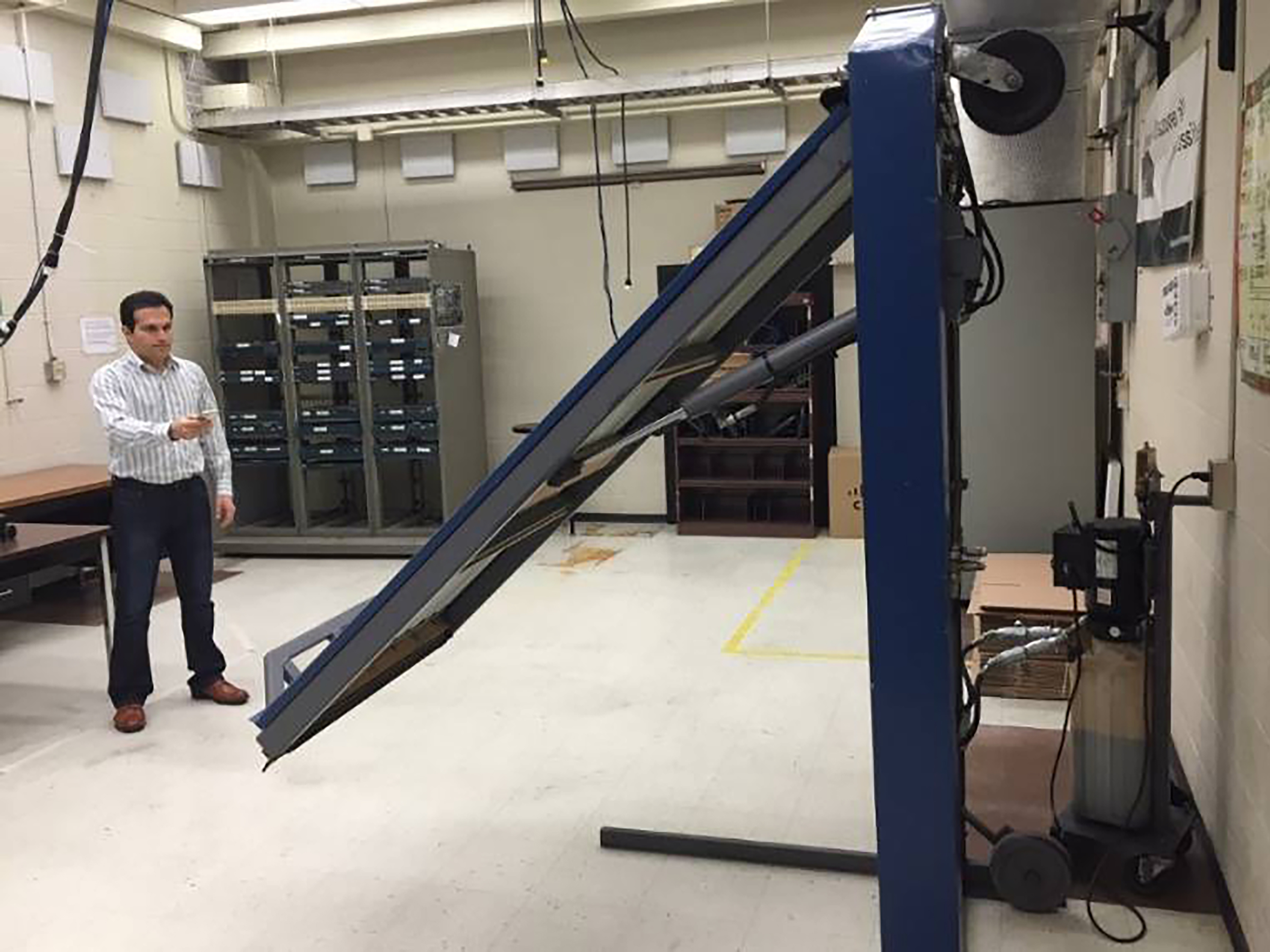
student, Eslami developed a solution to meet the company’s needs: an app combined
with remote cameras, sensors and lift controls connected to Wi-Fi, which allow someone
to remotely observe, open and close a commercial lift door.
“The invention provides means for enabling a user to control a large industrial/commercial
door unit (of a warehouse, machine shed, barn, or airplane hangar) without using a
mounted door panel or dedicated remote control devices,” Eslami explained.
“The user can monitor the door status by looking at live streaming video of the door
in the mobile application. This is particularly useful for giant commercial "lift"
doors… to prevent the door from hitting and damaging objects in the door’s path, ie.
cattle or expensive machinery.” Users can manage multiple doors from one app loaded
on a mobile device, which also provides a log history of each door's status.
Eslami worked with Wichita State’s Office of Tech Transfer and Commercialization to
file the paperwork to patent his team’s invention. He received word the patent for
“Internet-Based Remote Control and Monitoring System for Commercial Doors Using Mobile
Devices” was granted on June 23.
“We have been in touch with a couple of companies for licensing the patent while it
was pending. I think we have a good shot at getting a licensing deal now that it is
granted,” said Eslami.
“What Dr. Eslami and his team were able to accomplish for this local company goes
to the heart of what we mean when we say we are an economic driver for the state of
Kansas,” said Dennis Livesay, dean of the College of Engineering. “We have the will
and talent to provide innovative cost-saving solutions for companies, big and small.”
Now, in addition to saving the local company money by eliminating the need to buy
dedicated remotes, Dr. Eslami stands to make money for himself as well as Wichita
State. Under university policy, faculty and the university each receive 50% of revenue
generated by faculty patents.
According to Robert D. Gerlach, executive director of the Office of Tech Transfer
and Commercialization, licensing revenue for the university is a modest but growing
source of income. “The good news is it’s a positive upward trend,” Gerlach said.
Getting a patent is a significant accomplishment. Nearly a dozen have been granted
to College of Engineering faculty in the past three years. Those awarded patents include,
but are not limited to: Dr. Vinod Namboodiri for a beacon-based indoor wayfinding
system; Dr. Viswanathan Madhavan for an apparatus and method for simulating machining
and other forming operations; Dr. Shuang Gu for a method to convert of natural gas
into clean liquid fuels; Dr. Hyuck M. Kwon for a system and method for generating
exact symbol error rates of frequency-hopped signals; and Dr. Ramazan Asmatulu for
a composite magnetic nanoparticle drug delivery system.