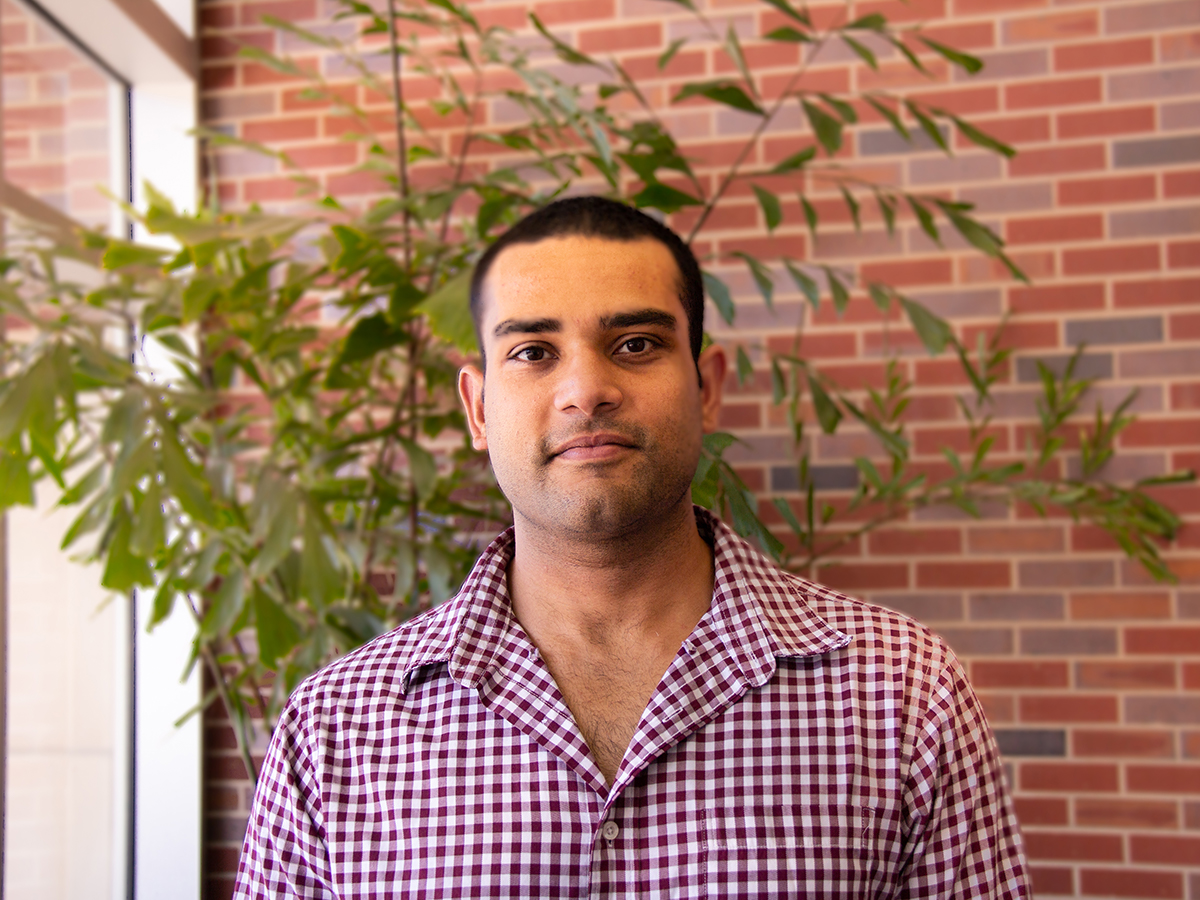
Pardhasai Chadalavada, an aerospace engineering grad student, won a grant from NASA
for his RainCube monitoring system proposal.Kayla Deines
Aerospace engineering grad student receives grant from NASA
Aug. 26, 2019
By Kayla Deines, marketing intern
College of Engineering
Since 1928, WSU's College of Engineering has built a reputation for equipping engineering
and computing students with the most complete education possible. From hands-on research
using the latest technology to their location in Kansas' center of industry, Shocker
engineering students have everything they need to make their dream careers a reality.
She is a marketing intern in the Office of Strategic Communications.
Pardhasai Chadalavada, a graduate student seeking a doctorate degree in aerospace
engineering, and Atri Dutta, an assistant aerospace engineering professor, recently
received a grant from NASA’s Earth and Space Science and Technology program. They
submitted a proposal to NASA and were one of only 120 chosen out of 966 proposals.
The premise of their proposal has to do with RainCubes, which are small satellites
that can use radar to track hurricanes. They have several advantages over the larger,
more traditional satellites currently in use. According to Pardhasai, the RainCubes
are cheaper, don’t have to go through such rigorous testing and take up much less
space on rockets.
Pardhasai and Dutta’s idea is to create a way for multiple RainCubes to talk to each
other. Because of their small size, the satellites have a smaller view angle. So,
in order to track large areas, they need to form a network.
NASA already has the RainCubes, but they do not have the program needed to allow them
to work together. This is what Pardhasai will be developing in the coming years. That
way, when NASA needs to use the cubes, they already have a blueprint.
With direction from Dutta, Pardhasai will begin work on the project, titled Continuous
Monitoring of Hurricanes Using RainCubes, in September. He plans to finish it within
the next three years.
After completing the project and getting his degree, Pardhasai plans to find work
in the space dynamics and controls industry. He is especially excited for this opportunity
because his dream is to eventually work for NASA.
“This is a good opportunity,” he said. “If I utilize it well, I think it could help
me a lot in the future.”
With an undergraduate degree from India and a master’s degree from San Jose State,
Pardhasai decided the best place to continue his education is Wichita State.
“WSU has a very good aerospace engineering program,” he said. “Being a student, I
think Wichita is a good place to stay because there is a great college and a great
aerospace industry.”