For WSU physician assistant students, professor Gina Brown’s case studies are life
and death
July 29, 2019
By Andrew Martin, marketing intern
WSU Physician Assistant Program
With more than 150 years of combined clinical and more than 85 years of healthcare
education experience, the department of Physician Assistant (PA) at Wichita State
University has a highly competitive master’s program ranked in the top 35 percent
of the nation.
Physician assistant (PA) students at Wichita State get to know one patient very well
over the course of their first year in the program. Her name is Penny Adams.
At the beginning of the fall semester, Penny is a newborn.
In the final case of the spring, Penny dies.
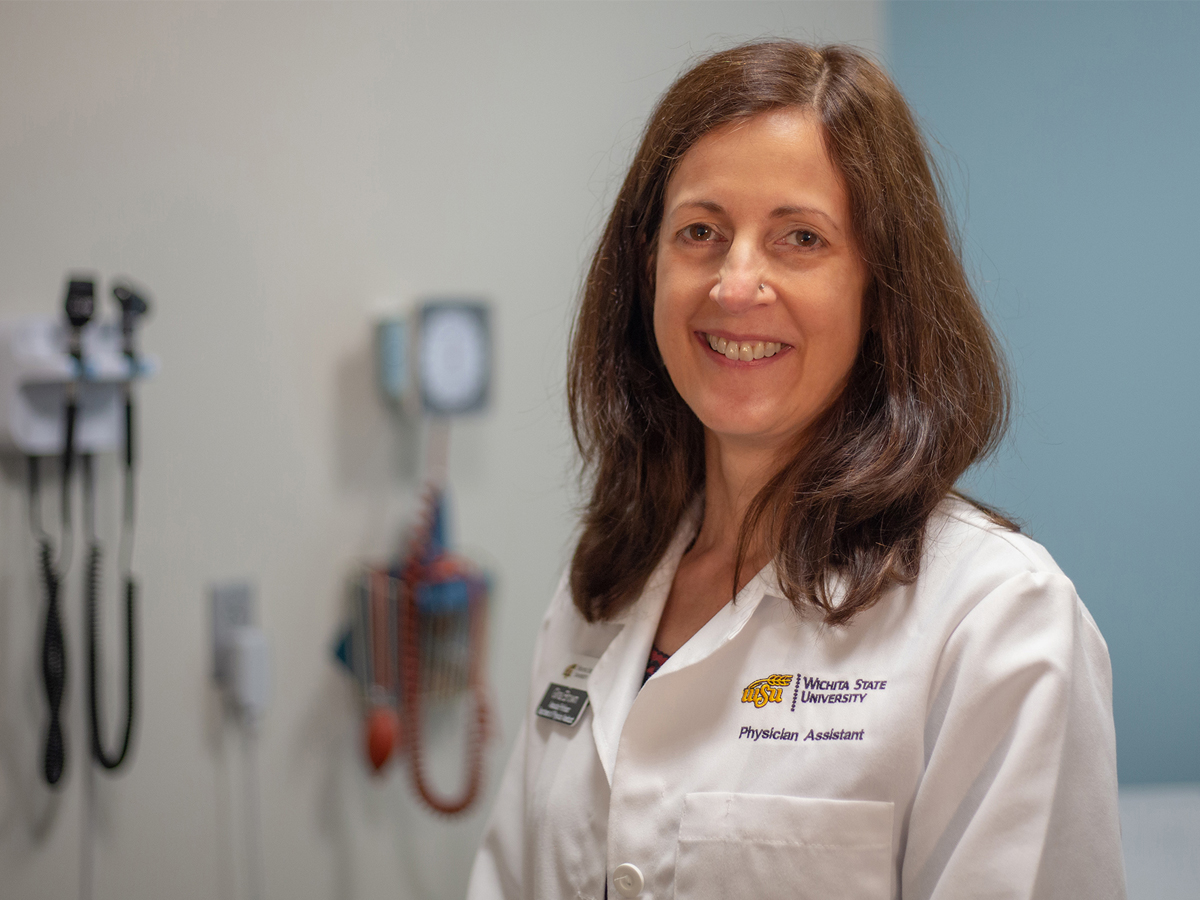
Penny lives her life on paper as the subject of a series of case studies. She was
penned by Gina Brown, PA professor, and a team of her colleagues to prepare students
for their second year.
Penny is unique to WSU, and so are many of Gina’s case studies. For the cases’ efficiency
and ability to prepare students, Gina was awarded 2019’s Leadership in Advancement
of Teaching award from the WSU Foundation.
Gina cares about preparing her students for practicing their studies on the field
in their second year. A PA student’s first-year course load is about 50 credit hours.
“There’s a large amount of medical information, and as we often say, it’s coming at
them like a fire hose,” Gina said. “They need to take all of this information and
pull it together.”
Gina believes that case studies are the best possible way to make sure that students
are incorporating everything they learn into their practice.
“It allows them to see their weaknesses in a way that a multiple-choice exam cannot,”
Gina said.
In many of Gina’s case studies, students only need to reflect on one subject, like
dermatology. Penny is different.
I want to give them evidence-based medicine, and I want to be able to communicate
it to my students in a sense of love and care for them.
— Gina Brown Professor of Physician Assistant, Wichita State University
“With Penny Adams, they don’t know which class they’re pulling from to solve her current
complaint. It integrates all of the medical classes and carries her throughout her
life,” Gina said.
Each of Gina’s cases is thoroughly detailed for lifelike measurements, including chemical
balances and vital readings.
Sometimes students point out inconsistencies in the cases, but Gina welcomes their
attention to detail. She considers it a crucial part of their development as competent,
compassionate PAs.
“I want to give them evidence-based medicine, and I want to be able to communicate
it to my students in a sense of love and care for them,” Gina said.
Evidence-based medicine is generally accepted medical practice that is supported by
extensive research. But, a patient’s desires may conflict with what evidence reveals
as good medical practice.
Still, Gina stresses that her PA students must deliver treatment in a compassionate
way.
“I try to tell a lot of stories which demonstrate compassionate responses to patients,”
Gina said.
Through the PA faculty’s combined efforts, Gina hopes that students leave with the
skills, knowledge and character necessary to provide patients with care that’s in
their best interest.
She believes that her students place their hearts in their work.
“They really do want to help other people in some way,” Gina said.
The statistics support her faith in her students, too.
“One hundred percent of PA graduates from WSU get a job with a good salary,” Gina
said.
Students come and go every year, but Penny Adams will continue to live on paper in
the Department of PA at WSU Old Town.