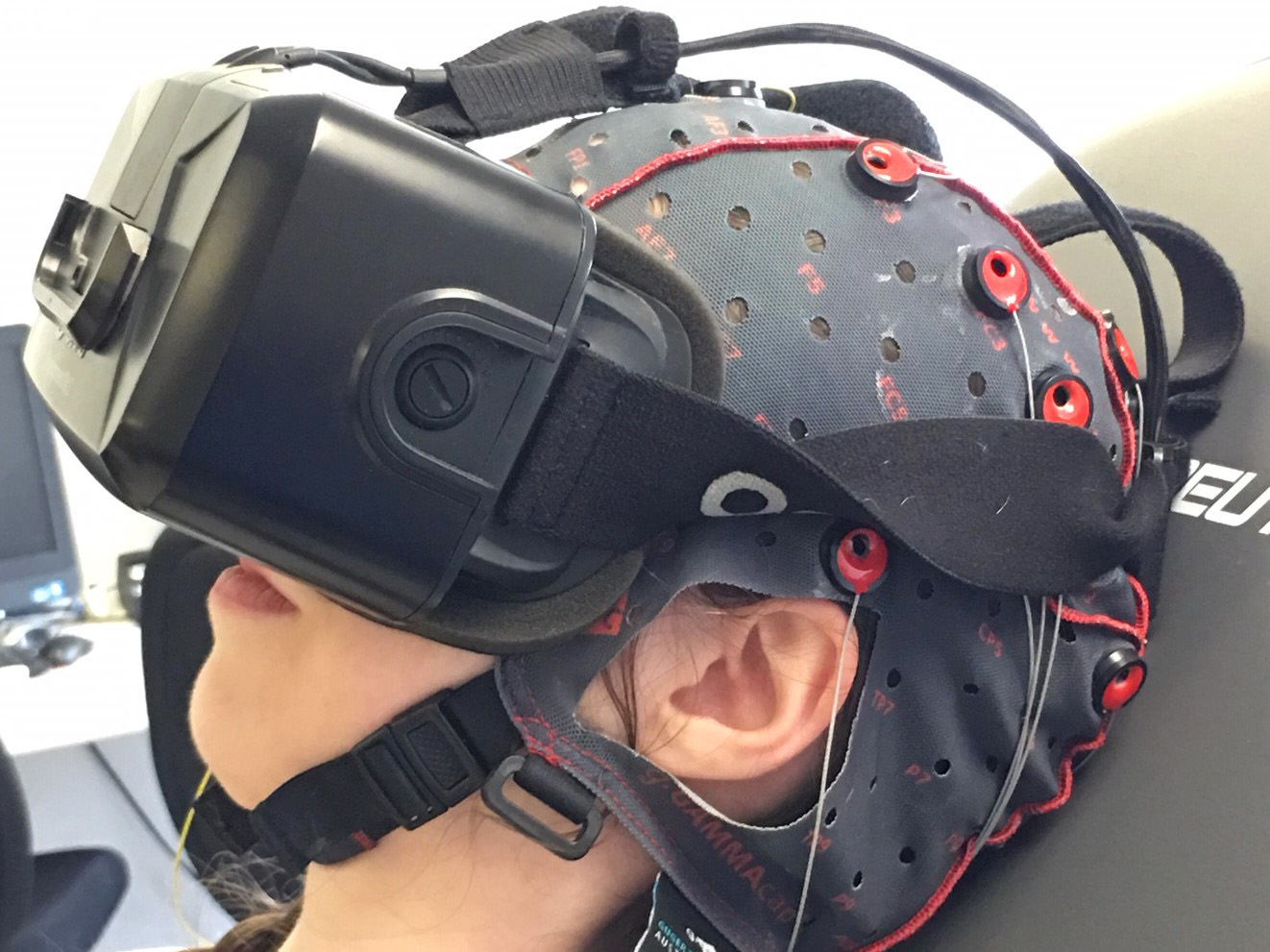
The neuro-virtual interface system being created by Wichita State researchers will
evaluate and learn the human brain response to gravity in difference space conditions.
WSU research studies affect of space gravity on the human brain
June 26, 2019
By Lainie Mazzullo
College of Engineering
From hands-on research using the latest technology to our location in Kansas' center
of industry, Shocker engineering students have everything they need to make their
dream careers a reality.
A NASA-funded Wichita State University research project will seek to understand how
the human brain responds to gravity while in space.
The Kansas NASA EPSCoR Program recently awarded $127,600 to a multidisciplinary research
group for the project.
Researchers will design a neuro-virtual interface system that will evaluate and learn
the human brain response in different gravity conditions, integrate neuro-robotic
control algorithms for a virtual robotic limb and quadcopter, and perform offline
and online testing on human subjects. It will use human brain signals to manipulate
or control mechanical systems in a virtual environment.
Understanding human brain responses in different gravity conditions (Earth, International
Space Station and Mars) plays an important role in astronauts’ ability to successfully
perform mission tasks in space, says Jaydip Desai, assistant professor of biomedical
engineering.
This will play an important and unique role … to ensure human safety and efficiency
for future space missions.
— Jaydip Desai
Along with Desai, the project team includes Aerospace Engineering Professor James
Steck, Assistant Professor of Mechanical Engineering Yimesker Yihun and scientists
from the Neuroscience Laboratory at NASA Johnson Space Center and local company Brij
Systems LLC.
WSU students will also play a key role in the research, which will include three graduate
students and two undergraduate students from biomedical, aerospace and mechanical
engineering disciplines at WSU.
The findings of this research will help to develop protocols for Human-Machine Interface
both in space operations through brain-machine interface and after space missions
for rehabilitation.
“This will play an important and unique role in establishing astronauts’ ability to
successfully control robots and other mechanical systems,” Desai says. “It will also
lay down a solid foundation to advance scientific knowledge and educate students in
the field of neuro-robotics, human-machine interface, and artificial intelligence,
and conduct experiments to ensure human safety and efficiency for future space missions.”