
NIAR's mission is to conduct research, transfer technology and enhance education for
the purpose of advancing the nation's aviation industry, and to assist non-aviation
industries that may benefit from aviation-related technologies.
An ongoing partnership between Wichita State University and Westar Energy recently
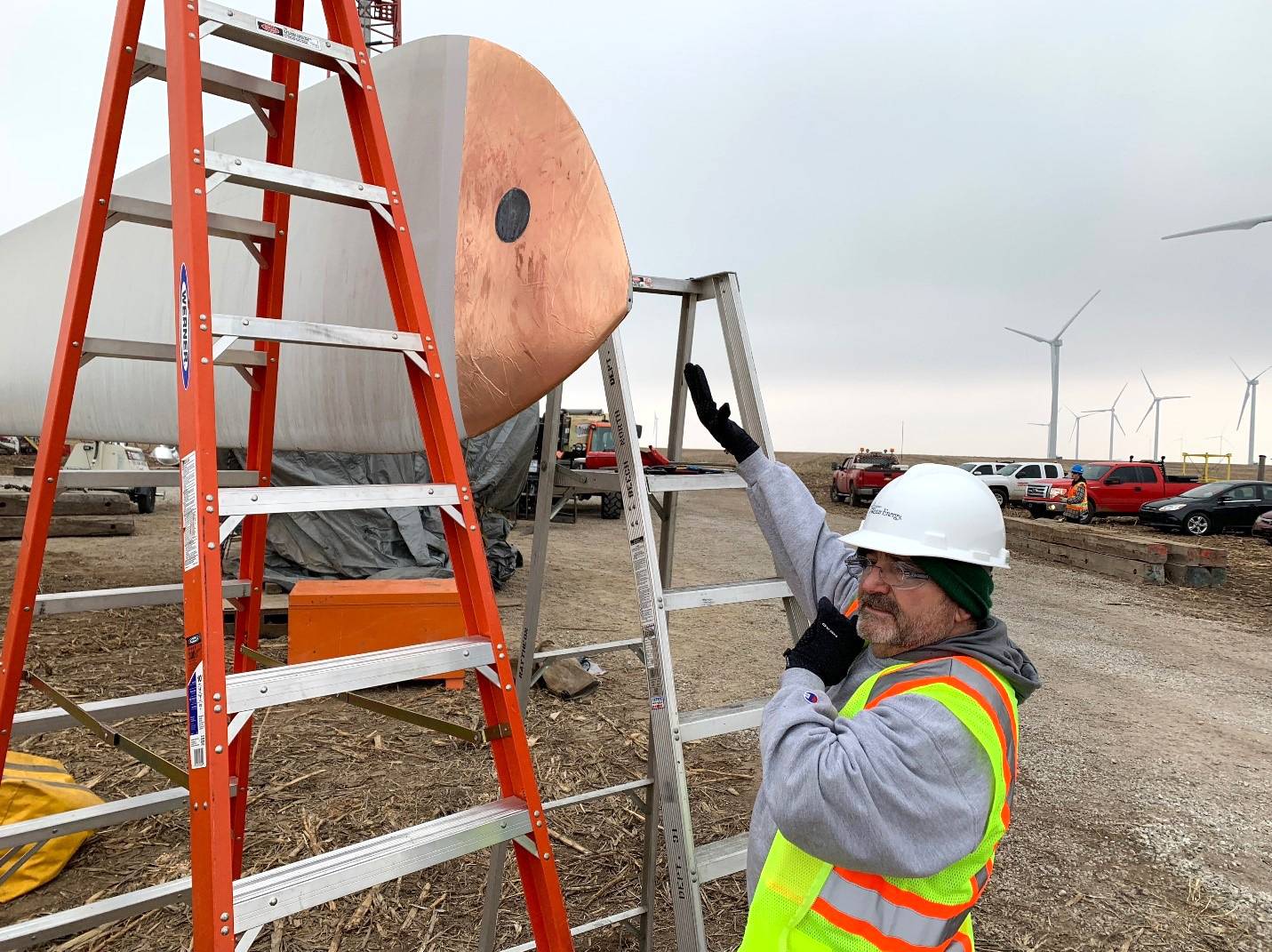
resulted in the implementation of a new technology aimed at protecting wind turbine
blades from lightning strikes.
The technology, which minimizes the damages and costs involved with lightning strikes,
was developed by Billy Martin, director and senior research scientist in the Environmental
Test Lab at WSU's National Institute for Aviation Research. With help from WSU Ventures,
Martin partnered with California-based Lightning Diversion Systems, a Ducommun Company,
to refine the technology for commercialization.
“Developing technology in the wind energy industry is a point of emphasis,” said Rob
Gerlach, WSU director of technology transfer. “Given our aviation expertise, we have
the ability to innovate in unique ways that can disrupt the industry.”
Recently, when Westar Energy was performing maintenance on turbines at their Flat
Ridge Wind Farm in Nashville, Kansas, Wichita State was invited to apply the technology
for testing purposes.
The technology enhances the lightning protection system of existing blades, ensuring
that the lightning current is properly transferred to the grounding connection. This
minimizes (and in some cases eliminates) the damage done to underlying blade surfaces
and sensitive electrical components, resulting in a reduction of repairs and allowing
the wind turbines to operate uninterrupted for longer periods of time.
WSU Ventures and Lightning Diversion Systems will work with Westar Energy to monitor
the covering's performance throughout the year and make improvements as needed.
Lightning strikes are a destructive force in the wind energy industry. They are the
root cause of damage to blade structures, control systems and electrical components.
Average costs to repair or replace a gearbox component or a damaged turbine blade
can be as high as $380,000 and $240,000, respectively. Although wind turbines have
existing lightning protection systems, these systems are often unable to safely and
effectively transfer lightning current to ground.