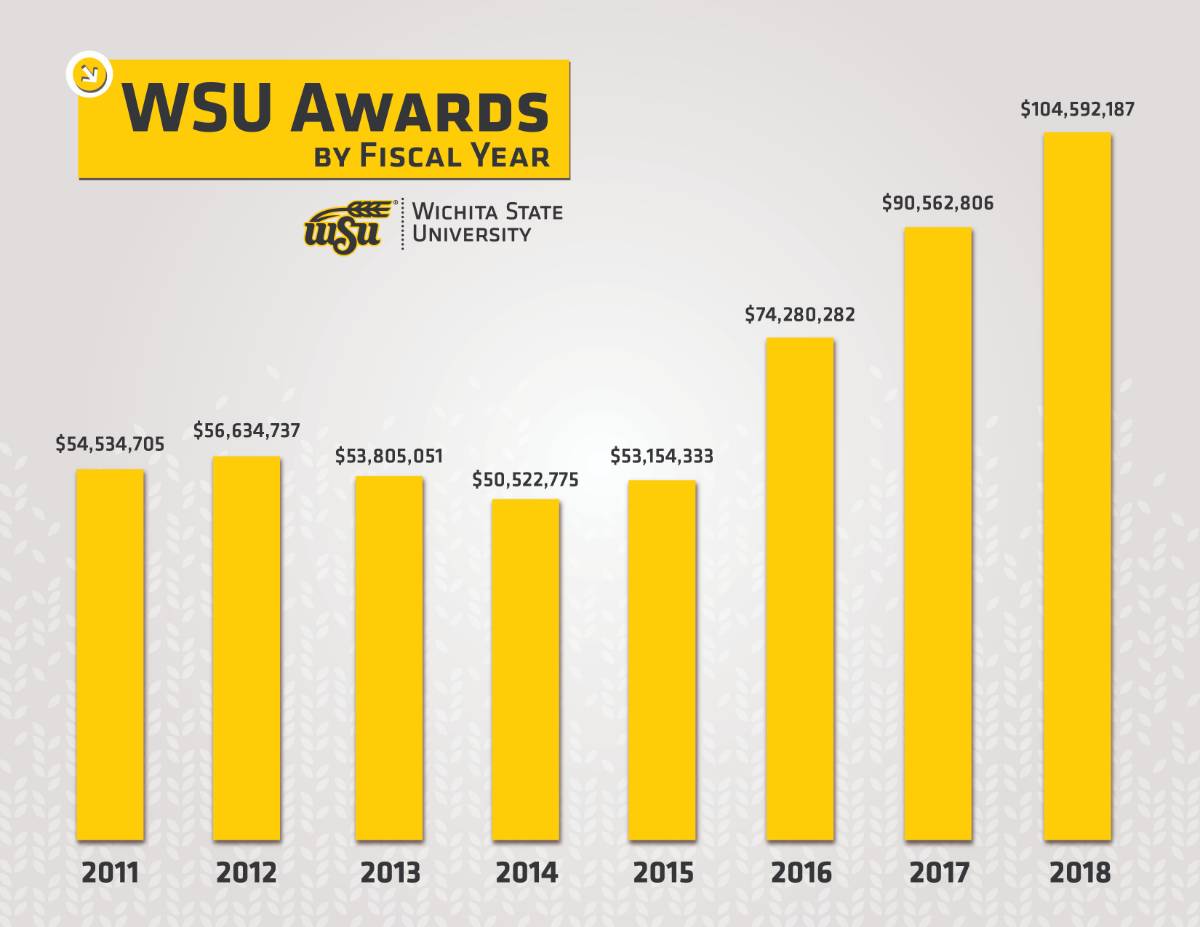
This is the first time the university has achieved greater than $100 million in research
awards.File
Wichita State University set a new record for total research and development awards
in fiscal year 2018 with a total of $104.5 million, increasing awards by more than
$14 million and achieving gains in most funded departments. This is the first time
the university has achieved greater than $100 million in research awards in its history.
This increase is a direct result of strategic efforts of the Office of Research to
increase the exposure of grant opportunities available through industry and government
agencies and to facilitate the development of strong proposal submissions.
Increasing research activity is critical to Wichita State's strategic plan and vision
to be internationally recognized as the model for applied learning and research.
Wichita State increased its industry and federal awards by more than $3 million each.
The National Institute for Aviation Research (NIAR) generates a significant amount
of the university's R&D funding to perform industry and government certification testing
and research. NIAR increased its award total by $8.3 million, garnering a total of
$69.3 million dollars in 2018. Awards to NIAR from industry for proprietary contract-based
programs totaled $45.7 million.
Funding from the Kansas Department of Commerce for multi-company collaborative aviation
research aimed at growing the state economy totaled $9.9 million, contributing to
research programs in areas such as composite material repair, lightning protection,
additive manufacturing and crashworthiness.
Wichita State awards from the Department of Defense reached nearly $12.1 million.
The U.S. Air Force Research Laboratory awarded NIAR $5 million dollars for research
programs to develop techniques to enhance advanced material characterization and structural
certification aided by high-fidelity damage modeling and efficient protocols for substantiation
of advanced composite structures, service life assessment and service life extension.
In addition, the U.S. Navy awarded $4 million for to support research infrastructure
to achieve these goals.
The U.S. Army's Aviation and Missile Research, Development and Engineering Center
awarded $1.9 million to establish FirePoint Innovation Center at Wichita State, which
aids in solving technology and equipment challenges identified by the Army to accelerate
the delivery of innovative capabilities to the warfighter.
The Division of Diversity and Community Engagement, College of Engineering and College
of Liberal Arts and Sciences also accomplished significant award gains – increasing
their total awards by more than $1 million each.
The Division of Diversity and Community Engagement received $9.7 million for GEAR
UP and TRIO programs designed to identify and provide services for low income and
disadvantaged middle and high school students in order to prepare them for college.
George Bousfield, a Jones Distinguished Professor of Biological Sciences, received
$1.8 million of an expected $10.5 million grant from the National Institute of Health
(NIH) to help to diagnose the onset of the menopausal transition, and investigate
the causes of bone loss in aging women.
Shuang Gu, assistant professor of mechanical engineering received $855,000 from the
Department of Energy for research involving a transformative alkaline-based solution
for solving the challenging problem of renewable yet affordable liquid-fuel production.
Katie Mitchell-Koch, assistant professor of chemistry, received two grants from the
National Science Foundation totaling $544,000 for research involving biomolecular
modeling.
“Externally funded R&D programs are crucial to the university's mission,” said John
Tomblin, vice president for research and technology transfer. “They provide opportunities
for faculty, staff and students to engage in basic and applied research, creating
opportunities for applied learning and interdisciplinary collaboration and increasing
the potential for technology transfer.”