Wichita State Cherokee class helps students broaden their worldview
Oct. 1, 2021
By WSU Strategic Communications
Story summary:
There are only about 1,200 native speakers of the Cherokee language in the world.
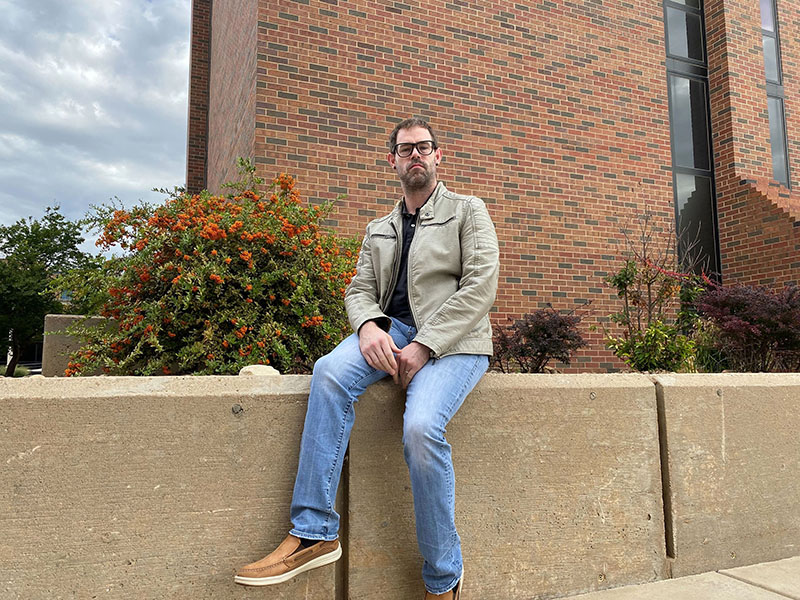
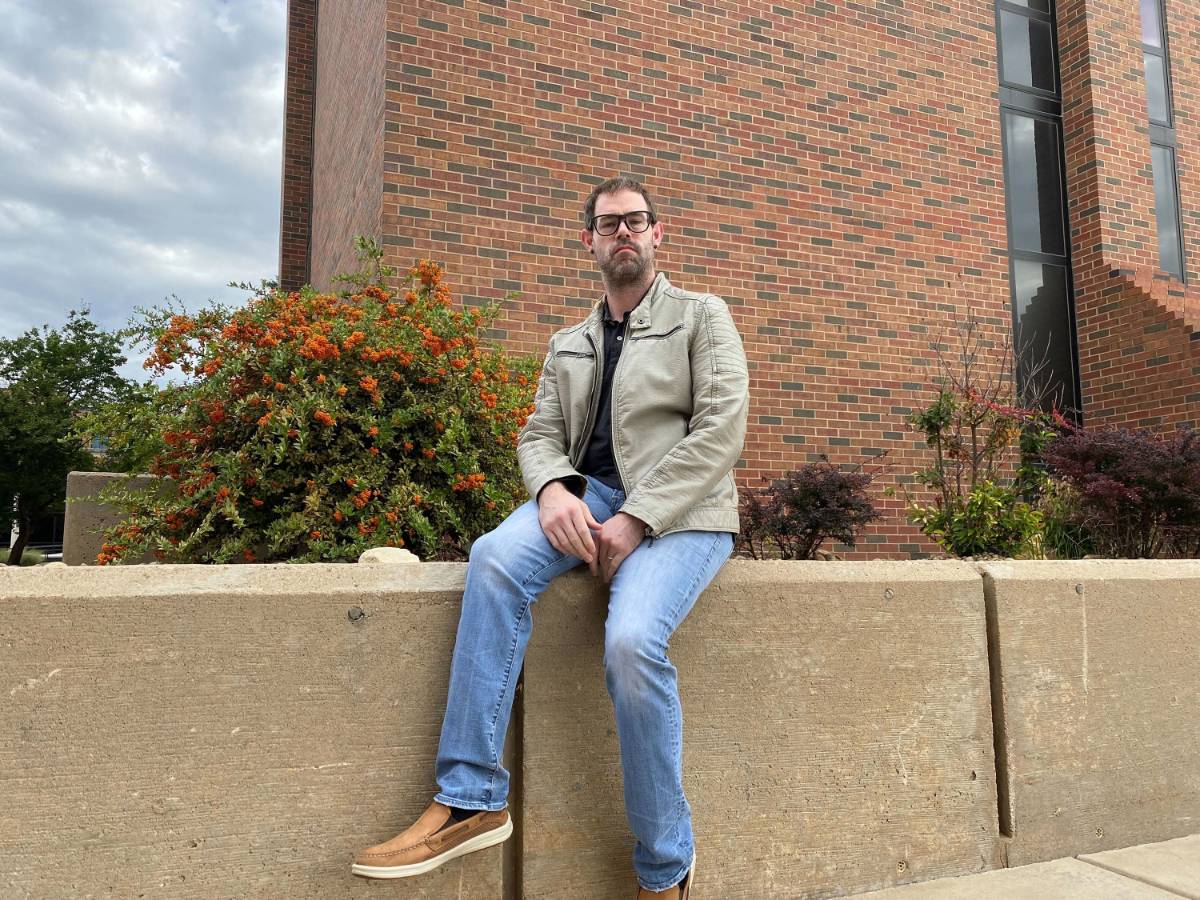
JW Webster, a certified Cherokee language teacher, is teaching Elementary Cherokee
I as part of Wichita State University's applied linguistics program.
Cherokee was Webster's first language, and he didn't learn English until he was 4
years old.
Contact: Lainie Mazzullo-Hart, director of news and media relations, 316-978-3409 or lainie.mazzullo@wichita.edu.
Before he could even walk, JW Webster could do something only a handful of other people
in the world could do: speak the Cherokee language.
Today Webster is one of only 1,200 people who can fluently read, write and speak the
indigenous language — which is ranked as one of the most difficult languages to learn.
In August, Webster’s sacred knowledge became part of Wichita State University’s applied
linguistics program through a new class, Elementary Cherokee I (LING 590).
Webster, a certified Cherokee language instructor, grew up in Cherokee Nation in Oklahoma
with his great aunt, and he didn’t learn English until just before he started kindergarten.
“My aunt could speak English, but she was traditional. It was a requirement to speak
Cherokee at home,” Webster said. “I’m a quarter Cherokee, but I was raised with full
blood. So my mind and my heart and my thought are all full-blood Cherokee.”
His language has been a powerful connection to the Cherokee culture, he said.
“Because I do know English and Cherokee, I can tell you beyond a shadow of a doubt
that the way I speak in Cherokee is a direct tie to our culture. By knowing how to
talk Cherokee, I know how we as Cherokees think. That’s where our culture lies,” said
Webster, who was 17 years old when he was certified by Cherokee Nation to teach the
language.
Throughout the past few centuries, the number of people who speak indigenous languages
has dwindled dramatically, as many Native Americans were killed, and government policies
systematically banned and discouraged Native Americans from speaking their languages
and practicing their cultural rituals.
And Cherokee isn’t a language that a person can casually pick up. It’s rated a class
IV language in its degree of difficulty, making it among the most difficult to learn.
Not only is it a polysynthetic language (meaning a sentence-word might be comprised
of several single words), but it’s also a tonal language (meaning how a word is spoken
can change its meaning). And on top of that, the written language has no diacritics
(such as accent marks) to let speakers know where to put the emphasis on certain words.
"I teach culture with the language class, which is a new approach to teaching Cherokee.
It’s our belief that you can’t learn Cherokee without learning how we live."
Student response to the class has been overwhelmingly positive, and it gives them
an opportunity to not only learn a new language, but it helps them understand the
world better.
“The languages of North America are different than anything in Asia, Europe or Africa,
so I thought it would be a good way to broaden my horizons,” said Raul Rangel, senior
in applied linguistics and modern classical languages. “I think it is helping me find
ways in which people communicate and think. For example, in the way Cherokee is structured
shows how it’s speakers see the world as if animals, plants and humans are equal in
terms of pronouns, unlike most European languages.”
Rangel said learning Cherokee is a challenge, but he wants to apply this experience
to his future endeavors.
“Every language in the world is a different way to look at the world. Right now, more
than ever, languages are dying and losing their place in their respective communities, and
it is important to recognize this as we go forward. Taking a class such as Cherokee
helps us understand many things about how the human mind works,” said Rangel, who’s
from Guadalajara, Mexico.
Eventually, Wichita State plans to add Cherokee II and Cherokee III language courses,
which will make students “semi-fluid speakers of the language,” Webster said.
The addition of the Cherokee course is part of the university’s new applied linguistics curriculum, and it demonstrates WSU’s commitment to its communities.
Cherokee is an indigenous language of the Iroquoian language family with less than
2,000 speakers.
“A course offering in Cherokee is an acknowledgment of WSU's commitment to community
engagement and a recognition of the indigenous history of the land WSU was built on,"
said Dr. Mythili Menon, assistant professor of English and linguistics.
Webster said that he’s helping students broaden their worldview and bridge a cultural
gap.
“How better can someone learn to be tolerant of the people in this world and the diverse
cultures than taking a Cherokee language class, which was one of the first languages
heard and spoke in this part of the world?” Webster said.
Wichita State University serves as the Kansas urban-based research university, enrolling
more than 15,000 students from every state in the U.S. and more than 100 countries.
Wichita State and WSU Tech are recognized for being student centered and innovation
driven.
Located in the largest city in the state with one of the highest concentrations in
the United States of jobs involving science, technology, engineering and math (STEM),
Wichita State University provides uniquely distinctive and innovative pathways of
applied learning, applied research and career opportunities for all of our students.
The Innovation Campus, which is a physical extension of the Wichita State University main campus, is one
of the nation’s largest and fastest-growing research/innovation parks, encompassing
over 120 acres and is home to a number of global companies and organizations.