
Wichita State doubles output of engineering grads ahead of schedule
Oct. 20, 2020
By WSU Strategic Communications
Story summary:
In 2011, Wichita State University vowed to double the number of engineering grants
as part of the state's University Engineering Initiative Act.
One year ahead of schedule, the College of Engineering has surpassed its goal.
With the help of a $35 million grant from the Kansas Legislature, the College of Engineering
has increased graduates by more than 100% for some groups of underrepresented populations.
Contact: Polly Wenzl, strategic communications officer for the College of Engineering, 316-993-8802 or
polly.wenzl@wichita.edu.
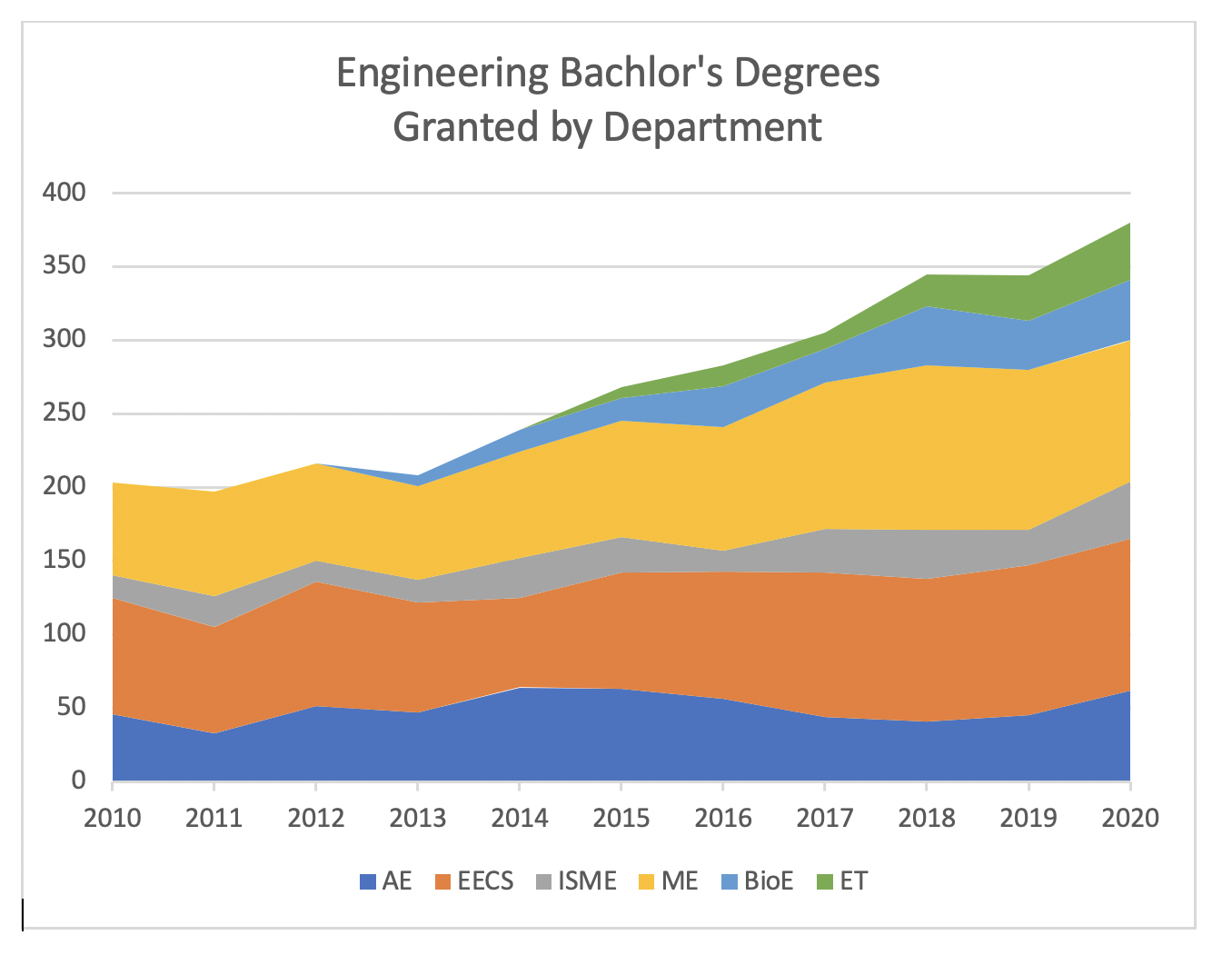
The Kansas Legislature in 2011 made a commitment to invest $105 million statewide
over the next decade with the purpose of increasing the number of engineers available
to industry. For its $35 million share of that money – granted under the University
Engineering Initiative Act (UEIA) – Wichita State College of Engineering pledged to
double the number of bachelor’s degrees it awarded annually. The aggressive goal was
surpassed this past academic year as the college awarded 380 bachelor’s degrees.
“This is the result of a decade of hard work,” said Dr. Dennis Livesay, dean of the
College of Engineering. “This amazing accomplishment is a testament to the efforts
of the entire college. Meeting our target seemed unfathomable when defined – having
to more than double the number of bachelor’s degrees awarded each year – but double
we did!”
With an annual infusion of $3.5 million in state money, the College of Engineering
worked aggressively toward its goal of doubling its number of graduates by doubling
its faculty, expanding its building footprint and creating new departments, new degrees
and new programs aimed at recruiting and retaining students.
Specifically, the UEIA covered roughly half the cost of the $32 million, 143,000-square-foot
John Bardo Center, which opened in January 2017 as the first phase in the development
of Wichita State's Innovation Campus. It houses 25 teaching labs as well as GoCreate,
a Koch collaborative, and industry partners Dassault Systemes, and Hexagon Manufacturing
Intelligence.
The UEIA also financed the creation of the Engineering Student Success Center (ESSC),
which houses six full-time staff who work in outreach, recruitment and retention,
with a particular emphasis on attracting and retaining first-generation college students
and students under-represented in STEM fields, including women, Hispanics, African
Americans and Native Americans.
Substantive gains were made in boosting the diversity of students studying engineering
and computing, with female enrollment rising 138% and Hispanic enrollment 175% from
2011 to 2019. African American enrollment also increased 45%. Overall all college
growth increased 53% during that period.
Outreach programming is aimed at generating interest in science, technology, engineering
math in children in kindergarten through high school, through robotics competitions,
summer camps, classroom visits and afterschool programs. The ESSC also works with
students in high school and community colleges to recruit them to Wichita State and
support their transition into our programs.
Once enrolled, College of Engineering students are supported by ESSC, which supervises
scholarship, mentoring, tutoring, diversity initiatives and other engagement programs
designed to help students feel connected to the university and persist to graduation.
A key driver in the increase of bachelor’s degrees awarded each year is the addition
of two new departments, majors and programs. The College of Engineering already had
programs in aerospace engineering, computer engineering, computer science, electrical
engineering, industrial engineering, manufacturing engineering, and mechanical engineering.
Two new departments — Biomedical Engineering and Engineering Technology — were created
following passage of the UEIA. More than 200 students have earned bachelor’s degrees
in biomedical engineering; the department now offers master’s and PhD programs, too.
Engineering Technology has awarded 124 bachelor’s degrees in areas of emphasis that
include civil engineering technology, engineering technology management, facilities
management, and mechatronics. In addition, Engineering Technology introduced what
is now a standalone degree program in applied computing, which includes an emphasis
in cybersecurity.
The addition of new programs required new faculty, and since the passage of the UEIA
the college has grown its full-time faculty from about 40 to more than 80. Faculty-to-student
ratios have also declined during this period.
“Everyone who played a role in this should be very proud of what we accomplished here,”
Livesay said.
Livesay acknowledged the contributions of his predecessors, including Dr. Zulma Toro,
who as dean was instrumental in getting the UEIA passed in 2011 before her departure
in 2012, and Dr. Royce Bowden, who led the college from 2014 until his retirement
in 2018.
Dr. Steven Skinner, associate dean for undergraduate studies, finance and administration,
played a critical role in developing and overseeing student support services, Livesay
said. He also thanked department chairs and faculty who revamped existing programs
and created the new departments with accompanying degrees.
“Even with this remarkable growth in the number of engineering and computer science
graduates,” Skinner said, “there is still heavy demand from industry for new graduates
coming from our college and I think opportunities for new students will remain strong
well into the future.”