
Researchers work to understand blue-green algae and mitigate its threat
Sept. 22, 2020
By WSU Strategic Communications
Story summary:
A team of researchers from Wichita State University, Kansas State University, University
of Kansas, and the Kansas Department of Health and Environment have been working together
for more than a year to understand the blue-green algae blooms in Marion Reservoir.
Blue-green algae is naturally occurring, but can be toxic — or even deadly — to wildlife,
pets, livestock and humans.
The large algae blooms can have a negative impact on tourism and fishing.
Contact: Joe Kleinsasser, co-director of news and media relations, 316-978-3013 or joe.kleinsasser@wichita.edu.
It emerges from the depths of the water, and it’s more lethal dead than alive.
It’s not a Loch Ness zombie. It’s blue-green algae, and it’s coming to a lake near
you — if it’s not there already.
Maybe it’s not as dramatic as all that, but it’s a serious threat to humans and wildlife.
A team of researchers from Wichita State University, University of Kansas and the
Kansas Department of Health and Environment (KDHE) are working to understand how to
mitigate its effect on those who use the Marion Reservoir, which is about 60 miles
north of Wichita, for recreation or drinking water.
Blue-green algae is quite common in ponds and lakes across the country. It thrives
in warm, nutrient-rich water. When conditions are right, the blue-green algae can
grow quickly to form blooms. Though quite iridescently beautiful, blue-green algae
can produce toxins that are linked to illness, or even death, in humans and animals.
“It can have a huge economic impact,” said Dr. Brian Bohnsack, program manager for
Wichita State’s Environmental Finance Center. “When it explodes or blooms on a reservoir,
you don't want to be out there, so that affects tourism, as well the fish and wildlife
in the lake.”
Even more serious, it can be harmful to humans, pets and wildlife.
“Under certain circumstances, it can be lethal to humans,” Bohnsack said. “We hear
all sorts of stories about pets. In Topeka, there’s a pond in Gage Park, where if
I were to take my dog there and let him drink while a bloom is going on, there’s a
good chance the dog’s going to die.”
And it can harm livestock – a big concern in this part of the country.
“If a farmer has a pond with blooms and the farmer doesn’t know, cattle drink from
it, and the cattle can die,” Bohnsack said.
Drinking water dangers
Kansas’ lakes and rivers are the source of water for many of the states’ public drinking
water utilities. The utilities treat the water to ensure that it meets federal and
state water quality standards before it is served to the public. Marion Reservoir
serves as the source of water for the towns of Hillsboro and Marion.
Blue-green algae is naturally occurring, and blooms when phosphorus enters the water
— either from particles on the wind, through water shed or erosion. Interestingly
though, the algae is harmless while it’s alive, said Nick Willis, program manager
for Wichita State’s Hugo Wall School of Public Affairs.
“You can have blue green algae without toxicity,” Willis said. “It's when they die
that they release their toxins. Of course, that's really threading the needle as somebody
trying to provide safe drinking water for people. It's best if it's not toxic in any
condition and then you don't have to worry so much about what you're doing.”
Furthermore, Willis said, most water treatment plants aren't set up to deal with blue-green
algae.
“As blue-green algae blooms become more problematic for public water utilities, there's
going to need for them to build additional infrastructure to either deal with treatment
or to get a backup water supply to utilize when blue-green algae is present,” he said.
Understanding algae blooms
Through their research, Willis and his colleagues from KU Biological Survey and KDHE
hope to better understand the variables that affect the blue-green algae and its blooms
at Marion Reservoir: weather, lake inflow and outflow patterns, wind speeds, temperature
and sunlight.
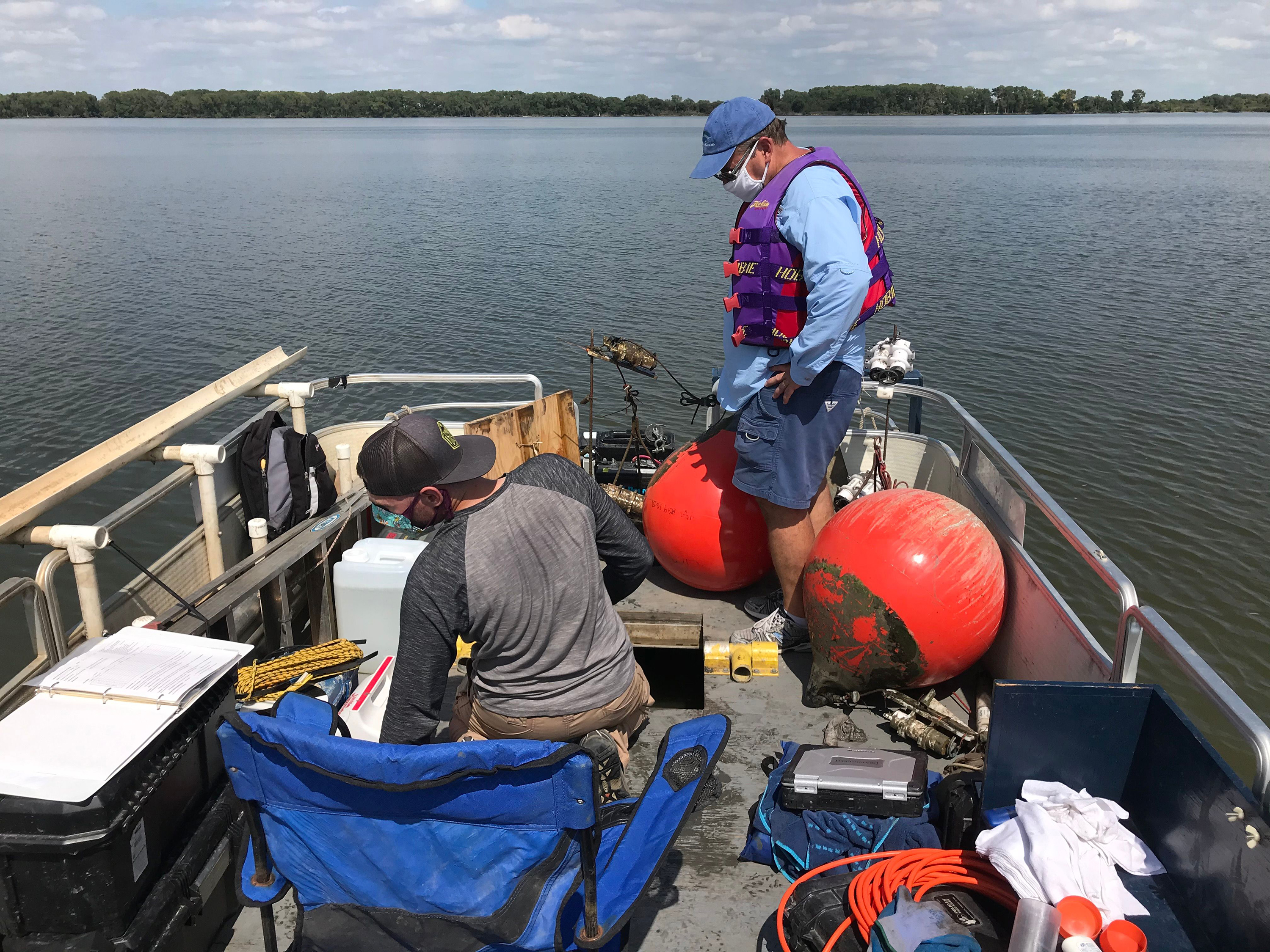
“We had sensors out on the lake to monitor conditions this summer,” Willis said. “The
lake is also part of KDHE’s blue-green algae watch, where they take calls from people
who think there is blue-green algae in a water body.”
Also at issue is blue-green algae’s ability to grow rapidly. It thrives in warm, still
waters, he said.
“If it’s sunny and not breezy, the water will have very strong temperature gradations
within them,” Willis said. “The top will be close to air temperature and below might
be 10 or 15 degrees colder. It seems like blooms largely follow those windless days.”
The team’s blue-green algae factfinding mission started in 2019, but the project was
delayed because of the high water levels in Kansas lakes due to the record rainfall
that occurred in 2019. As a result, the initial field sampling began in February 2020
after the lake level returned to normal. The research crew installed two buoys with
water quality sensors in May to monitor water quality throughout the summer.
The goal, Bohnsack said, isn’t to eliminate blue-green algae altogether. They’re an
important part of the water ecosystem.
“What we want to do is control their overall intensity and the frequency of the blooms,”
he said.
Willis said with the sentiment, researchers will be able to better evaluate how much
phosphorus is being released under certain environmental conditions.
“That will help us better understand the precursor to algae blooms,” he said. “We
think when the phosphorus is released from sediment during certain environmental conditions,
that helps fuel the algae growth. Then the algae growth happens, and you get your
problems.”
Research and policymaking
Once the research team analyzes the sensors from Marion Reservoir, the report will
hopefully shed light on what can be done to mediate the damage caused by blue-green
algae blooms.
“We'll be looking at the results and preparing a report that hopefully will allow
us at least a better predictor bloom before it happens,” Willis said. “I think the
big thing will be a better knowledge of nutrient loading within the lake, which will
help form policy going forward from the perspective of the state.”
Willis and Bohnsack hope their research can direct municipalities on best and most
economical practices to protect their drinking supplies from blue-green algae.
“A lot of these solutions are attached to millions of dollars of capital investment
if a wastewater treatment plant has to reduce nutrients or if the drinking water treatment
plant has to add filters and other infrastructure to remove the algae from the drinking
water,” Willis said. “That may be a significant investment for a community. We want
to know that a solution is going to help if we're going to have invest that kind of
money.”
Wichita State University serves as the Kansas urban-based research university, enrolling
more than 20,000 students from every state in the U.S. and more than 100 countries.
Wichita State and WSU Tech are recognized for being student centered and innovation
driven.
Located in the largest city in the state with one of the highest concentrations in
the United States of jobs involving science, technology, engineering and math (STEM),
Wichita State University provides uniquely distinctive and innovative pathways of
applied learning, applied research and career opportunities for all of our students.
The Innovation Campus, which is a physical extension of the Wichita State University main campus, is one
of the nation’s largest and fastest-growing research/innovation parks, encompassing
over 120 acres and is home to a number of global companies and organizations.